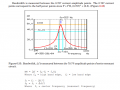
Bandwidth in resonant circuit (from textbook on this site/education tabs)

Thread Starter

Dat Gio

Joined Oct 13, 2016
5
Hi. I am studying this chapter and I can not figrue out why bandwidth is measure between the 0.707 current amplitude points. And where is the formular: "BW = fc/Q" from ??? I worked with the formulars and they don't show that the fl and fh are symmetric with fc if i = sqrt(2).(I resonant). Thank u so much for helping me
 

Attachments

MrAl

Joined Jun 17, 2014
13,775
Hello,

The way to get all these formulas is to analyze the circuit and solve for the 0.7071 (-3db) points. For a bandpass there are two points.
Since Q=fc/BW you can easily turn that around to solve for either variable.
The 0.7071 points come from long ago when they realized that the human ear and brain work in such a way that when the volume of a tone is 3db down it is interpreted as half as loud. It's been a standard measure for a long time.
Q stems from power lost as compared to total power.
You're right, the f1 and f2 upper and lower frequencies are not symmetrical about fc but they are often assumed to be so anyway for simplicity.
You can solve for f1 and f2 by solving the transfer function amplitude first for the critical point fc (call this amplitude Ac) and then for the two solutions where the amplitude is equal to Ac/sqrt(2).
 
Last edited:

Thread Starter

Dat Gio

Joined Oct 13, 2016
5
Thank you MrAI,

I have read carefulluly your answer, I understand all if we accept to work around with 0.707 points and the simplicity of f1 and f2 you talked about. But I still don't understand the part: "when the volume of a tone is 3db down it is interpreted ashalf as loud". Do I have to read others textbook to understand this, could you recommend me any sources ?
 

MrAl

Joined Jun 17, 2014
13,775
Thank you MrAI,

I have read carefulluly your answer, I understand all if we accept to work around with 0.707 points and the simplicity of f1 and f2 you talked about. But I still don't understand the part: "when the volume of a tone is 3db down it is interpreted ashalf as loud". Do I have to read others textbook to understand this, could you recommend me any sources ?
Hi,

Well when the human ear/brain hears one tone, then the same tone but half as loud, that decrease is considered to be -3db. I am sure there must be lots on the web about this. I believe there are other ways to reason this out too but i'd have to look around on the web.
 

Thread Starter

Dat Gio

Joined Oct 13, 2016
5
yeah I understand: the decrease is -3db means half the loud but why is the bandwidth measured between those points
 

MrAl

Joined Jun 17, 2014
13,775
Hello,

Oh sorry, yes there is more logic to it.

The ear hears the -3db point as less as loud, but before that it has trouble hearing any change at all. So it is the min change that the ear doesnt have as much trouble detecting.

It also comes from transmission lines, and i think that was one of the original uses. The phone line amplitude was varied and the human ear started to hear a change when the level went down by 3db. Before that it had trouble noticing a difference.

I'm pretty sure you can look this up and find a better explanation though. If you have trouble i'll start looking again too.

In fact, i may have mixed up the meaning a little.
The -3db is the half power point, and that is the maximum that the human ear can detect as any change. Any less than that and it can not detect a change. That became the standard because they used it with transmission lines with telephones for testing, and they wanted a place to reference to.

So when we see a -3db cutoff point, that means the ear hears a change and so they call the frequency up to that point the bandwidth. Any less than that and it doesnt matter, and more than that the ear detects more change. For an audio amplifier we want the ear to hear all frequencies the same if we can, so when the signal drop is detected by the ear that's not what we wanted anymore so we call that the bandwidth or cutoff point. That also relates to the logarithmic response of the human ear.
 
Last edited:

Thread Starter

Dat Gio

Joined Oct 13, 2016
5
Hello,

Oh sorry, yes there is more logic to it.

The ear hears the -3db point as less as loud, but before that it has trouble hearing any change at all. So it is the min change that the ear doesnt have as much trouble detecting.

It also comes from transmission lines, and i think that was one of the original uses. The phone line amplitude was varied and the human ear started to hear a change when the level went down by 3db. Before that it had trouble noticing a difference.

I'm pretty sure you can look this up and find a better explanation though. If you have trouble i'll start looking again too.

In fact, i may have mixed up the meaning a little.
The -3db is the half power point, and that is the maximum that the human ear can detect as any change. Any less than that and it can not detect a change. That became the standard because they used it with transmission lines with telephones for testing, and they wanted a place to reference to.

So when we see a -3db cutoff point, that means the ear hears a change and so they call the frequency up to that point the bandwidth. Any less than that and it doesnt matter, and more than that the ear detects more change. For an audio amplifier we want the ear to hear all frequencies the same if we can, so when the signal drop is detected by the ear that's not what we wanted anymore so we call that the bandwidth or cutoff point. That also relates to the logarithmic response of the human ear.

Thank u, I understand much more, I very appreciate your help
 
Top