Facebook
 Google
 GitHub
 Linkedin
Hi,
Your responses last time I posted were very helpful so here goes again. Apologies upfront because I have used generic terms and wording because I am just a guy in his shed poking about with a multimeter and power supply and this alternator stuff is new to me. I'm careful not to use technical terms I have read/heard because I probably don't have the proper knowledge that goes with it.
I am in the process of swapping an alternator in an old vehicle. It has an external regulator and I am changing to an internal regulator version. I currently have only the wiring loom and vehicle electrics on the bench - I do not have a running vehicle and am bench testing by spinning the alternator with an electric drill. I have the complete electric components of the car on the bench functioning as it would if fitted in the vehicle. Everything works as intended.
I have the original externally regulated alternator working and spinning it with the drill results in the charge lamp turning off and the battery being charged so I am satisfied that it is working how it is intended. And now I want to swap to an internally regulated alternator.
I have bench tested the internally regulated alternator (second hand) connected direcly to the battery with a lamp connected in the lamp circuit. It works as it should, the lamp turns off and the battery is receiving charge.
The original circuit diagram is as follows: (apologies for the rough diagram - the factory manual doesn't include details of the inside of components so I made my own by checking online for similar and poking about with a multimeter to confirm and then piecing it all together to work out what does what)
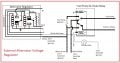
If I understand the above drawing correctly, during the start cycle the fuel pump and choke are powered from the start circuit. When the alternator starts spinning and producing 'power' the contacts in the voltage relay side of the regulator switch which connects the lamp wire and voltage regulator coils to the b+ terminal through the voltage relay contacts (I'm not considering what happen in the voltage regulation side other than the fields initial power). The B+ voltage is 'fed' back into the lamp wire resulting in the charge lamp 'turning off' and the coils in the fuel pump relay energising and switching contacts so power is then supplied to the fuel pump (through a resistor) and choke by the ignition circuit. The engine is now running.
Looking online I have followed common process and connected the internally regulated alternator as follows:
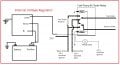
When I remove the external regulator from the wiring loom I am left with 2 wires. One is connected to the charge lamp circuit which includes the fuel pump relay coils and the other is switched ignition so the connection looks straight forward but it doesn't work properly. I am trying to maintain factory function and without modifying the core wiring too much.
The issue with the setup is the the charge light remain dim and the contacts in the fuel pump relay don't consistently switch and they don't switch with the same enegry or in other words the click is not as loud or strong. The voltage at the lamp wire on the alternator only rises to 5-6 volts where as it will rise to 12 plus if I connect it to positive via a separate globe. The other part of the problem is that if the fuel pump contacts do switch, they don't release when the alternator stops spinning like what occurs with the externally regulated setup further above. I have tested and it is charging but how well I don't know. Maybe good enough for the bench testing but not good enough for driving.
I have tried a few different ways to connect it but I am at a loss as to how I can connect an internally regulated alternator and maintain the factory function of the charge lamp and fuel pump relay. I can get the charge lamp to turn off but then the fuel pump relay wont switch and if I get the fuel pump relay to switch the charge lamp remains fully illumitated.
I believe the issue stems from the difference in how the charge lamp works for both alternators and how that fits withing the existing wiring of the vehicle. External regulator version does not require the lamp to even be in the circuit because the field is initially powered by the ignition circuit via the regulator not through the lamp like so many online articles show. Also the charge lamp will illuminate even when the alternator is completly removed from the circuit which I think is due to the ground connection through the fuel pump relay coils. Where as the internal regulated will not function unless the charge lamp wire is connected to 12V+ through the lamp and if the alternator is removed from the circuit so is the ground connection for the lamp and obviously it doesn't illumitate. I'm assuming I may have to use a relay that is only triggered when the alternator is making power to provide power to the coils of the fuel pump relay but then what do I do with the charge lamp and isn't that what the fuel pump relay is already doing? I have also wondered about a diode (don't recall which one) in the lamp wire at the alternator that only let power flow once a certain voltage has been reached but I don't think that will work either. I'm at a loss here.
Anyway, thanks for making it through all of that. I appreciate any feedback or information on how I can get this working.
Thanks from Australia.
Your responses last time I posted were very helpful so here goes again. Apologies upfront because I have used generic terms and wording because I am just a guy in his shed poking about with a multimeter and power supply and this alternator stuff is new to me. I'm careful not to use technical terms I have read/heard because I probably don't have the proper knowledge that goes with it.
I am in the process of swapping an alternator in an old vehicle. It has an external regulator and I am changing to an internal regulator version. I currently have only the wiring loom and vehicle electrics on the bench - I do not have a running vehicle and am bench testing by spinning the alternator with an electric drill. I have the complete electric components of the car on the bench functioning as it would if fitted in the vehicle. Everything works as intended.
I have the original externally regulated alternator working and spinning it with the drill results in the charge lamp turning off and the battery being charged so I am satisfied that it is working how it is intended. And now I want to swap to an internally regulated alternator.
I have bench tested the internally regulated alternator (second hand) connected direcly to the battery with a lamp connected in the lamp circuit. It works as it should, the lamp turns off and the battery is receiving charge.
The original circuit diagram is as follows: (apologies for the rough diagram - the factory manual doesn't include details of the inside of components so I made my own by checking online for similar and poking about with a multimeter to confirm and then piecing it all together to work out what does what)
If I understand the above drawing correctly, during the start cycle the fuel pump and choke are powered from the start circuit. When the alternator starts spinning and producing 'power' the contacts in the voltage relay side of the regulator switch which connects the lamp wire and voltage regulator coils to the b+ terminal through the voltage relay contacts (I'm not considering what happen in the voltage regulation side other than the fields initial power). The B+ voltage is 'fed' back into the lamp wire resulting in the charge lamp 'turning off' and the coils in the fuel pump relay energising and switching contacts so power is then supplied to the fuel pump (through a resistor) and choke by the ignition circuit. The engine is now running.
Looking online I have followed common process and connected the internally regulated alternator as follows:
When I remove the external regulator from the wiring loom I am left with 2 wires. One is connected to the charge lamp circuit which includes the fuel pump relay coils and the other is switched ignition so the connection looks straight forward but it doesn't work properly. I am trying to maintain factory function and without modifying the core wiring too much.
The issue with the setup is the the charge light remain dim and the contacts in the fuel pump relay don't consistently switch and they don't switch with the same enegry or in other words the click is not as loud or strong. The voltage at the lamp wire on the alternator only rises to 5-6 volts where as it will rise to 12 plus if I connect it to positive via a separate globe. The other part of the problem is that if the fuel pump contacts do switch, they don't release when the alternator stops spinning like what occurs with the externally regulated setup further above. I have tested and it is charging but how well I don't know. Maybe good enough for the bench testing but not good enough for driving.
I have tried a few different ways to connect it but I am at a loss as to how I can connect an internally regulated alternator and maintain the factory function of the charge lamp and fuel pump relay. I can get the charge lamp to turn off but then the fuel pump relay wont switch and if I get the fuel pump relay to switch the charge lamp remains fully illumitated.
I believe the issue stems from the difference in how the charge lamp works for both alternators and how that fits withing the existing wiring of the vehicle. External regulator version does not require the lamp to even be in the circuit because the field is initially powered by the ignition circuit via the regulator not through the lamp like so many online articles show. Also the charge lamp will illuminate even when the alternator is completly removed from the circuit which I think is due to the ground connection through the fuel pump relay coils. Where as the internal regulated will not function unless the charge lamp wire is connected to 12V+ through the lamp and if the alternator is removed from the circuit so is the ground connection for the lamp and obviously it doesn't illumitate. I'm assuming I may have to use a relay that is only triggered when the alternator is making power to provide power to the coils of the fuel pump relay but then what do I do with the charge lamp and isn't that what the fuel pump relay is already doing? I have also wondered about a diode (don't recall which one) in the lamp wire at the alternator that only let power flow once a certain voltage has been reached but I don't think that will work either. I'm at a loss here.
Anyway, thanks for making it through all of that. I appreciate any feedback or information on how I can get this working.
Thanks from Australia.