Automotive circuit to for tailgate/hatch release button

MisterBill2

Joined Jan 23, 2018
27,650
I suggest that the diode will have no effect because that circuit will be open at the outside push button contacts except when the button is pushed. ALSO, consider that a diode failure will leave the outside button always available. Probably a poor choice. This is not a place to promote your diode religion!!!
 

Thread Starter

Snail_D3

Joined Jun 28, 2024
20
We have a winner! but first I'll respond to some points.

Also, if those loc/unlock devices use 5 wires, they are much more than simple solenoids.
Yes apologies I was using generic terms, The door solenoids are indeed motor driven actuators with various gears, levers and circuits inside. 2 wire versions are simply actuators but 5 wire versions provide feedback to the module for its status. So it you use the door key or internal snib to lock or unlock the car the module 'knows' and can lock or unlock the other doors. Where as an alarm system, with remote button, sends a ground signal to the lock or unlock wire for the module to change state and the actuators follow.

And one big concern is how do you get in when the battery is dead?? That is the fatal issue with not having a non-electric unlock means available.
Thanks for the concern and apologies again if this wasn't clear in my posts, but I simply use the key to unlock the front door and get it. In my case it is only the tailgate I have made completly electric and remove the key barrel and open handle, and the front doors continue to function they way the manufacturer intended. It is no different to more modern cars that use electric systems to lock/unlock, open/close, proximity sensors etc that wouldn't work with a dead battery. The manufacturer provides a way to get into the vehicle and access the battery. In my case the front doors retain all of the manufacturer equipment including key locks and handles but I have added central locking actuators for convenience, it's only the tailgate that is now completly electric.

A 4700μF capacitor at each of the relay control
the cheating fix is to add series capacitors
To make the latching relay not consume power constantly, just add an electrolytic cap in series with the +12 VOLT FEED. Current will only flow until the cap is charged. Leakage will discharge the cap after a while. Or add a 1 MEG shunt resistor.
So the capacitors would go in series with the Lock and Unlock connections to the Latching Relay (positive polarity to the relay coil).
After faffing about with for an hour with capacitors, resistors and diodes, I was gettng nowhere and got curious as to what was inside the 'module'. I had assumes it was some sort of relay and when I opened it up that's about all that is in there, a couple of relays, some resistors and a few capacitors. I started poking about with a multimeter to see what I could make of it and confirmed the lock and unlock wires are a direct connection to ground through a relay when their state is active. The non active wire goes 'nowhere'.

It was at that moment that this comment made sense to me

If my understanding is correct then connecting the outside push button to the unlock wire instead of directly to ground should work.
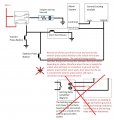
At first I was reading this as a misnderstanding of the issue and that LesJones thought I was trying to send an unlock signal with the external press button but no, this is actually a simple, elegant solution and does exactely what I am after with zero quiescent current. I can remove all of the latching relay part of the circuit completly, no capacitors, resistors or other electronics needed at all, it is already there inside the central locking module. Instead of taking the external press button to ground I connect it diretly to the unlock wire of the central locking module. Therefore when the car is unlocked, the unlock wire will be ground and the button works but when the car is locked the unlock wire does not provide a path to ground and the external button does not work.

I tested this on the bench using a light globe as the load instead of the solenoid and it work correctly. When the car is locked, pressing the external button does nothing and when unlocked the globe illuminates when I press the button. Bingo Bango problem solved and the tailgate press button opening will be secured when the vehicle is locked and accessible when unlocked.! With it all connected this way I can still provide a momentory ground to either lock or unlock wires and the car locks or unlocks so the alarm connection to the central locking system will work too.

Thanks everyone for taking the time to repsond and LesJones for thinking past what I was doing for a solution.

For the time being I will leave the diodes and see what happens.

Here is the revised circuit.

Thanks everyone. :D

Boot Release for Old Car2.jpg
 
Top