Auto Switching Reverse Polarity With Stop

djsfantasi

Joined Apr 11, 2010
9,237
Actually, the max input voltage for Arduinos is 15VDC. It then regulates to 5V and 3.3V.
Which Arduino are you referring to? (I was bit by responding to a different module than you were talking about before. Don’t want that to happen again)

As I know, the maximum supply voltage for an Arduino is 20V. 15V should be acceptable, except it is suggested that anything over 12V may cause overheating of the onboard regulators and the board might be damaged.
 

SamR

Joined Mar 19, 2019
5,491
Yup, I searched my books for the 15V limit I had stuck in my head and could not find my source. So, I went online and pulled up the PDFs for the genuine boards and it does say 20VDC. I did find the caveat that over 12V can cause their voltage regulator to start overtemp protection cycling. Just for giggles I pulled up the Nano PDF and expected to find 5V since it uses a USB connector but no, it is also 20V max. Note that this is for the genuine Arduinos and may not hold up for the clones as their hardware typically differs.
EDIT: The nano also has Vin & GND pins on the board, so it doesn't depend solely on the USB connection for power if wanted.
 
Last edited:

MisterBill2

Joined Jan 23, 2018
27,555
The "H Bridge" drive circuit with two relays will be a lot simpler for a newcomer into electronic to assemble and to wire. And a lot easier to make certain that it is going to work correctly the first time. The TS has already commented about being "a newbie."
and consider that without programming an arduino is just a hunk of circuit board.

As for the benefit of a stirrer that reverses, in a container of unknown size and an unknown shape, reversing stirrer directions will provide more uniform agitation than establishing a constant flow pattern.
 

MisterBill2

Joined Jan 23, 2018
27,555
The mechanical requirements for any crank-type of arrangement get tedious very rapidly, especially if any great amount of force is required. A reversing prop immersed in the liquid is much simpler to implement.
 

LesJones

Joined Jan 8, 2017
4,511
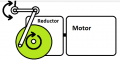
Another possible mechanical solution would be to have the motor driving a reduction gear. There would be a disk at the low output speed with a notch in the edge. There would be two micro switches positioned such that the levers on the micro switches dropped into the notch. Each micro switch would trigger the reversing circuit causing the motor to change direction. If you chose a reduction ratio of 10:1 then you get the motor to rotate a bit under 10 revolutions in each direction. If it is a small motor it may be OK to reverse it without a pause to allow it to stop. We could design a circuit just using relays for the reversing.

Les.
 

MisterBill2

Joined Jan 23, 2018
27,555
Maybe the thread starter will come back with a few more details? Then again maybe not. There are likely a dozen ways to make a stirrer motor drive and less anymore details where we are now is as good as it gets. Over the counter and inexpensive it can be as simple as this or it can be as expensive as this. No clue what we are stirring or mixing? Density of water or rice pudding?

Ron
Actually we do have a clue. A line in post #1 " im look at using a 12v low amperage motor to use as a miying station to keep some liquids stirred and not stagnant. "
Keeping something mixed in the chemical works part of some mining venture. (or a MIXING venture?) Evidently a big enough container to support a 12 volt motor driving some sort of mixing device. And probably a fair bit larger than those cute lab magnetic mixers . Thus the concept of a more energetic mechanism and the heavier duty relays. That reversig scheme has been used in several threads a while back, and it works very well. Those relays have the terminal markings, which I do not recall right now. And that digital dual timer from amazon could drive those relay coils cycling for a very long time.
 

Reloadron

Joined Jan 15, 2015
7,891
Actually we do have a clue. A line in post #1 " im look at using a 12v low amperage motor to use as a miying station to keep some liquids stirred and not stagnant. "
Keeping something mixed in the chemical works part of some mining venture. (or a MIXING venture?) Evidently a big enough container to support a 12 volt motor driving some sort of mixing device. And probably a fair bit larger than those cute lab magnetic mixers . Thus the concept of a more energetic mechanism and the heavier duty relays. That reversing scheme has been used in several threads a while back, and it works very well. Those relays have the terminal markings, which I do not recall right now. And that digital dual timer from amazon could drive those relay coils cycling for a very long time.
I caught the 12 volts low amperage problem is what is low amperage? If low amperage is under 2.0 amps there are dozens of small module boards using the old L298N chip and other inexpensive MOSFET modules easily running 10 amps. I have an old CanaKit 2.0 amp module laying here somewhere capable of PWM (speed control) and driving two motors. Actually made in Canada. Anyway I would not use relays but just a MOSFET H Bridge module. Something like this and I have seen less expensive.,
Here is a data sheet for the 2.0 amp CanaKit I mentioned earlier.These things are simple and easy to use and since the thread starter mentioned an Arduino they will interface easily. I also mentioned early on I see an Arduino as overkill when a little ATTINY85 would do fine. Anyway 12 volts leaves much to be desired, like planned current?

Ron
 

MisterBill2

Joined Jan 23, 2018
27,555
Really, the post in which the TS only mentions the name, "looks like it could be wired up on an arduino board", referring to a drawing with relays and diodes. And still a Newbie in the field. Still that dual timer board linked to in post #3 controlling the relays should be the way to go. No need to invest in programming learning and packaging a micro.
 

Reloadron

Joined Jan 15, 2015
7,891
Really, the post in which the TS only mentions the name, "looks like it could be wired up on an arduino board", referring to a drawing with relays and diodes. And still a Newbie in the field. Still that dual timer board linked to in post #3 controlling the relays should be the way to go. No need to invest in programming learning and packaging a micro.
My suggestion is drop the relays switching every 15 seconds and use a MOSFET or L298 chip and a simple timer. You figure relays are a better choice cool with me. The only merit to a uC is if they want speed control which remains unanswered.

Ron
 

vu2nan

Joined Sep 11, 2014
357
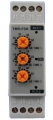
DIN Rail mounted timers, suitable for this application, are available online.

They are designated TMR - FSR.

2.png

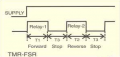
Here's the timing diagram.

1.png

Nandu.
 
Last edited:

MisterBill2

Joined Jan 23, 2018
27,555
DIN Rail mounted timers, suitable for this application, are available online.

They are designated TMR - FSR.

View attachment 257839

Here's the timing diagram.

View attachment 257840

Since only SPDT contacts have been provided, external relays with DPDT contacts may be used for an 'H bridge' with four fly-back diodes.

Nandu.
Two of the Single Pole double throw relays is all that it takes to provide all three modes: forward, Stop, and Reverse. The great thing about the relays I keep suggesting is the 30 amp contacts made for use in 12 volt systems. Certainly a 30 amp transistor can be used, either bipolar or mosfet, but for a 30 amp rating there will be a bit of heat sinking needed, and so suddenly it gets a bit more complex. That is why I suggest those particular relays. In addition, they are all set for use with 1/4 inch Faston lugs, meaning no soldering required. Not everybody is a master at soldering. Plus, that style of relays is available almost everywhere cars are used.
 

vu2nan

Joined Sep 11, 2014
357
Two of the Single Pole double throw relays is all that it takes to provide all three modes: forward, Stop, and Reverse. The great thing about the relays I keep suggesting is the 30 amp contacts made for use in 12 volt systems. Certainly a 30 amp transistor can be used, either bipolar or mosfet, but for a 30 amp rating there will be a bit of heat sinking needed, and so suddenly it gets a bit more complex. That is why I suggest those particular relays. In addition, they are all set for use with 1/4 inch Faston lugs, meaning no soldering required. Not everybody is a master at soldering. Plus, that style of relays is available almost everywhere cars are used.
Many thanks for pointing it out, Bill.

I'll modify my answer accordingly.

Nandu.
 
Top