Audio ADC beginner questions

Thread Starter

diamondman

Joined May 23, 2010
19
For Pete's sake.

RCA is a plug. It does not do anything to any audio signal but helps in interconnection.

OP is confused over so many things. He dunno what RCA actually is. He has no Idea on how to digitize an audio signal. 10bit audio suites for landlines phones, nothing more, Vocal range so to say.

Wow... Sorry for the confusion, I thought it was obvious.

OBVIOUSLY an RCA jack like the one found on the back of a tv or sterio doesn't DO anything... it is just a connector. I am, however, trying to connect to such a plug from such a device, so however the signal comes out, i need to be able to interpret it. Again, the RCA plug itself doesn't DO ANYTHING, but since so many devices connect through it to send audio, the ELECTRONICS DRIVING the RCA plug has to do something consistent! Because of earlier confusion on my part, I was under the impression that said ELECTRONICS DRIVING the RCA plug in standard audio equipment modulated the current and not the voltage (NO, I DO NOT think the RCA plug itself is doing any sort of work on the signal, that would be utterly retarded). After some of the many nice people who are trying to help me attempted to shed light on my confusion, it seems I was wrong and that the ELECTRONICS in the said standard audio equipment DRIVING the rca plug (Usually on the back of the said audio equipment) primarily change the voltage and i should be able to scale (and possibly shift) the VOLTAGE of the signal i get from the RCA (just a plug) input (with maybe an opamp and some resistors) to prepare it for my ADC.

Also, I already have an ADC I was planning on experimenting with. But since I didn't want to blow it up be doing something stupid, I wanted to get all my facts straight. Currently I am taking blueroomelectronics's advice and writing the software for my pc as a proof of concept before i delve into the microcontroller.
I am also aware that 10 bit audio isn't all that good. As previously stated, the project I am working on DOES NOT NEED high audio quality, but if i feel it needs better, I may use the Maxim 16 bit ADC suggested earlier by GetDeviceInfo (thanks for suggesting it btw).

Hopefully all confusion is gone now ;)

@blueroomelectronics Yes it is sad RCA doesn't really make anything good anymore...
@kubeek I am under the impression that since the movement of the speaker is done by he work of the magnetic field on it, which is the work of the electric current, that if you let the current bounce around when you changed voltage, or vice versa, you would at least get an unhappy or unpredictable power in the speaker (the power wouldn't be linearly based on which ever variable you chose to modulate).
Supporting this, many amplifier circuits I have seen, hold either the voltage OR the current constant (with active components) and then are free to change the other to linearly change the power.
And I would agree with you that if i didn't anticipate active components holding either the voltage or the current constant that i would have no concept of ohm's law, but I hope I have proved you wrong for my own ego's sake ;).
 
Last edited:

kubeek

Joined Sep 20, 2005
5,796
@kubeek I am under the impression that since the movement of the speaker is done by he work of the magnetic field on it, which is the work of the electric current, that if you let the current bounce around when you changed voltage, or vice versa, you would at least get an unhappy or unpredictable power in the speaker (the power wouldn't be linearly based on which ever variable you chose to modulate).
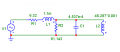
Well, the 8ohms is just a basic simplification. The actual model of my 15" 8ohm woofer without enclosure looks like this:

It isn´t too simple, but it certainly is predictable for any current or voltage applied.

Supporting this, many amplifier circuits I have seen, hold either the voltage OR the current constant (with active components) and then are free to change the other to linearly change the power.
I just don´t get this. When you put some constatnt AC voltage (or current) source through a load (speaker), you just can´t set the other to your liking. It gets set for you.

For example, you put 1A through and 8 Ohm speaker (lets just say it´s purely resistive), then the voltage HAS to be 8V to get 1A and nothing else.
 

Attachments

Audioguru

Joined Dec 20, 2007
11,248
A power amplifier does not set the voltage or the current to a constant value. It changes the voltage to whatever the signal is doing then the current in the speaker varies according to Ohm's law.
 

thatoneguy

Joined Feb 19, 2009
6,359
I think you will get further with an AVR dev board starting out by showing the ambient temperature on an LCD by reading the voltage across a thermistor.

Once that is done, try tackling faster changing signals, like motor speed from measured back EMF. Then add in the IP stack and see if you can get that info to a PC. Once that is done, tackle the audio, or you will probably be disillusioned with the entire uC ADC concept.

With microcontrollers, you do not have the benefit of OS or device libraries to simply call on to get a result, such as with a sound card, or sending a network packet.
 

Thread Starter

diamondman

Joined May 23, 2010
19
This was really helpful for determining what circuit to use with an opamp. Hope it is useful to someone else.
http://www-k.ext.ti.com/srvs/cgi-bin/webcgi.exe?Company={5761bcd8-11f5-4e08-84e0-8167176a4ed9},kb=analog,case=obj%2812303%29,new
 
Top