Facebook
 Google
 GitHub
 Linkedin
Hello!
I am designing an embedded system that would be normally powered from an AC to DC power supply (MYRRA 47152).
The 5V output of this supply will be regulated down to 3.3V by an LDO regulator (MCP1825ST-3302E/DB).
When I want to program the MCU, I don't want to actually use high ac voltage to power it, but rather supply 3.3V from an external regulator.
My question is, does the regulator care if it has 3.3V applied between its output and ground while its input is not active (i.e. disconnected or 0V).
To better explain the situation there's a schematic:
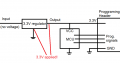
So can the regulator get damaged from this voltage?
I am designing an embedded system that would be normally powered from an AC to DC power supply (MYRRA 47152).
The 5V output of this supply will be regulated down to 3.3V by an LDO regulator (MCP1825ST-3302E/DB).
When I want to program the MCU, I don't want to actually use high ac voltage to power it, but rather supply 3.3V from an external regulator.
My question is, does the regulator care if it has 3.3V applied between its output and ground while its input is not active (i.e. disconnected or 0V).
To better explain the situation there's a schematic:
So can the regulator get damaged from this voltage?