Any Experts in Inverters ( DC to AC ) trouble shooting will be greatly appreciated

Thread Starter

arishy

Joined Apr 26, 2014
128
I need a very simple inverter from 4 volt dc to 220 volt ac. the load is extremely low ( less that 3 Watt and only for few seconds at a time). So, I went to "ytube"and discovered zillions of circuits NONE worked !!!!. I will go from today to a month back ( if needed):
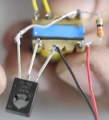
1. Got High frequency transformer ( Two Primary and one secondary) Let us call them P1 P1 and S. I did all the measurements to make sure that the three coils are working ( multimeter tests). The simplest circuit use one low resistance ( 30-100 ohm) and an NPN transistor. I tried so many Transistors NONE of them worked. The schematic is extremely simple See att. And I will summerize it here:
top side we have four pins: P11 P12 P1 P22 and Two pins on the other side: S1 S2 :
P11-P12 to the load 220 volt ac
P21 to Base of the NPN transistor
P22 to S12 Resistor ( 330 -100 ohm)
S11 to Collector
Emitter to -ve of the 4 volt Battery and S12 is the +ve of the Battery.
I tried 2 transistors: TIP122 and TIP41C and 2N3055.

Your help in debugging this extremely simple circuit will be greatly appreciated.

P.S. You will notice in the att. The transistor used is D822 which I do not have. And I hope it is not the issue here. Any NPN transistor will do.
As I said in the title anyone worked with this "empirical" circuits will be able to give me a hand. The reason I am saying this; is because there is no "math" behind it.!!!!
 

Attachments

Irving

Joined Jan 30, 2016
5,064
Is there a purpose to this, or just by way of playing with bits?

Anyway, I translated your description to a circuit and guessed some inductor values and it sort of works... the second primary has to be the opposite way round to the first primary - see the dots indicating the start of the winding. You cant tell by resistance measurement which way round, so if no output try reversing the base winding. However the other reason it may not work is that the second 'primary' winding at the base is generating a high voltage (yellow trace) that will instantly destroy most transistors.

Another reason for not working: transformer inductances might be so low that the natural 'resonant frequency' is too high for the transistor;

1703336324937.png

A capacitor & diode as shown below will give a lower frequency but more sinusoidal output with a reduced peak voltage....

1703337280585.png
 
Last edited:

Thread Starter

arishy

Joined Apr 26, 2014
128
Is there a purpose to this, or just by way of playing with bits?

Anyway, I translated your description to a circuit and guessed some inductor values and it sort of works... the second primary has to be the opposite way round to the first primary - see the dots indicating the start of the winding. You cant tell by resistance measurement which way round, so if no output try reversing the base winding. However the other reason it may not work is that the second 'primary' winding at the base is generating a high voltage (yellow trace) that will instantly destroy most transistors.

Another reason for not working: transformer inductances might be so low that the natural 'resonant frequency' is too high for the transistor;

View attachment 310676

A capacitor & diode as shown below will give a lower frequency but more sinusoidal output with a reduced peak voltage....

View attachment 310677
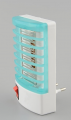
WOW What a response this is much more than just debugging. It is a master response to someone who have many questions about such circuit. For me to absorb all the issues you raised I need time. But I would like to answer your first question. It is a funny story. I am a grandfather and my grandson came to me with a mosquito racquet that is not working and asked me to help him. I could not find the problem so I replaced the circuit with one "stationary circuit" that I have and I managed to get the thing working. BUT my circuit works with 240 v input, I need to make it "portable" The old circuit had a good battery so if I can "squeeze" an inverter I can use the battery to generate the 240 volt required. This was the original purpose of that battery.
That is why I said the use will be for seconds and the circuit load is a bridge and few capacitors to make the spark.
I will be back in the meantime I will plug the actual values from my measurements ( which I will more than happy to pass it to you) and use Qspice ( I am just a beginner ). and try to debug this sucker!! just kidding.
Thanks to you; you are taking me to a fantastic journey

P.S. The work you did elevated this simple circuit to something worth a while.
 

Thread Starter

arishy

Joined Apr 26, 2014
128
..... provided it can easily handle a 1A collector current.
Thanks for the warning. I am aware of that; that is why I use High power Transistors, 2N3055 is high enough. And I believe Mr. Irving was aware of that too in his response.
 

Thread Starter

arishy

Joined Apr 26, 2014
128
Is there a purpose to this, or just by way of playing with bits?

Anyway, I translated your description to a circuit and guessed some inductor values and it sort of works... the second primary has to be the opposite way round to the first primary - see the dots indicating the start of the winding. You cant tell by resistance measurement which way round, so if no output try reversing the base winding. However the other reason it may not work is that the second 'primary' winding at the base is generating a high voltage (yellow trace) that will instantly destroy most transistors.

Another reason for not working: transformer inductances might be so low that the natural 'resonant frequency' is too high for the transistor;

View attachment 310676

A capacitor & diode as shown below will give a lower frequency but more sinusoidal output with a reduced peak voltage....

View attachment 310677
Here are the measurements:
P1(the 220v out) 1.01 mH
P2(the coil connected to the Tran. Base) 25 uH
S (the coil connected to the Tran Collector) 12 uH.

I love to get your simulation. In the mean time I will apply your modifications and report results. I will use 2N3050. I already ordered the D882.
 

Thread Starter

arishy

Joined Apr 26, 2014
128
As is now, that racquet seems to be a dangerous device. Am I right?
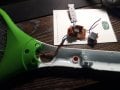
Not really. The circuit that I used is a safe circuit. It just need 240 volt. It has is it's own bridge rectifier followed by a bunch of capacitors same as the old one in the racquet . Remember the old one must have the extra setup to recharge the battery. Think of this as blocks. The old one has 4 blocks (1. the racquet ( common to both), 2. DC high voltage to spark creation ( common to both), AC source to provide high DC voltage (common to both), DC to AC needed for the potable). All I did isto try to add the DC to AC circuit and the Battery from the old one. see att. of the one I used. Of course the picture does not tell much but I can provide circuit details. The issue here is to add the dc to ac to run the racquet to catch the mosquitos.
 

Attachments

MisterBill2

Joined Jan 23, 2018
27,311
The inverter circuit in post#2 looks a lot like what we had back in 1967, but with an NPN silicon transistor instead of PNP germanium. The circuit can work but the voltage out and the frequency depend on the load.
 

Thread Starter

arishy

Joined Apr 26, 2014
128
The holidays are over and I am still in need of help. I have used at least 5 good working adapters to extract the HF transformer that I need to use for the conversion. Every attempt I tried failed to generate the 220 volt needed to drive this simple mosquito circuit. One major reason apart from lack of experience is the need for proper equipment.
I am very interested in proving to myself that the small RF transformer can produce 220v. So I need your help to try this little experiment. All the adapters I have has a working circuit; by that I mean they all have RF transformer that generate 5 volt RF. My question is: is it possible to connect the output of this 5 volt RF signal to an external RF transformer and actually see if the external transformer can produce the 220v RF signal that provide power to small lamp. I know from a design point of view the adapter circuit is not designed to drive another transformer but designed to be rectified then produce the 5 volt dc that is designed for. But I need you view on this rather unprofessional approach.
 

Pyrex

Joined Feb 16, 2022
501
hi,
it is not easy to generate 3W output by such a simple circuit. If you have some ferrite transformers and other components, i'd like to recommend you to built a more reliable inverter. Take in mind, a lot of wide spreaded circuits in the internet do not work, unfortunatelly...
The oscillator and component specifications:

https://www.mikrocontroller.net/articles/Royer_Converter

in fact, it's Baxandall oscillator, not Royer, you can google easily
 

Thread Starter

arishy

Joined Apr 26, 2014
128
I am delighted to hear this. I started getting very frustrated. None of the ytube adhock circuits work. So; is there a properly designed circuit not relying on SMPT concept can be simply built. The source will be rechargeable 3.7 Volt battery. And the output required is 220 V ac with a Max of 1 AMP. Your circuit that you kindly sent to me; rely on building the winding and I am too old for that. I am hoping for a design that does not rely on any kind of transformer that I cannot buy off the shelf.
 

Alec_t

Joined Sep 17, 2013
15,112
The source will be rechargeable 3.7 Volt battery. And the output required is 220 V ac with a Max of 1 AMP.
Output Watts = 220V x 1A = 220W.
So, allowing for a conversion efficiency of 90% (which might be achieved with a good circuit), the battery would have to provide 220W/0.9 = 244W. That means a current of 244W/3.7V = 66 Amps.
Methinks you're going to be disappointed.:(
 

MisterBill2

Joined Jan 23, 2018
27,311
Once again, it is not reasonable to expect to find useful information on yootoob. It may sometimes be found, but mostly not.
It is not likely that a single device inverter will be very efficient without exactly the correct transformer, although it can work at some level of efficiency..
There have been quite a few circuits published that use two transistors in an inverter circuit NOT SIMILAR to a switches supply. They were designed to power tube-type transmitters for mobile radio use. They all produce at least 250 volts at quite a bit more than a watt of power. Those "off the shelf" inverter products are sort of obsolete since mobile radios are mostly not using vacuum tubes any more. But the circuits, along with part numbers, can be found in older ham radio publications.
 

Pyrex

Joined Feb 16, 2022
501
I am delighted to hear this. I started getting very frustrated. None of the ytube adhock circuits work. So; is there a properly designed circuit not relying on SMPT concept can be simply built. The source will be rechargeable 3.7 Volt battery. And the output required is 220 V ac with a Max of 1 AMP. Your circuit that you kindly sent to me; rely on building the winding and I am too old for that. I am hoping for a design that does not rely on any kind of transformer that I cannot buy off the shelf.
you can put some ferrite transformers into a jar , pour some acetone and close firmly with a lid. Leave it for a day , take transformer away and try to disassemble the ferrite core. In most cases it will work.

Or, it is possible to use a transformer say, from a wall wart PSU with some free space on the bobbin. Simply push through double wire to form the primary winding. Imho, 5 or 10 turns will form the primary winding. Primary of the transformer can be used as secondary in your inverter
 

MrAl

Joined Jun 17, 2014
13,680
I need a very simple inverter from 4 volt dc to 220 volt ac. the load is extremely low ( less that 3 Watt and only for few seconds at a time). So, I went to "ytube"and discovered zillions of circuits NONE worked !!!!. I will go from today to a month back ( if needed):
1. Got High frequency transformer ( Two Primary and one secondary) Let us call them P1 P1 and S. I did all the measurements to make sure that the three coils are working ( multimeter tests). The simplest circuit use one low resistance ( 30-100 ohm) and an NPN transistor. I tried so many Transistors NONE of them worked. The schematic is extremely simple See att. And I will summerize it here:
top side we have four pins: P11 P12 P1 P22 and Two pins on the other side: S1 S2 :
P11-P12 to the load 220 volt ac
P21 to Base of the NPN transistor
P22 to S12 Resistor ( 330 -100 ohm)
S11 to Collector
Emitter to -ve of the 4 volt Battery and S12 is the +ve of the Battery.
I tried 2 transistors: TIP122 and TIP41C and 2N3055.

Your help in debugging this extremely simple circuit will be greatly appreciated.

P.S. You will notice in the att. The transistor used is D822 which I do not have. And I hope it is not the issue here. Any NPN transistor will do.
As I said in the title anyone worked with this "empirical" circuits will be able to give me a hand. The reason I am saying this; is because there is no "math" behind it.!!!!
Hi,

You should really post a schematic not a drawing of parts soldered together.

It is not easy to go from 4v to 200v. If you are using a transformer the transformer has to be able to handle 200vac which means the core has to have enough area and there has to be enough turns so that it can handle that voltage level.

Probably better to use a boost converter. It depends though on what that 200v (or 220v or whatever) has to look like on the output. Does it have to be a sine wave, square wave, or is a short pulse good enough.
 

Thread Starter

arishy

Joined Apr 26, 2014
128
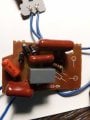
For those of you that did not look closely to a mosquito "killer" it is a very simple circuit that ONLY works when you press a button. A mesh of wires is energized so when it catches the little monster it blows it away. The power required is really very small since it only lasts while pressing a button. The chinese managed to do it very cheaply. Use a small 4 volt battery ( rechargeable ) and few ceramic capacitors, to create the spark when touched. They are NOT using any transformers.
The circuit IS working once I provide 220 volt. There are THREE pairs of wires: 1. to the right is 220 volt with a switch. 2. Up blue led 3. to the left the mesh wire that kills the poor soul.

This circuit DOES NOT show the portable part ( The rechargeable Battery ).

How much power to use this device. It is so small that cannot be even measured.

For those of you who are not aware of the full "saga" this circuit is not mobile. And I want to make it mobile.
 

Attachments

Irving

Joined Jan 30, 2016
5,064
That's a 4-stage Cockcroft-Walton multiplier (multiplies/rectifies peak AC input -> DC x 4), but whats the grey box?
 
Top