Facebook
 Google
 GitHub
 Linkedin

Hi,
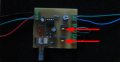
I made a Wienbridge oscillator that is almost the same as the one I found >here<. It has two frequency ranges. The high frequency range (460 - 67500 Hz) uses 22nF polyester film box capacitors and it works fine. The lower range (30 - 4750 Hz) uses 330nF
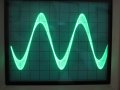
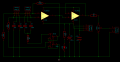
multilayer monolithic ceramic capacitors, in case that matters. It's unstable from about 80 Hz and up where it shows some kind of amplitude modulation. Two pictures of this at the same frequency but different time scales are attached as well as the circuit diagram that I used.
I noticed that when I heat up the ceramics capacitors with my fingers the modulation slowely disappears. Also, when starting the circuit from cold at a problematic frequency it takes a few seconds before modulation becomes apparent.
Does anyone know what might cause this? Are ceramic caps a bad choice for this and/or known to be thermally unstable?
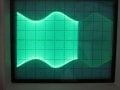
I made a Wienbridge oscillator that is almost the same as the one I found >here<. It has two frequency ranges. The high frequency range (460 - 67500 Hz) uses 22nF polyester film box capacitors and it works fine. The lower range (30 - 4750 Hz) uses 330nF
multilayer monolithic ceramic capacitors, in case that matters. It's unstable from about 80 Hz and up where it shows some kind of amplitude modulation. Two pictures of this at the same frequency but different time scales are attached as well as the circuit diagram that I used.
I noticed that when I heat up the ceramics capacitors with my fingers the modulation slowely disappears. Also, when starting the circuit from cold at a problematic frequency it takes a few seconds before modulation becomes apparent.
Does anyone know what might cause this? Are ceramic caps a bad choice for this and/or known to be thermally unstable?