All of us are Scientist.

Thread Starter

dcbingaman

Joined Jun 30, 2021
1,065
We generally think of a scientist as someone in a long white lab coat, staring down a microscope. But what is science? I say it is the search for the truth, regardless of how we get there. For electronics we have to test our circuits with prototypes, in physics we have to again test our findings, in mechanics we have to verify that bridge will not fall down. For a chemist we have to verify that a mixture of oxygen and hydrogen (say a gallon jug with the magic 1-2 ratio of hydrogen gas to O2 gas, blows up when you add a spark! I feel sorry for that poor guy. For programmers we have to test our code. And the list goes on and on.... But the foundation of it all is a search for the truth and is that not what we all want? Just a little more truth?
 

crutschow

Joined Mar 14, 2008
38,589
But the foundation of it all is a search for the truth and is that not what we all want?
Most of us, but not all.
There are many, including the dogmatic religious and numerous politicians, who declare the truth to be whatever they believe or say (alternate truths), and to heck with the Science.
 

Ian0

Joined Aug 7, 2020
13,163
"Science" is a 19th century concept. Before then it was known as "Natural Philosophy" - a search for understanding of how the world (and the universe) works.
 

Ya’akov

Joined Jan 27, 2019
10,263
You have to be careful about assigning semantic content to a word and then using the overloaded term in cases where some of its various legitimate denotations and connotations don’t apply.

Just because two things can be called by the same name it is not immediately evident they share anything else. For example I can legitimately call both a mammal of the species C. familiaris and the small, notched bit of metal that pulls material through a sewing machine, “dog”.

But, this does not prove any relationship or common trait between the two. Surely sometimes words arise a labels precisely because of a perceived similarity between two things. But, not only is it a sure path to misapprehension of the truth to extend analogies beyond their legitimate application, it is even worse when there is no such analogy to begin with.

So, first—I can’t agree that “science is the search for truth”.
”Truth” is something exclusive to human experience and it is not freely interchangeable with ”facts” even though we tend to act that way. People will say, “the facts speak for themselves” and those who agree with the conclusions they are trying to defend with nod knowingly.

But the facts don’t speak for themselves, ever. For facts to have meaning there must be a context of logical connections and “the facts speak for themselves“ is the same as saying “though I will not state my assumptions all right-thinking people know what to conclude from the bespoke subset of facts I have chosen to report”.

“Truth” is a purely human thing that can’t have an objective form because there must and always will be a set of assumptions underlying it. Truth with the big ”T” in particular is a phantom of the human mind and should be left out of science as it is sure to poison the process from the start.

The small T “truth” is another problem since there is no distinction between it and agreement among people. It is a trivial exercise to test this. Find any sentence organically uttered by people where the word truth can’t be substituted with agreement or consensus and you will have disproved my thesis. But you can’t, because that’s what “truth“ means!

”That is true” means “I agree with that”. Or, if a person is asserting something is “true” they mean to say it comports with the facts and so in the cases where we as humans get as close as we can to objectivity (an unreachable goal) we can say “it is factual”.

But the vast ocean of meaning one must leap to go from “factual” to “true”—with all of ”truth’s” intense, value-laden, and almost invariably utterly hidden content—is startling in its magnitude. Particularly in light of how trivial it is for us to simply ignore the huge chasm of unquestioned assumption.

So, I will say science is not the pursuit of truth, and also that science is not one thing and conflating (or even confusing) the different identities contained in the word is a sure way to turn math into poetry. Don‘t get me wrong, I think poetry is a powerful thing that can accomplish, for human communication, something amazing that specific and unambiguous speech can’t.

But I am not going to design an airliner with poetry, nor would I try to use calculus to write a love note or describe feelings about the search for ”Truth” in its most elevated sense of human striving for meaning.

The word “scientist” inherits the strengths and weaknesses of its root and has the same pitfalls. So to avoid writing another few thousand words, let me suggest how I would go about defining this things and distinguishing among the usages.

What is “science”?
Science is a
method. The scientific method has been shortened in usage to ”science” (and not for good). Science, as a method, is a way of testing a hypothesis to see if what that hypothesis describes is repeatable. Science is not a fixed method, it is a set of methods and heuristics to be applied as they suit the circumstances.

We find hypotheses that offer repeatable results very useful, and so a method for determining in any one might fit that class is also very useful. But, this practical value of science, it’s very greatest attribute can be obscured by human, social-mediated demands of “science” that add more than immediate practical value as parameters for “good science”.

Since Popper, falsifiability has grown in the philosophically naïve mind as an absolute requirement for legitimate “science”. But this is just wrong—it is an orthodoxy that doesn’t bother asking about the goals of our application of science to real world problems. It’s not that Popper’s idea wasn’t important when dealing with strong assertions of “provability” as the hallmark of ”science”, as when dealing with the ascendant Logical Positivists of his day, but as a foundational claim with the smell of religious dogma, it’s just as damaging.

Science is a tool of the scientist, it should take the shape that works. That is, produces the most useful results without reference to the theoretical properties of the approach itself.

Science is a human enterprise. Big ”S” Science is what we call the human enterprise comprising “scientists”, and the infrastructures we have built around training and equipping humans to join in on the creation of technology. “Science has given us…” is not referring to a method, or a particular thing—it is referring to this human enterprise with fuzzy edges and poorly defined components that pervades the modern world.

A “Scientist” is a person who participates in this enterprise “officially”. That is, someone who has entered into the infrastructure and through training, education, or even just experience, has made themselves into one of the human parts of the scientific enterprise.

It is certainly reasonable to suggest that anyone who employs the scientific method to whatever extent is acting like a scientist—but that doesn’t make them a “scientist” any more that being a “legitimate scientist” makes someone an expert or intellectually superior, or even more informed than a person who can’t be called “scientist”.

And this is the problem. If I need someone to provide legitimacy in an informal argument, in a news report, in testimony to a court or to lawmakers—then I want a “Scientist”. I want a PhD, and years of experience, and a history of publications. But, even if I find someone with all of that, I still have to listen to opposing arguments and test them to see if they have merit—if I am actually interested in what science has to say.

This is a dangerous thing: scientists can’t speak for Science, they can only report on test results. But while this is true it is also the case that if I don‘t know better myself, and have to blindly trust one or another account, the one given by the legitimate scientist is my best bet… or is it?

What isn’t a scientist?
A scientist is not, by definition, a superior human. She is not, by dint of the title, morally superior and more interested in that pesky “Truth”. The lab coat is not armor against any of the various human failings we are all subject to—greed, lust, egotism, fear, and the rest. The scientist is a person without any special reference to social qualities that raise them above… anything.

Scientists lie, cheat, and steal to the same extent the general population of relevant demographics suggest they will. Scientists don’t deserve and should not get any special pass on providing true information when making a case for something in which they have a personal interest.

So, no, scientists are not searching for, nor is science itself the search for truth. Instead, I would propose this:

Technology is the search for “truth” where truth is as close as we get to comporting with “what is”. Technology either works or doesn’t. It is either improved or it isn’t. And so long as we set the criteria so these things are testable, technology is “reality”.

Technology is what used to be called magic. Applied mechanics is technology, applied chemistry is technology, even applied math is technology—and anyone trying to make something “work” is a technologist.

It is not what a technologist says about technology that is the “truth”, rather it is the technology itself that embodies truth. Don’t get the impression I am ignoring or denying the critical rôle science plays in the advancement of technology. I surely am not. But, just as wizards get their social power by effectively brewing their potions (every one of which was just an application of chemistry or mechanics, no matter the proffered explanation), not from the impenetrable texts and indecipherable diagrams, scientists get their power of legitimacy from the medicines, devices, and effective frameworks for producing them.

It is in the latter case—the frameworks—that science stepped out of the obscurantism of wizardry. And it is in the form of technologists that scientists gained their power in the current world.
 

boostbuck

Joined Oct 5, 2017
1,056
Truth has no objective existence?
Popper's falsifiability is an incorrect orthodoxy?
Technology is a 'search for truth'?

Fighting words!
 

ElectricSpidey

Joined Dec 2, 2017
3,343
Science can roughly be defined as "the study of" or a system of knowledge.

Truth has little or no meaning in the context of science.

The search for truth was the original purpose of religion, of course that is where it went wrong.
 
Last edited:

Thread Starter

dcbingaman

Joined Jun 30, 2021
1,065
You have to be careful about assigning semantic content to a word and then using the overloaded term in cases where some of its various legitimate denotations and connotations don’t apply.

Just because two things can be called by the same name it is not immediately evident they share anything else. For example I can legitimately call both a mammal of the species C. familiaris and the small, notched bit of metal that pulls material through a sewing machine, “dog”.

But, this does not prove any relationship or common trait between the two. Surely sometimes words arise a labels precisely because of a perceived similarity between two things. But, not only is it a sure path to misapprehension of the truth to extend analogies beyond their legitimate application, it is even worse when there is no such analogy to begin with.

So, first—I can’t agree that “science is the search for truth”.
”Truth” is something exclusive to human experience and it is not freely interchangeable with ”facts” even though we tend to act that way. People will say, “the facts speak for themselves” and those who agree with the conclusions they are trying to defend with nod knowingly.

But the facts don’t speak for themselves, ever. For facts to have meaning there must be a context of logical connections and “the facts speak for themselves“ is the same as saying “though I will not state my assumptions all right-thinking people know what to conclude from the bespoke subset of facts I have chosen to report”.

“Truth” is a purely human thing that can’t have an objective form because there must and always will be a set of assumptions underlying it. Truth with the big ”T” in particular is a phantom of the human mind and should be left out of science as it is sure to poison the process from the start.

The small T “truth” is another problem since there is no distinction between it and agreement among people. It is a trivial exercise to test this. Find any sentence organically uttered by people where the word truth can’t be substituted with agreement or consensus and you will have disproved my thesis. But you can’t, because that’s what “truth“ means!

”That is true” means “I agree with that”. Or, if a person is asserting something is “true” they mean to say it comports with the facts and so in the cases where we as humans get as close as we can to objectivity (an unreachable goal) we can say “it is factual”.

But the vast ocean of meaning one must leap to go from “factual” to “true”—with all of ”truth’s” intense, value-laden, and almost invariably utterly hidden content—is startling in its magnitude. Particularly in light of how trivial it is for us to simply ignore the huge chasm of unquestioned assumption.

So, I will say science is not the pursuit of truth, and also that science is not one thing and conflating (or even confusing) the different identities contained in the word is a sure way to turn math into poetry. Don‘t get me wrong, I think poetry is a powerful thing that can accomplish, for human communication, something amazing that specific and unambiguous speech can’t.

But I am not going to design an airliner with poetry, nor would I try to use calculus to write a love note or describe feelings about the search for ”Truth” in its most elevated sense of human striving for meaning.

The word “scientist” inherits the strengths and weaknesses of its root and has the same pitfalls. So to avoid writing another few thousand words, let me suggest how I would go about defining this things and distinguishing among the usages.

What is “science”?
Science is a
method. The scientific method has been shortened in usage to ”science” (and not for good). Science, as a method, is a way of testing a hypothesis to see if what that hypothesis describes is repeatable. Science is not a fixed method, it is a set of methods and heuristics to be applied as they suit the circumstances.

We find hypotheses that offer repeatable results very useful, and so a method for determining in any one might fit that class is also very useful. But, this practical value of science, it’s very greatest attribute can be obscured by human, social-mediated demands of “science” that add more than immediate practical value as parameters for “good science”.

Since Popper, falsifiability has grown in the philosophically naïve mind as an absolute requirement for legitimate “science”. But this is just wrong—it is an orthodoxy that doesn’t bother asking about the goals of our application of science to real world problems. It’s not that Popper’s idea wasn’t important when dealing with strong assertions of “provability” as the hallmark of ”science”, as when dealing with the ascendant Logical Positivists of his day, but as a foundational claim with the smell of religious dogma, it’s just as damaging.

Science is a tool of the scientist, it should take the shape that works. That is, produces the most useful results without reference to the theoretical properties of the approach itself.

Science is a human enterprise. Big ”S” Science is what we call the human enterprise comprising “scientists”, and the infrastructures we have built around training and equipping humans to join in on the creation of technology. “Science has given us…” is not referring to a method, or a particular thing—it is referring to this human enterprise with fuzzy edges and poorly defined components that pervades the modern world.

A “Scientist” is a person who participates in this enterprise “officially”. That is, someone who has entered into the infrastructure and through training, education, or even just experience, has made themselves into one of the human parts of the scientific enterprise.

It is certainly reasonable to suggest that anyone who employs the scientific method to whatever extent is acting like a scientist—but that doesn’t make them a “scientist” any more that being a “legitimate scientist” makes someone an expert or intellectually superior, or even more informed than a person who can’t be called “scientist”.

And this is the problem. If I need someone to provide legitimacy in an informal argument, in a news report, in testimony to a court or to lawmakers—then I want a “Scientist”. I want a PhD, and years of experience, and a history of publications. But, even if I find someone with all of that, I still have to listen to opposing arguments and test them to see if they have merit—if I am actually interested in what science has to say.

This is a dangerous thing: scientists can’t speak for Science, they can only report on test results. But while this is true it is also the case that if I don‘t know better myself, and have to blindly trust one or another account, the one given by the legitimate scientist is my best bet… or is it?

What isn’t a scientist?
A scientist is not, by definition, a superior human. She is not, by dint of the title, morally superior and more interested in that pesky “Truth”. The lab coat is not armor against any of the various human failings we are all subject to—greed, lust, egotism, fear, and the rest. The scientist is a person without any special reference to social qualities that raise them above… anything.

Scientists lie, cheat, and steal to the same extent the general population of relevant demographics suggest they will. Scientists don’t deserve and should not get any special pass on providing true information when making a case for something in which they have a personal interest.

So, no, scientists are not searching for, nor is science itself the search for truth. Instead, I would propose this:

Technology is the search for “truth” where truth is as close as we get to comporting with “what is”. Technology either works or doesn’t. It is either improved or it isn’t. And so long as we set the criteria so these things are testable, technology is “reality”.

Technology is what used to be called magic. Applied mechanics is technology, applied chemistry is technology, even applied math is technology—and anyone trying to make something “work” is a technologist.

It is not what a technologist says about technology that is the “truth”, rather it is the technology itself that embodies truth. Don’t get the impression I am ignoring or denying the critical rôle science plays in the advancement of technology. I surely am not. But, just as wizards get their social power by effectively brewing their potions (every one of which was just an application of chemistry or mechanics, no matter the proffered explanation), not from the impenetrable texts and indecipherable diagrams, scientists get their power of legitimacy from the medicines, devices, and effective frameworks for producing them.

It is in the latter case—the frameworks—that science stepped out of the obscurantism of wizardry. And it is in the form of technologists that scientists gained their power in the current world.
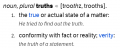
Well I am not necessarily disagreeing with that, when I think truth it is just something that is true or not.

Similar to the dictionary (from dictionary.com) first two definitions:

1699228479024.png

The earth is sphere (close to it) is true.
Steel is strong than Aluminum is true.

I use the scientific method all the time, I like to run experiments and find out what is true. (Science is the search for truth). Example either my circuit meets the required criteria or it does not. The problem is people might have a bias. A chemist who works on a project for a company may
'fudge' on how well the chemical works. Basically lying and not telling the truth. Thus we have to be objective.
 

Jerry-Hat-Trick

Joined Aug 31, 2022
832
For me, science is about observing the natural world and explaining what you observe, often with (mathematical) models which may lead us to looking for something which we have yet to observe but which is suggested by the model. Personally, I don't think truth comes into it, we probably don't have the brain power to truly understand. Models which help explain are useful, think of gravity and relativity. Light is neither a particle or a wave, it's just light, which has characteristics which we can explain using our understanding of particles and waves.

I like the quote by Carl Sagan “Every kid starts out as a natural-born scientist, and then we beat it out of them. A few trickle through the system with their wonder and enthusiasm for science intact.”
 

cmartinez

Joined Jan 17, 2007
8,799
I do believe in the existence of Objective Truth. That we, limited and imperfect humans that we are, are uncapable of comprehending it is an entirely different thing.
 
Top