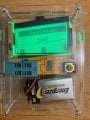
I have a $50.00 meter just because it is small.
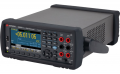
I also have one of these when I want a good reading.
Then I have a meter that cost real money.
I would go to digikey.com or somewhere that is trusted and get a 0.1% resistor. or a 0.01%. They don't cost that much and test you meter. 0.1% 10k $0.65, 0.01% 10k $6.50 I have not purchased a through hole resistor in years.
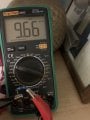
The reading on my VOM matches the M328 tester reading. I guess they could both be off but it is unlikely they would both be off by exactly the same amount so that their readings match.
I do not doubt that some components from common web-sites such as E-Bay may be questionable (either out of claimed tolerance, re-sleeved second-hand units, remarked lower specification units or just completely fake) but in most cases 1% accuracy isn't really needed and I do buy them - I doubt any would be worse than 5%.
My main issue with cheap components is their use of tinned/plated steel leads rather than tinned copper, which may create issues in any kind of damp environment - the good old resistors from the 70s & 80s still residing in my component bins have no desire to attach themselves to a magnet.
If the value of a component is critical I always measure the specific component before use, irrespective of where I bought it, to be honest the typical value spread of these cheap resistors isn't that bad considering the price.
But to get a meaningful result with a 1% resistor you need a meter with 0.1% accuracy or better and if the resistor is a lowish value (not an issue with your 10k one) you really need to use 4 wire measurement to get a truly accurate result rather than just nulling out the leads. The meter also needs to be calibrated at the recommended intervals against a certified standard, though in most cases it will just be a confirmation that the accuracy is still within specification rather than an actual recalibration.
My everyday use DMMs are around 1% accuracy or a bit better, depending on the range and type of measurement - they have worked without issue, other than the odd blown fuse (my fault), for years and if I do break one it won't cause me much distress.
I have more accurate ones that achieve 0.01% on resistance, 0.003% on DC volts, but I don't use them every day as accidentally breaking a £1000 meter would be somewhat upsetting! If I get my best meter calibrated I can then use it to verify the accuracy of my other meters.
Having said that, cheap meters and component testers do achieve remarkable accuracy for the money and are quite adequate for the typical hobbyist, my main concern with cheap DMMs is build quality and safety if used on high voltages or on low voltage high current systems such as storage batteries.
I do not doubt that some components from common web-sites such as E-Bay may be questionable (either out of claimed tolerance, re-sleeved second-hand units, remarked lower specification units or just completely fake) but in most cases 1% accuracy isn't really needed and I do buy them - I doubt any would be worse than 5%.
My main issue with cheap components is their use of tinned/plated steel leads rather than tinned copper, which may create issues in any kind of damp environment - the good old resistors from the 70s & 80s still residing in my component bins have no desire to attach themselves to a magnet.
If the value of a component is critical I always measure the specific component before use, irrespective of where I bought it, to be honest the typical value spread of these cheap resistors isn't that bad considering the price.
But to get a meaningful result with a 1% resistor you need a meter with 0.1% accuracy or better and if the resistor is a lowish value (not an issue with your 10k one) you really need to use 4 wire measurement to get a truly accurate result rather than just nulling out the leads. The meter also needs to be calibrated at the recommended intervals against a certified standard, though in most cases it will just be a confirmation that the accuracy is still within specification rather than an actual recalibration.
My everyday use DMMs are around 1% accuracy or a bit better, depending on the range and type of measurement - they have worked without issue, other than the odd blown fuse (my fault), for years and if I do break one it won't cause me much distress.
I have more accurate ones that achieve 0.01% on resistance, 0.003% on DC volts, but I don't use them every day as accidentally breaking a £1000 meter would be somewhat upsetting! If I get my best meter calibrated I can then use it to verify the accuracy of my other meters.
Having said that, cheap meters and component testers do achieve remarkable accuracy for the money and are quite adequate for the typical hobbyist, my main concern with cheap DMMs is build quality and safety if used on high voltages or on low voltage high current systems such as storage batteries.
For my current project (a voltage divider for an LM311 reference voltage), the 10K resistor does not have to be precisely 10K. Its real value does, however, have to be precisely known to me. So having measured it at 9,688 ohms and again at 9,699 ohms, I know it precisely enough.
The other half of the voltage divider is a 50K trim pot. So, knowing the 9,688 ohms value for R1, I can set a value on the trim pot R2) that is in the ballpark. Then I just use the tiny screwdriver to adjust the trim pot to dial in the exact voltage I want across the trim pot.
Are you sure? Even a fixed 20% uncertainty in its value would not matter if you are using the trim pot to set a voltage and are monitoring tha voltage while adjusting the pot.
Are you sure? Even a fixed 20% uncertainty in its value would not matter if you are using the trim pot to set a voltage and are monitoring tha voltage while adjusting the pot.
The reason was that the “TL072” from eBay was counterfeit. It was an op-amp of some sort but it was not a genuine TI TL072 and did not perform like a genuine TL072. I proved that by ordering some genuine TL072’s from a US based, well known supplier. The real TL072’s worked fine in the circuit.
When I challenged the eBay vendor about the fake IC he said that the eBay posting clearly stated that the chip was made in China. I responded and said, that is fine, lots of chips are made in China, even chips made by well known companies. I said this chip had a fake TI logo on it. How can you defend putting a logo of a famous company on your counterfeit product? He had no response to that.
If these crooked eBay vendors would just use their efforts for good instead of evil they would still be able to sell. They could sell genuine products and I would buy again. Sigh.
I have bought from Tayda before and I do like them. I thought they only sold electric guitar related electronic parts? I will need to go check out their website again. I have not bought from them in a while.
The reason was that the “TL072” from eBay was counterfeit. It was an op-amp of some sort but it was not a genuine TI TL072 and did not perform like a genuine TL072.
Many of the components I bought on eBay were from sellers selling one-off lots of components. I bought thousands of dollars worth of components and equipment from a seller who bought company liquidations by the pound and resold some of it on eBay. That meant I was able to get things like oscilloscopes for less than $20.
I don't know whether you could consider yourself lucky, or not.
A member bought some temperature sensors on eBay for a price that seemed too good to be true. He got NPN transistors.
They don't care because they're evil by nature.
Many of the components I bought on eBay were from sellers selling one-off lots of components. I bought thousands of dollars worth of components and equipment from a seller who bought company liquidations by the pound and resold some of it on eBay. That meant I was able to get things like oscilloscopes for less than $20.
I thought that was what I was getting. Some sort of closeout or liquidation of “New Old Stock”. Live and learn. I do notice now that the crooked vendors tend to put “generic” in the manufacturer field in their listings so as to cover their butts. But putting a TI logo on a product that is not a genuine TI product is totally crooked. In America that is trademark infringement and there are severe legal penalties for doing that. I guess overseas vendors selling on eBay don’t care about trademark infringement.
Re-labeling components is big business in China. They remove components from discarded electronics, separate by package, "refurbish", re-label, and sell.
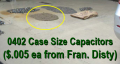
Even things you wouldn't think they'd bother with:
Everything sold here is counterfeit:
That's why you need to be careful about where you buy components these days. If you're a hobbyist, you don't want to be spending time troubleshooting problems caused by defective/counterfeit components. Spending a bit more money can save you a lot of time.
Even buying assembled boards (e.g. Arduino Uno) on eBay, Amazon, or AliExpress is a gamble. Apparently people who build these things can't be bothered with details. I have several Arduino Uno clones, but they didn't know the difference between LMV358 and LM358. They used LM358, which is cheaper, but is *not* a substitute for LMV358. It's pretty sad when they aren't even competent enough build something correctly when they have the complete schematic.

 Facebook
 Google
 GitHub
 Linkedin