Advice on dual voltage in house..

MaxHeadRoom

Joined Jul 18, 2013
30,716
As for a transformer...

There is nothing inherently unsafe about that. In fact, it could be argued it make it safer.

.
If an isolation transformer were used and any of the equipment had a earth GND conductor, one side of the secondary would have to be connected to the service earth ground for safety purposes and set up a grounded neutral.
Max.
 

Thread Starter

Steve Wright

Joined Jun 28, 2019
15
Before putting too much horsepower to planning; make sure your UK TV will work on the broadcast system, soon to be digital ATSC region 2? there.

----> https://en.wikipedia.org/wiki/List_of_digital_television_deployments_by_country

A coffee machine does not deserve an outlet for itself because is is an inexpensive item, but if you have an electric range, an outlet/extension cord can be cheaply derived from its internals towards the countertop.

---->

A vacuum cleaner does not deserve several dedicated outlets at several rooms, plus installation and transformer costs. Get a 120V/60Hz one.
Better re-think your plans.
- The TV is already functioning here no problem with a 300W transformer, so no issues there.

- The coffee machine is a nice one, and for an equivalent over here would be $1000+, so it’s not really an inexpensive item.

- I would only install one extra PowerPoint in the house, maybe two at most, for the vacuum cleaner, and just use a extension chord to access the rest of the house. It works at both 50Hz/60Hz.

- yes 100% a pro will be doing it! I just like to understand the process before I begin anything. As for the gear, the computer and screen both run off either 110 or 220, the other stuff doesn’t have a switch - 220V only.
 

Thread Starter

Steve Wright

Joined Jun 28, 2019
15
If an isolation transformer were used and any of the equipment had a earth GND conductor, one side of the secondary would have to be connected to the service earth ground for safety purposes and set up a grounded neutral.
Max.
Yes they do have ground conductor, for the guitar amp this is especially important to avoid hum (I have a smaller 1Watt amp, and trying to use it through the transformer is useless due to the lack of earth).

Ultimately, I want the solution to be neat, efficient, and electronically sound in every way. I will be doing my professional work there, and possibly bringing other U.K.-spec electronics over. Reason being I still spend time in the UK for work, often bringing gear back and forth. Even if getting a bit of extra wiring would cost a bit, I still feel the benefits of having the plugs ready to go in the wall will be a way more neat, streamline, and electronically sound solution. Especially given the inflated cost to replace a lot of my appliances over here... although I appreciate everyone’s opinion and comments, it’s all very informative!
 

MaxHeadRoom

Joined Jul 18, 2013
30,716
Yes they do have ground conductor, for the guitar amp this is especially important to avoid hum (I have a smaller 1Watt amp, and trying to use it through the transformer is useless due to the lack of earth).
So in that case you would need the secondary referenced to earth GND for two reasons.!;)
Max.
 

nsaspook

Joined Aug 27, 2009
16,369
Yes they do have ground conductor, for the guitar amp this is especially important to avoid hum (I have a smaller 1Watt amp, and trying to use it through the transformer is useless due to the lack of earth).

Ultimately, I want the solution to be neat, efficient, and electronically sound in every way. I will be doing my professional work there, and possibly bringing other U.K.-spec electronics over. Reason being I still spend time in the UK for work, often bringing gear back and forth. Even if getting a bit of extra wiring would cost a bit, I still feel the benefits of having the plugs ready to go in the wall will be a way more neat, streamline, and electronically sound solution. Especially given the inflated cost to replace a lot of my appliances over here... although I appreciate everyone’s opinion and comments, it’s all very informative!
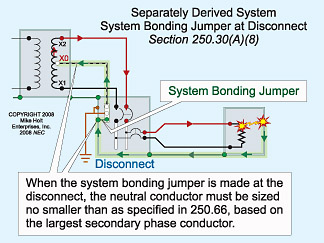
My suggestion (a little bit of overkill) to eliminate possible power quality issues is to have a isolated sub-panel dedicated to the rooms equipment. While this can require an extra expensive for the large transformer needed, it provides technical power with almost no ground induced hum or interference from common house loads and appliances. This sub-panel should be powered from the main panel 220V to an isolation transformer of sufficient power (KVA) to handle all of the 110V/220V loads. I used a 4KVA 220 to 220 split-phase for my media room power requirement. Because this power panel is classified as a 'separately derived system' a separate ground wire and rod (bonded to the normal house grounding system outside the house) is used to create a new, clean, power neutral and ground connections just for the rooms equipment in addition to the required AC power.

https://www.ecmweb.com/nec/grounding-and-bonding-separately-derived-ac-systems
 

Thread Starter

Steve Wright

Joined Jun 28, 2019
15
My suggestion (a little bit of overkill) to eliminate possible power quality issues is to have a isolated sub-panel dedicated to the rooms equipment. While this can require an extra expensive for the large transformer needed, it provides technical power with almost no ground induced hum or interference from common house loads and appliances. This sub-panel should be powered from the main panel 220V to an isolation transformer of sufficient power (KVA) to handle all of the 110V/220V loads. I used a 4KVA 220 to 220 split-phase for my media room power requirement. Because this power panel is classified as a 'separately derived system' a separate ground wire and rod (bonded to the normal house grounding system outside the house) is used to create a new, clean, power neutral and ground connections just for the rooms equipment in addition to the required AC power.

https://www.ecmweb.com/nec/grounding-and-bonding-separately-derived-ac-systems
Thanks for this - I did think about the idea of having a sub panel for the studio. However, part of the purpose of getting the 220 was to also enable some of my U.K. electronics in the house, at which point the idea of having a sub panel just for studio is semi-redundant. Out of interest, how much did it cost you in total?

It’s a nice idea, and perhaps one for the future, but for now I feel that the best option is just getting a circuit, or perhaps 2, just to cover a couple of places in the house. Once I’m in the house (we’ve signed an entry agreement but not yet in the house), I’ll be able to check the the panel, and make a bit more of a plan. What makes me happy/excited, is I have various options to get the ideal set up!
 
In the US, you have split phase 120-0-120 in the panel. If you put in a double breaker, it supplies 240,

So, we run dedicated 240 V lines to things like electric water heaters, airconditioneers and electric stoves and possibly electric dryiers.

The 120 circuits are daisy chained. A lot of outlets on a 15 or 20A breaker. 20 A is kitchens on a more modern home.

So wiring would be 12/2 with a bare ground and 14/2 with a bare ground.

So, for 120 you have ground, neutral and Line (L1 or L2).

For 240, you can have ground, L1 and L2 outlets or
For 240, you can have ground, neutral, L1 and L2

But the UK and US systems are different because of the way neutral connects.

You can make a UK system for a house as nsaspook says.

So, some of the 120 outlets could change to 240. All you would have to do is move the neutral (white) to the other 120 side and tape the ends red.

For the US 240, the switch has to break both L1 and L2. With isolation or a derived system, that's not required anymore.

US clothes dryers were wired wrong from the beginning of time. So, there are 3 and 4 wire dryers and conversions between them,
 

Thread Starter

Steve Wright

Joined Jun 28, 2019
15
Don't do it or try it. Replace your UK products.
Having explained, I think you’ve failed to appreciate that there are some things I don’t want to/can’t replace. The non-necessary stuff (such as coffee machine) is merely a bonus after I get the proper power for the things I absolutely need.

Can I ask why such a blunt objection, when it appears to be a relatively simple thing to do, with the box already having the correct capabilities?
 

dendad

Joined Feb 20, 2016
4,641
In most places, it is illegal to do such work if you are not qualified. And if anything goes wrong, you can be libel. Also, not insured.
And, if you do it incorrectly, there is a very real chance of killing someone.
And if you have to ask how to do it, you are definitely not qualified to do the work.
Please take the advice.
 
The stereo is probably the easiest with a local transformer.

We had some Germans doing research in our building and they wanted German furnaces. They got German 240 V power.

A derived system using a separate panel and transformer and UK outlets. Just label them U.K. style 240 60 Hz.

The transformer puts the neutral for UK 240 in the right place. Finding space in the kitchen is probably messy. A sub-panel with a derived system should be a lot easier. The vacuum is kind a pain.

Work moved and switched from 240 high delta three phase to 208 V 3 phase WYE. Heaters in diffusion pumps had to be replaced witb 208V types, Not an easy task. Other equipment had to have taps changed.

Systems with 240 V 5-wire, you can run 120 V stuff off of it, but we don't fuse our plugs. I had equipment that had a 90 A 3 phase 208 plug.
 

Thread Starter

Steve Wright

Joined Jun 28, 2019
15
In most places, it is illegal to do such work if you are not qualified. And if anything goes wrong, you can be libel. Also, not insured.
And, if you do it incorrectly, there is a very real chance of killing someone.
And if you have to ask how to do it, you are definitely not qualified to do the work.
Please take the advice.
Again, I know it’s a long thread so perhaps you haven’t read my posts, but I have said that I 100% do NOT intend of doing anything myself. There are plenty of qualified electricians to do the work I have 0 knowledge in this. Unfortunately were not just talking a stereo - I’m a music composer and I have a lot of various pieces of valuable audio equipment for my work), which is why I hope to have it done well, cleanly, and correctly. And as it is my work, I want to have an appreciation and understanding of what it involves, rather than not having an f’ing clue what the engineers are doing to my house! Kind of sensible I think :)

IF I can get a few other points around the house for other items I’ve brought with me, then this is only going to be a bonus. Again appreciate all the opinions.
 

MaxHeadRoom

Joined Jul 18, 2013
30,716
IF I can get a few other points around the house for other items I’ve brought with me, then this is only going to be a bonus. Again appreciate all the opinions.
I hold a Industrial Electricians licence for UK, and if I were in your shoes and you are able to get the installation done for you as you say, then I would favour the couple of dedicated 240v sockets installed as you mention, this is what I have done for myself in the past here in Canada, which is basically the same system you are going to.
Don't worry about the power system differences as essentially the equipment won't know the difference.
Max.
 

Thread Starter

Steve Wright

Joined Jun 28, 2019
15
Max - thank you for your final follow up post which I didn’t reply to. We will finally have keys to the house in two weeks! Therefore trying to organize an electrician to come and carry out the work for us before we redecorate/have all our stuff everywhere.

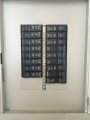
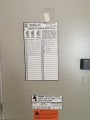
Managed to get two photos of the breaker box. One of the breakers, the other of the labeling. It’s in Spanish, but for those who don’t know Spanish, the two lowest entries on the right are the two that I think are of interest to me. They read ‘toma cocina’ and ‘toma secadora’, which translates to outlet kitchen and outlet dryer.

As they are both signaled with two arrows, denoting two breakers for each, I presume both these circuits are set up for 220v?

If so, that’s pretty good news. I could use the kitchen outlet for any kitchen-related 220 appliances, by getting an extension cord wired into it. As our washer dryer is actually 110v, I can use that circuit as a dedicated circuit for the studio equipment. It will involve laying new wires, but it’s not a huge house so I doubt it’ll be an issue.

If anyone could comment confirming my suspicions/hopes, that would be great!

Thank you once again.
 

Attachments

MaxHeadRoom

Joined Jul 18, 2013
30,716
You also have allowance on the panel for one more double breaker and one single.
The electrician may not want to wire an outlet into the kitchen (stove) outlet, unless you are not wiring and actual appliance at that location.
Max.
 

Thread Starter

Steve Wright

Joined Jun 28, 2019
15
Hello everyone,

long time since I posted this thread, but finally got around to doing this in my house.

Electrician came, re-ran new properly-gauged wires from the panel to three points in my house (kitchen, living room, and upstairs landing). The kitchen is on its own breaker, the living room and upstairs landing on the same circuit.

Used a special 3-prong 240V socket that you typically find over here/US, re-wired one of my old UK extension chord plugs with the new type plug, and now I can use everything I need in the house (ie coffee machine, TV, vacuum cleaner, other electrical bits from the UK) with no issues, and no re-wiring of the appliances, just the plug of the 4-gang extension chord. Works like a charm, and dare I say perfectly safe.

Electrician charged me $30 USD per outlet, so a total of $90 to get it up and running. less than $10 for the outlets and new plugs.

Admittedly this is with Ecuadorean labor costs (ie very low), but $100 to get all my stuff going is an absolute no brainer, and it works seamlessly. Very happy, thank you for all of your input.

As for the studio, I've done more research and I'm going to get a Sub-panel installed, to run both 110V/220V outlets independent of the main house, along with the lights running separately. This will minimise interference, and keep all the power for my audio gear nice and clean (hopefully).

Thanks again for the assistance. Hopefully someone else reading this can benefit.
 
Top