Facebook
 Google
 GitHub
 Linkedin
Hi all,
I have been trying to create a circuit to measure the voltage through a piezo buzzer but am struggling to understand what is going on with this system so I will describe what is happening.
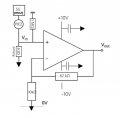
I have a 27mm DI Piezo disc that is being fed with a square wave signal, at the negative end of the piezo I have a 0.1-ohm resistor as a shunt and an op-amp (AD820) connected after the piezo and before the shunt as seen in the image below.
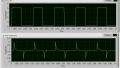
The top graph image is the signal from the signal generator and the bottom signal is from the op-amp, this is the closest I have gotten to a tangible signal from the piezo however it now looks as if the signal has been differentiated at some point. I am assuming that I should be getting a square wave out of the op-amp but am unsure as to what has happened.
Note that the op-amp is powered by a +/-10v power supply and has capacitors alongside the inputs.
Ultimately I am trying to measure the instantaneous power draw and the time average power so that I can create a few types of piezo actuators and this will be part of the selection process as we are looking for good performance and low energy needs.
I have been trying to create a circuit to measure the voltage through a piezo buzzer but am struggling to understand what is going on with this system so I will describe what is happening.
I have a 27mm DI Piezo disc that is being fed with a square wave signal, at the negative end of the piezo I have a 0.1-ohm resistor as a shunt and an op-amp (AD820) connected after the piezo and before the shunt as seen in the image below.
The top graph image is the signal from the signal generator and the bottom signal is from the op-amp, this is the closest I have gotten to a tangible signal from the piezo however it now looks as if the signal has been differentiated at some point. I am assuming that I should be getting a square wave out of the op-amp but am unsure as to what has happened.
Note that the op-amp is powered by a +/-10v power supply and has capacitors alongside the inputs.
Ultimately I am trying to measure the instantaneous power draw and the time average power so that I can create a few types of piezo actuators and this will be part of the selection process as we are looking for good performance and low energy needs.
Attachments
-
 26.9 KB Views: 17
 -
 162.7 KB Views: 19