AC equivalent of this ?!

Thread Starter

sama956

Joined May 31, 2018
10
Hello

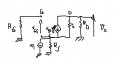
evryone please could you help me drawing AC equivalent of this configuration and simplify it , and fin Z(in) and Z(out) (input and output impedance )
 

Attachments

WBahn

Joined Mar 31, 2012
32,847
Hello

evryone please could you help me drawing AC equivalent of this configuration and simplify it , and fin Z(in) and Z(out) (input and output impedance )
"Help" you does not involve doing it for you. You need to show YOUR best attempt to work YOUR homework. That gives us a starting point from which to help YOU find a path to discovering YOUR solution to it.
 

Thread Starter

sama956

Joined May 31, 2018
10
Thank you , but it is not what i want ,

"Help" you does not involve doing it for you. You need to show YOUR best attempt to work YOUR homework. That gives us a starting point from which to help YOU find a path to discovering YOUR solution to it.
it is not a home work , i just want to do it for myself ,

i did find a difficulty and a doubt in simplifying the circuit equivalent :
 

Attachments

I don't understand. It's called "homework help" and then when someone asks for help with homework they get lambasted!?!?!

"help me drawing AC equivalent of this configuration and simplify it , and fin Z(in) and Z(out) (input and output impedance"
he is asking for help - so maybe a push in the right direction???? I need help with something like this as well, but am scared to ask!!
 

WBahn

Joined Mar 31, 2012
32,847
I don't understand. It's called "homework help" and then when someone asks for help with homework they get lambasted!?!?!

"help me drawing AC equivalent of this configuration and simplify it , and fin Z(in) and Z(out) (input and output impedance"
he is asking for help - so maybe a push in the right direction???? I need help with something like this as well, but am scared to ask!!
Asking someone to show their best attempt so that we have something to work from IS a push in the right direction.

Just posting a problem and saying "help" isn't a good enough starting point, especially when the problem isn't fully presented and we have no idea what the context of the problem is within the course. For instance, there are several different small signal models for a transistor and we have no idea which one the TS is expected to use. Are they using a low-frequency model? A high-frequency model? What topology? Are they taking output resistance into account?

But if they show us at least some attempt to work the problem, we at least get a decent hint as to which one they are using at that point in the course or in their studies. Similarly, we have no firm idea whether the capacitors in the schematic are there to define a "flat" pass band or whether they form filters that are active within the pass band. See how they handle them in their attempt at least gives us a clue.

You can see right here the effect of not having enough information. Danadak had nothing to go on but offered some links anyway based on his best guess of what would be helpful and the response was "that is not what I want." Well, we are not mind readers. We can't tell what is wanted or needed unless we can get the TS to provide enough information for us to go on. The best and surest way to get that going is to post a best attempt, even if it is completely wrong and just a start.
 

WBahn

Joined Mar 31, 2012
32,847
Thank you , but it is not what i want ,


it is not a home work , i just want to do it for myself ,

i did find a difficulty and a doubt in simplifying the circuit equivalent :
Your initial transformation looks fine, provided you are justified in using the low-frequency small-signal model and are operating at frequencies in which it can be safely assumed that the capacitors can be treated as shorts.

Now, try to analyze the circuit as best you can. Remember, it's just a circuit that happens to have a dependent current source in it. Pick one thing -- input impedance, output impedance, or gain -- and try to apply the definition of what that thing is in general to determine what it is for this circuit.
 
Understood, Eagle Keeper! Thanks - have a good one.


Asking someone to show their best attempt so that we have something to work from IS a push in the right direction.

Just posting a problem and saying "help" isn't a good enough starting point, especially when the problem isn't fully presented and we have no idea what the context of the problem is within the course. For instance, there are several different small signal models for a transistor and we have no idea which one the TS is expected to use. Are they using a low-frequency model? A high-frequency model? What topology? Are they taking output resistance into account?

But if they show us at least some attempt to work the problem, we at least get a decent hint as to which one they are using at that point in the course or in their studies. Similarly, we have no firm idea whether the capacitors in the schematic are there to define a "flat" pass band or whether they form filters that are active within the pass band. See how they handle them in their attempt at least gives us a clue.

You can see right here the effect of not having enough information. Danadak had nothing to go on but offered some links anyway based on his best guess of what would be helpful and the response was "that is not what I want." Well, we are not mind readers. We can't tell what is wanted or needed unless we can get the TS to provide enough information for us to go on. The best and surest way to get that going is to post a best attempt, even if it is completely wrong and just a start.
 

Thread Starter

sama956

Joined May 31, 2018
10
I don't understand. It's called "homework help" and then when someone asks for help with homework they get lambasted!?!?!

"help me drawing AC equivalent of this configuration and simplify it , and fin Z(in) and Z(out) (input and output impedance"
he is asking for help - so maybe a push in the right direction???? I need help with something like this as well, but am scared to ask!!
Thank you !

Your initial transformation looks fine, provided you are justified in using the low-frequency small-signal model and are operating at frequencies in which it can be safely assumed that the capacitors can be treated as shorts.

Now, try to analyze the circuit as best you can. Remember, it's just a circuit that happens to have a dependent current source in it. Pick one thing -- input impedance, output impedance, or gain -- and try to apply the definition of what that thing is in general to determine what it is for this circuit.
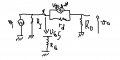
is this correct?
 

Attachments

WBahn

Joined Mar 31, 2012
32,847
Thank you !


is this correct?
I'm assuming you are asking if this circuit matches your prior circuit. The best way do so that is to make the netlist for both and compare them, even if it is just mentally. Is each node connected to the same ends of the same set of components?

Now, consider that resistor Rg. IF you are justified in using the low-frequency model, then can any current flow in Rg? If not, then what is the voltage across it forced to be? Does that permit further simplification?
 
Top