About gravity, explanations

Thread Starter

Motanache

Joined Mar 2, 2015
652
There are many theories about gravity.
And yet gravity is the force in nature that we know the least about.

Is there any connection between the gravitational force and the electrostatic attraction?
Newton wrote the law of universal attraction, i.e. gravitational attraction by copying Coulomb's law of attraction between two electric charges.
If the formula is similar, they would have something in common, I think.

Einstein tells us in TRG that space curves near bodies with a large mass.
This is why we have gravitational lenses because light bends.
But the photon has a mass. To be a simple gravitational interaction between a photon with mass and a star?
No, because all colors are curved the same way.
And yet there is a red shift.

We can explain anything by any model. But is it useful?
Is there technological transfer?
Are there ideas that are applied in engineering useful for people who derive from these theories?

A few years ago they announced the discovery of the Higgs boson
Through a Nobel Prize article with about 2000 authors.
This would explain why bodies have mass.

But where is the expected technological revolution?
What was applied in engineering and industry?


Some have revived the theory of the ether


I recently read about a particle that has mass only in one direction?


What happened to Galileo Galilei when he stated that the Earth is round?
So if they laugh at this discussion, it will be too small a price.

i want a a brainstorming.
I am waiting for any idea even if it seems inadequate but honest.
I don't want personal attacks.
 

WBahn

Joined Mar 31, 2012
32,702
There are many theories about gravity.
And yet gravity is the force in nature that we know the least about.

Is there any connection between the gravitational force and the electrostatic attraction?
Newton wrote the law of universal attraction, i.e. gravitational attraction by copying Coulomb's law of attraction between two electric charges.
It's rather hard to take you seriously when you start off with such a glaring factual blunder.

How is it that Isaac Newton copied anything from someone that was born a decade after he (Newton) died?

If the formula is similar, they would have something in common, I think.
Based on what -- that the formulas that describe them have similar form?

Well, let's follow that line of "logic" and see where it leads.

F=ma (force is proportional to acceleration with the proportionality constant being the mass)

V=IR (voltage is proportional to current with the proportionality constant being the resistance)

P=RT (pay is proportional to time with the proportionality constant being the hourly pay rate)

d=st (distance is proportional to time with the proportionality constant being the speed)

Gee, the formulas are all similar. They must all have something in common.
 

Ya’akov

Joined Jan 27, 2019
10,226
There are many theories about gravity.
And yet gravity is the force in nature that we know the least about.
Could you list some of the ”many theories” and why they need consideration?

While there is no unification of gravity with other forces it doesn’t mean we don’t “know about“ it. The difficulty is not with gravity but with how gravity is connected to the rest of the known forces.

Einstein tells us in TRG that space curves near bodies with a large mass.
Actually, Einstein tells us that any mass has a gravitational effect. It doesn’t have to be large.

But the photon has a mass. To be a simple gravitational interaction between a photon with mass and a star?
No, because all colors are curved the same way.
Are you saying that photons of different colors have different masses? Does that mean that if I observe a photon which is moving towards me, and therefore appears to be blue it has a different mass after it passes by and looks red?

But where is the expected technological revolution?
You may be the only person who expected a technological revolution based on the discovery of the Higgs Boson. The question is, why? Why would you expect that?

What happened to Galileo Galilei when he stated that the Earth is round?
So if they laugh at this discussion, it will be too small a price.
“Like Galileo, I am just a misunderstood genius trying to point out the truth. If you laugh at me, not okay does that prove I am right but I will be a martyr for the sake of humanity.”

Do you understand what you sound like?

It is very easy to “point out the obvious” when you haven’t got enough information to understand what is really going on. Your assertions suggest you need to spend a lot more time learning the scientific consensus before you entertain “alternative” theories.

Do you really believe that all of the highly intelligent researchers in these areas somehow missed something that is obvious to you—someone who doesn’t even understand the problem?

This is not a personal attack. In fact, if I didn’t want to try to help you I wouldn’t have bothered to reply at all. You need to take a step back and look at things. You are setting yourself up to live in a fantasy world where you can see things that others, who actually know the problems needing solutions, somehow can’t see.

Very occasionally, ignorance of the details in one area, combined with deep understanding of another, can lead to important insights. But, it requires that deep understanding of some analogous or related area for such things to happen. Do you have that?

And for the record, Galileo‘s stand was for a heliocentric model, not a “round earth”. That the earth is roughly spherical was known and measured long, long before Galileo‘s observations convinced him the earth orbited the sun and not the other way around.
 

Thread Starter

Motanache

Joined Mar 2, 2015
652
“Like Galileo, I am just a misunderstood genius trying to point out the truth. If you laugh at me, not okay does that prove I am right but I will be a martyr for the sake of humanity.”

Do you understand what you sound like?

It is very easy to “point out the obvious” when you haven’t got enough information to understand what is really going on. Your assertions suggest you need to spend a lot more time learning the scientific consensus before you entertain “alternative” theories.
Unfortunately, the discussion is diverted in the following direction:
I would be a fool who thinks he's smart. And many will look for ways to explain to me that I have shortcomings and I have to go back to learn.
At the expense of the problem raised in the topic, they will pay attention to my shortcomings.


"Do you really believe that all of the highly intelligent researchers in these areas somehow missed something that is obvious to you—someone who doesn’t even understand the problem?"
This is again putting the group against me because I would think that others are stupid and I would be smarter than them.

In this context, it is worth continuing the discussion?

But the discussion can remain as an example,
How do people with above average IQ like those in this forum,

They can be turned against someone like me who respects and appreciates them.
 

BobTPH

Joined Jun 5, 2013
11,463
Unfortunately, the discussion is diverted in the following direction:
I would be a fool who thinks he's smart. And many will look for ways to explain to me that I have shortcomings and I have to go back to learn.
At the expense of the problem raised in the topic, they will pay attention to my shortcomings.


"Do you really believe that all of the highly intelligent researchers in these areas somehow missed something that is obvious to you—someone who doesn’t even understand the problem?"
This is again putting the group against me because I would think that others are stupid and I would be smarter than them.

In this context, it is worth continuing the discussion?

But the discussion can remain as an example,
How do people with above average IQ like those in this forum,

They can be turned against someone like me who respects and appreciates them.
I don’t think it has anything to do with IQ. Brilliant people have stupid (actually ignorant is the better word here) ideas. The difference is in the ability to filter them out, first, by thinking about them a bit more, and second by researching them a bit more.

I invent multiple “new” things every day. Then I question why they do not exist. Usually, that will expose a fatal flaw. If it doesn’t I will search for them on the web. Usually I find one of two things, either it does exist, or others have tried and failed to produce it. If I find nothing, then that means the idea may actually be new and therefore needs more scrutiny. You get the idea. Looking stupid often comes from expressing ideas before they have been properly vetted.

I admit to having fallen into this trap here in the forum.
 

nsaspook

Joined Aug 27, 2009
16,249
Unfortunately, the discussion is diverted in the following direction:
I would be a fool who thinks he's smart. And many will look for ways to explain to me that I have shortcomings and I have to go back to learn.
At the expense of the problem raised in the topic, they will pay attention to my shortcomings.


"Do you really believe that all of the highly intelligent researchers in these areas somehow missed something that is obvious to you—someone who doesn’t even understand the problem?"
This is again putting the group against me because I would think that others are stupid and I would be smarter than them.

In this context, it is worth continuing the discussion?

But the discussion can remain as an example,
How do people with above average IQ like those in this forum,

They can be turned against someone like me who respects and appreciates them.
You asked in another post about what you need to do. Stop saying and thinking people here have some personal vendetta against you. If you keep doing this, it likely will eventually be true.
 

crutschow

Joined Mar 14, 2008
38,316
But the photon has a mass.
No.
The photon has momentum, but not mass.
As I assume you know, anything with mass cannot travel at the speed of light.

The photon momentum is proportional the mass equivalent of the photon's energy, thus shorter wavelength photons have higher momentum.
When a photon is absorbed by a mass, its energy generates a momentum increase to the mass, and the mass value is increased by the absorbed energy.
So basically a photon is mass converted to pure energy.

Edit: Another interesting observation is that, if a photon bounces off a mirror, it can transfer some of its momentum to the mirror, which reduces the photon's energy slightly, resulting in a redshift of the photons frequency.
 
Last edited:

Thread Starter

Motanache

Joined Mar 2, 2015
652
The photon momentum is proportional the mass equivalent of the photon's energy, thus shorter wavelength photons have higher momentum.
1738947100960.png

I specify that I am asking as a hobbyist, not as a professional.
Many times I have calculated the mass of the photon, but I have not asked myself the question very seriously what it actually represents

How about light pressure? Can a strong beam of light spin a <windmill>?
.

How is it possible that being hit with a ray of light creates something similar to a mechanical impact with a force, very small indeed,
 

Thread Starter

Motanache

Joined Mar 2, 2015
652
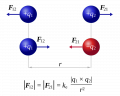
I was referring to the similarity between the Coulomb force formula between two electric charges 1785
1738948173842.png

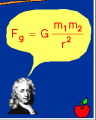
And the law of universal attraction Newton 1789
1738948469130.png

G is a constant in the formula, if it were written K instead of G, the similarity between the formulas would be even more visible.

To be a simple similarity between the formulas? Or does the formula tell us that gravity has something in common with electrostatics?
 

WBahn

Joined Mar 31, 2012
32,702
I was referring to the similarity between the Coulomb force formula between two electric charges 1785
View attachment 342123

And the law of universal attraction Newton 1789
View attachment 342124

G is a constant in the formula, if it were written K instead of G, the similarity between the formulas would be even more visible.

To be a simple similarity between the formulas? Or does the formula tell us that gravity has something in common with electrostatics?
Do at least a few minutes of research. Newton DIED in 1727. He published his laws of motion and universal gravitation in the Principia in 1687.
 

crutschow

Joined Mar 14, 2008
38,316
Many times I have calculated the mass of the photon, but I have not asked myself the question very seriously what it actually represents
That's not the actual mass, but the mass equivalent of the energy.
Since the photon is pure energy, it has no actual mass.
 

nsaspook

Joined Aug 27, 2009
16,249
View attachment 342120

I specify that I am asking as a hobbyist, not as a professional.
Many times I have calculated the mass of the photon, but I have not asked myself the question very seriously what it actually represents

How about light pressure? Can a strong beam of light spin a <windmill>?
.

How is it possible that being hit with a ray of light creates something similar to a mechanical impact with a force, very small indeed,
The full form of the Einstein's Mass-Energy equivalence equation has a momentum as a variable.

When you think of Einstein’s most famous equation, you should still recognize how profound the simple statement, E = mc², actually is. It tells us that every massive particle has an inherent amount of energy inherent to it, even when it’s at rest, and that its energy can never drop below that key value: mc². If you want to create a particle like it, you require at least that much energy; if you must create that particle along with its antiparticle counterpart, you require at least double that energy. And if you destroy or annihilate any massive particle away, all of that rest mass energy, all mc² of it, will become part of the energy that all of the “daughter particles,” or particles produced in the annihilation, carry away.
But you should also recognize that E = mc² is only part of the full story: because particles not only exist at rest, but also move through the Universe. The quantity of motion that they carry with them, momentum, leads to a certain amount of energy-of-motion being associated with that particle as well. For slow-moving, massive particles, you can approximate that energy-of-motion with E = ½mv². For massless particles and ultra-relativistic massive particles, you can approximate that energy of motion with E = pc. But if you want the general case, where rest mass and momentum both are included, you need the full equation for the energy of a particle:
E = √(m²c⁴ + p²c²)

https://bigthink.com/starts-with-a-bang/einsteins-e-mc-squared-half-equation/
Why Einstein’s E = mc² is only half of the equation
Einstein’s most famous equation is E = mc², which describes the rest mass energy inherent to particles. But motion matters for energy, too.
 

Wendy

Joined Mar 24, 2008
23,797
The fact that there is a particle responsible for mass gives me hope that someday we might be able to control gravity a little bit. But hey, the math is over my head So what do I know.
 

WBahn

Joined Mar 31, 2012
32,702
My mistake, I apologize, I correct it 1687
But that's not the real mistake.

You asserted that "Newton wrote the law of universal attraction, i.e. gravitational attraction by copying Coulomb's law of attraction between two electric charges."

On what basis do you make this assertion? Just the order in which you thought they were developed? Now that you know the correct order, are you now going to assert that Coulomb copied his equation from Newton?

The mistake isn't the ordering, it is the unfounded and unsupported claim that one of them was copied from the other. The equations were developed independently of each other based on empirical observations and was preceded by the work of others. This is particularly the case with the electrostatic force where several people before Coulomb asserted that the force fell as a power of the distance, but didn't have sufficiently good data to assert that the exponent was identically two -- some, including Priestley Robison, and Cavendish, hypothesized that it was likely two, but were only able to put limits on it such as between 1.98 and 2.02, in the case of Cavendish. What Coulomb brought to the table was a new experimental approach, using a torsion balance, that allowed him to get sufficiently good data that allowed him to assert that the relationship was, in fact, inverse-square.
 

Thread Starter

Motanache

Joined Mar 2, 2015
652
But that's not the real mistake.

You asserted that "Newton wrote the law of universal attraction, i.e. gravitational attraction by copying Coulomb's law of attraction between two electric charges."

On what basis do you make this assertion? Just the order in which you thought they were developed? Now that you know the correct order, are you now going to assert that Coulomb copied his equation from Newton?
Correct.
I had this wrong information in mind for a long time since school.
That's why I was surprised by your reply and mistakenly thought it was a misunderstanding.

correct order, are you now going to assert that Coulomb copied his equation from Newton?
asserted that the force fell as a power of the distance, but didn't have sufficiently good data to assert that the exponent was identically two -- some, including Priestley Robison, and Cavendish, hypothesized that it was likely two, but were only able to put limits on it such as between 1.98 and 2.02, in the case of Cavendish. What Coulomb brought to
This was a reason that later strengthened my wrong belief.

If you place an electrified cork in the middle of an electrically charged sphere. He will not suffer any force. Symmetry of forces.
But at any point inside an electrified sphere you place an electrified body, it will not suffer a net force.
Now the symmetry of forces is broken.
The only mathematical case would be for the Coulomb force to depend on 1/r^2
This made me reinforce my wrong belief that Newton had no way of knowing that it is exactly 1/r^2

Newton's experiment, the existence of sea tides, ebb and flow, attraction, the Earth and the Moon, were far too imprecise for him to conclude that the force has exactly 1^r^2

You can approximate the size of the Moon by looking from the Earth, the Earth-Moon distance could be found, but you did not know the average density of the Moon to calculate and experimentally verify the Newton formula.
Probably the other way around, starting from the fact that Newton's formula is correct, the average density of the Moon was calculated.
Like it was related to an experiment by Franklin, but I'm not sure.

Anyway, the idea of opening this discussion
It comes from a news that appeared recently, that a particle that has mass only if it moves in a certain direction has been discovered

I hesitated to open a discussion about this, because I know it sounds crazy.
1739009641725.png


Why the discussion here?

I wish there were no interests of scientists to support an idea unjustly.
Just like a bread seller will claim that the bread he sells is the best, even if he found out in the meantime that it is not good.

I want to take the experimental data, analyze them, if they are public, what led to this conclusion,
 
Last edited:

boostbuck

Joined Oct 5, 2017
1,032
Newton's experiment, the existence of sea tides, ebb and flow, attraction, the Earth and the Moon, were far too imprecise for him to conclude that the force has exactly 1^r^2
Newton arrived at his inverse square law from an understanding of Kepler's third law describing the nature of planetary orbits.
 

BobTPH

Joined Jun 5, 2013
11,463
Newton arrived at his inverse square law from an understanding of Kepler's third law describing the nature of planetary orbits.
Exactly. The only things you need to know to derive Newtonian gravity is F=ma and planetary orbits are elliptical.

Edited to add: and the conjecture that there is an attractive force proportional to the masses.
 
Last edited:

Thread Starter

Motanache

Joined Mar 2, 2015
652
A funny video that shows that if the radius increases, the rotation speed decreases.

This is about Kepler: The planets move in elliptical orbits and in equal periods the vector radius sweeps equal areas.

I feel that it must be here, but I still haven't made the connection with 1/r^2 from the formula of universal attraction.

Edit: The explanation I found still does not prove why the power of r is fixed 2.
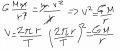
They write the force of gravitational attraction equal to the centrifugal force:
1739028483649.png

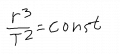
1739028697588.png
Which is in agreement with Kepler's third law.
Which in turn is based on experimental observations with large limits of error.

I tried to calculate why inside a thin metallic ring charged with charge q the electric field E is 0 at any point without using Gauss's law.
The calculation had become complicated and I abandoned it.
 
Last edited:
Top