Facebook
 Google
 GitHub
 Linkedin

Kind Friends...
In obviation of liability to failures corollary to unnecessary ‘admixture’ of EHT and semiconductors, I’ve constructed an ultra-simple, ‘bullet proof’, passive EHT indicator of a D'Arsonval movement (100uA FS), a dropping resistor and a variable shunt/calibration resistor.
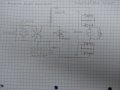
Please see file attached (immediately) below for schematic and typical application:
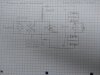
Inasmuch as it must measure a (pure DC) potential difference between two terminals having no ‘ground reference’ whatever, the unit is assembled in a case/chassis which being insulated to at least 200kV from its environs (via CPVC ‘stilts’) – such that the entire assembly is ‘floating’ --- Note: the return lead is ‘ohmically bonded' to the chassis…
The difficulty presents as ‘sticky’ and otherwise erratic and inaccurate indicator performance at EMFs much above 30kV --- Please note that, under similar conditions, said difficulty is likewise manifest in other movements and, indeed, active digital instruments (albeit, in the latter case, with different ‘symptoms’ such as ‘beeping’ ‘glitching’ erratic display, etc...)
While it is clear that said undesirable operation owes to corona effects, the best solution would appear elusive?
Although, for instance, ‘flooding’ the instrument with ionized air or intense ionizing radiation during operation improves performance (via, I can only suppose, neutralization/prevention of charge formation upon the movement’s dielectric surfaces) – such is both less than satisfactory and cumbersome. Similarly (although untried at this time) Faraday shielding of the unit via wire mesh, metalized/conductive glass, etc. might be expected to eliminate the difficulty altogether (via preclusion of coronal discharge from movement surfaces) -- but at the cost of impaired scale visibility (a significant 'handicap' considering good radiological/electrical safety practice often requires maintenance of several meters viewing distance).
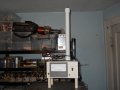
For clarification here’s an image of the prototype (Yes! I know! ‘Tis a bit ‘Science Fair’– but'cha know, it’s not exactly a precision instrument and there really are just so many hours on the clock!
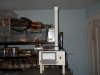
Seriously! -- I can’t ‘shake’ the feeling that I’m missing an obvious solution?
In any event, all insight, feedback and/or suggestions will be greatly appreciated!
Best regards
HP
PS – Issues I’ve already considered:
1) The return lead’s connection to the much greater surface area of the chassis sets up imbalanced loading of the PSU…
>>Conclusion: – this in not important inasmuch as all currents involved are pure DC –AND– The PSU supplies sufficient current (60Ma @100kV) to render ‘corona loading’ insignificant…
2) The return lead is insulated to only 40kV
>>Conclusion: I don’t ‘count on’ the return lead’s insulation -- during operation said lead is appropriately ‘suspended’ by PTFE supports/standoffs.
3) Perhaps the movement is defective…
>>Conclusion: – The movement operates smoothly through its entire range when ‘floating’ < 30kV above Earth ground… --- Also, as stated above, the difficulty is present with other movements and technologies…
Please feel free to challenge any of these 'conclusions' should they appear 'thin'
Again – Many advance thanks!
In obviation of liability to failures corollary to unnecessary ‘admixture’ of EHT and semiconductors, I’ve constructed an ultra-simple, ‘bullet proof’, passive EHT indicator of a D'Arsonval movement (100uA FS), a dropping resistor and a variable shunt/calibration resistor.
Please see file attached (immediately) below for schematic and typical application:
Inasmuch as it must measure a (pure DC) potential difference between two terminals having no ‘ground reference’ whatever, the unit is assembled in a case/chassis which being insulated to at least 200kV from its environs (via CPVC ‘stilts’) – such that the entire assembly is ‘floating’ --- Note: the return lead is ‘ohmically bonded' to the chassis…
The difficulty presents as ‘sticky’ and otherwise erratic and inaccurate indicator performance at EMFs much above 30kV --- Please note that, under similar conditions, said difficulty is likewise manifest in other movements and, indeed, active digital instruments (albeit, in the latter case, with different ‘symptoms’ such as ‘beeping’ ‘glitching’ erratic display, etc...)
While it is clear that said undesirable operation owes to corona effects, the best solution would appear elusive?
Although, for instance, ‘flooding’ the instrument with ionized air or intense ionizing radiation during operation improves performance (via, I can only suppose, neutralization/prevention of charge formation upon the movement’s dielectric surfaces) – such is both less than satisfactory and cumbersome. Similarly (although untried at this time) Faraday shielding of the unit via wire mesh, metalized/conductive glass, etc. might be expected to eliminate the difficulty altogether (via preclusion of coronal discharge from movement surfaces) -- but at the cost of impaired scale visibility (a significant 'handicap' considering good radiological/electrical safety practice often requires maintenance of several meters viewing distance).
For clarification here’s an image of the prototype (Yes! I know! ‘Tis a bit ‘Science Fair’
– but'cha know, it’s not exactly a precision instrument and there really are just so many hours on the clock!Seriously! -- I can’t ‘shake’ the feeling that I’m missing an obvious solution?
In any event, all insight, feedback and/or suggestions will be greatly appreciated!
Best regards
HP
PS – Issues I’ve already considered:
1) The return lead’s connection to the much greater surface area of the chassis sets up imbalanced loading of the PSU…
>>Conclusion: – this in not important inasmuch as all currents involved are pure DC –AND– The PSU supplies sufficient current (60Ma @100kV) to render ‘corona loading’ insignificant…
2) The return lead is insulated to only 40kV
>>Conclusion: I don’t ‘count on’ the return lead’s insulation -- during operation said lead is appropriately ‘suspended’ by PTFE supports/standoffs.
3) Perhaps the movement is defective…
>>Conclusion: – The movement operates smoothly through its entire range when ‘floating’ < 30kV above Earth ground… --- Also, as stated above, the difficulty is present with other movements and technologies…
Please feel free to challenge any of these 'conclusions' should they appear 'thin'
Again – Many advance thanks!
Attachments
-
 2.7 MB Views: 65
 -
 2.7 MB Views: 63
Last edited: