7400 series's

Thread Starter

74F00

Joined Oct 26, 2026
58
I made this chart from my research. It is pretty nice for comparing different 7400 series's.

SeriesRelease EraPropagation DelayStatic Power (Per Gate)Operating VoltageDescription
74Mid 1960s10ns10mW4.5 - 5.5VThe first
74HLate 1960s6ns22mW4.5 - 5.5VApparently was hot but at the time was quite fast. H stands for high-speed.
74LLate 1960s33ns1mW4.5 - 5.5VL stands for low-power. Quite obviously it is. (untill you look at CMOS)
74SEarly 1970s3ns19mW4.5 - 5.5VUses Schottky clamping. Makes it faster.
74LSMid 1970s9ns2mW4.5 - 5.5VPretty good. Was really popular and apparently still is. LS stands for low-power schottky
74FLate 1970s3.4ns4mW4.5 - 5.5VInvented by fairchild semiconductors. F is short for FAST: Fairchild Advanced Schottky TTL. Or just because its fast for other manufactures!
74ALSEarly 1980s4ns1mW4.5 - 5.5VPretty much the best it gets for TTL. ALS stands for Advanced Low-power Schottky.
74ASEarly 1980s1.7ns8mW4.5 - 5.5VThe fastest true bipolar TTL family ever made. AS is for advanced Schottky.
 

Thread Starter

74F00

Joined Oct 26, 2026
58
Thanks Dennis for the advice. I will update my table to just have 5v because all ranges have 5v, and nobody really uses those small ranges:

SeriesRelease EraPropagation DelayStatic Power (Per Gate)Operating VoltageDescription
74Mid 1960s10ns10mW~5VThe first
74HLate 1960s6ns22mW~5VApparently was hot but at the time was quite fast. H stands for high-speed.
74LLate 1960s33ns1mW~5VL stands for low-power. Quite obviously it is. (untill you look at CMOS)
74SEarly 1970s3ns19mW~5VUses Schottky clamping. Makes it faster.
74LSMid 1970s9ns2mW~5VPretty good. Was really popular and apparently still is. LS stands for low-power schottky
74FLate 1970s3.4ns4mW~5VInvented by fairchild semiconductors. F is short for FAST: Fairchild Advanced Schottky TTL. Or just because its fast for other manufactures!
74ALSEarly 1980s4ns1mW~5VPretty much the best it gets for TTL. ALS stands for Advanced Low-power Schottky.
74ASEarly 1980s1.7ns8mW~5VThe fastest true bipolar TTL family ever made. AS is for advanced Schottky.

And now for CMOS:


SeriesRelease EraPropagation DelayStatic Power (Per Gate)Operating VoltageDescription
74CMid 1970s~ 30ns-400ns~0.00001 mW3 - 15VSame origional 4000 series tech in 7400 series pinouts.
74HCEarly 1980s~ 33 – 45 ns~0.00001 mW2 - 6VHigh-Speed CMOS; matched 74LS speeds at near-zero
idle.
74HCTEarly 1980s~ 15ns~0.00001 mW~5VHigh-Speed CMOS with inputs modified to accept lower
TTL thresholds.
74ACMid 1980s~ 1 - 9.5ns~0.00001 mW2 - 6V74AC devices can occasionally generate ground bounce or ringing on fast signal transitions
74ACTMid 1980s4ns~0.00001 mW~5V74AC with TTL compatibility. Has same problems as 74AC

Again let me know if I am getting anything wrong here. The propagation delays here vary on supply voltage so I have larger ranges (surprisingly it gets faster the lower the voltage)!
 

Thread Starter

74F00

Joined Oct 26, 2026
58
74C had some parts that had no CD4xxx equivalents.
Same origional 4000 series tech in 7400 series pinouts.
I see what you mean. What I was saying by "4000 series tech", is the configurations of the types of CMOS transistors inside the 4000 series.
In TTL the different series are not just changing externally, they are also changing entire technologies internally, like changing resistor values (74 and 74L), adding transistors (74 and 74H), even entire different circuits (74 and 74S). This is to the point where if you can see what is inside any chip in a series you can know what series it is without even testing it.
With CMOS things get a little different. There are less things to tweek with. So the main difference is with the different ways to make a CMOS transistors. For example for 74HCT they use Level-Shifted Transistors to make it compatible with TTL.

In short what I meant was that the technology of the CMOS transistors themselves and the way they put them together in the 4000 series was directly put into the 74H00 series. This also means that they would have pretty much the same speks if I put them both in my chart.
 
Last edited:

MisterBill2

Joined Jan 23, 2018
28,576
Unless the higher speed is the primary motivator, my question is "why didnt most designs abandon TTL and use CMOS?? The power used was less and the operating voltage range was much larger. Was the main reason price and availability?? or what??
CERTAINLY, the CMOS data book was much more friendly than the TTL data book at that time.
(Other people's experiences may differ.)
 

Thread Starter

74F00

Joined Oct 26, 2026
58
Unless the higher speed is the primary motivator, my question is "why didnt most designs abandon TTL and use CMOS?? The power used was less and the operating voltage range was much larger. Was the main reason price and availability?? or what??
CERTAINLY, the CMOS data book was much more friendly than the TTL data book at that time.
(Other people's experiences may differ.)
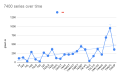
Great question. I actually was wondering the same thing when I first started looking into the area. The amazing thing about CMOS is that the lower you put the voltage, the faster you get. The 7400 series ever was the 74AUC (advanced ultra-low voltage CMOS) it has a propagation delay of only 0.8ns and static power of 0.000002mW, which in comparison the fastest TTL family ever was 74AC (advanced schottky) 1.7 ns with 8mW. The funny thing is 74AUC can't even run at 3.3V! It is for 0.8 - 2.7V! I have also finished my table so here it is for comparison.7400 series over time.png


seriesdatetcd (ns)tpd (ns)avtpd (ns)Freq (Mhz)standby power (mW)Voltage
7419667119111105V
74H19675107.5133225V
74L19683135333015V
74S1971253.528619.55V
74LS197191512831.55V
74C1975305040250.00000253-15V
74F19781.563.7526745V
74ALS1980385.518215V
74AS198214.52.7536485V
74HC19837108.51180.000012-6V
74HCT1983812101000.001254.5-5.5V
74AC19853.264.62170.002752-6V
74ACT19853.264.62170.00013754.5-5.5V
74AHCT19853.554.252350.013754.5-5.5V
74BCT19882.543.253080.54.5-5.5V
74ABT199122.52.254440.068755V
74LVC199323.62.83570.00008251.65-5.5V
74LV199364525.5390.00001652-5.5V
74LV-A19933.585.751740.02752-5.5V
74ALVC199414.42.73700.0001651.65-3.6V
74AHC19963.264.62170.02752-5.5V
74AVC19980.82.11.456900.00361.2-3.6V
74AUC20020.61.51.059520.0270.8-2.7V
74AUP20032.23.42.83570.000720.8-3.6V
If you notice any errors or inaccuracies, please feel free to point them out. Additionally, if you are aware of any 7400-series logic families that I may have overlooked, I would be more than happy to add them to the chart.

I intend to use this chart as a reference for selecting the most appropriate logic family for my various projects, so I would greatly appreciate any suggestions or additions!
 

WBahn

Joined Mar 31, 2012
33,342
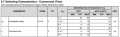
It's not that lower voltage results in faster speed, it's quite the opposite. Consider the following from the TI 74HC00 datasheet:

1793585631301.png

What you are observing is that, to get faster speeds, you need to make the devices smaller and, in particular, reduce the thickness of the gate oxide. But doing that reduces the maximum gate voltage that the device can tolerate before it punches through the gate. So it's a case of higher speeds not tolerating as high a voltage. If they could, you would still get higher speed with higher voltage (and you do still see that within the range of operating voltages that are allowable).
 

Attachments

Thread Starter

74F00

Joined Oct 26, 2026
58
What you are observing is that, to get faster speeds, you need to make the devices smaller and, in particular, reduce the thickness of the gate oxide. But doing that reduces the maximum gate voltage that the device can tolerate before it punches through the gate. So it's a case of higher speeds not tolerating as high a voltage. If they could, you would still get higher speed with higher voltage (and you do still see that within the range of operating voltages that are allowable).
Yeah sorry I got that one wrong! What I was trying to say was even though perhaps many of the 5v CMOS series that he saw where slower then some of the TTL, if you look at some of the low voltage CMOS series then you can find much faster ICs.
CERTAINLY, the CMOS data book was much more friendly than the TTL data book at that time.
Haha! Well I am lucky enough to have The TTL Data Book for Design Engineers from TI that has the 74, 74H, 74L, 74S, 74LS, and their 54 counterparts. I also have the High-speed CMOS logic Data Book by TI that goes through the 74HC and some of the 74HCT ICs. My comparison: The TTL Databook is very nice but compact which for me is not a problem. In most of the equivalent datasheets you find online you can find all of the information spread out throughout the book. To show you what it is like finding out about the 74H52 (just a random number that came to mind) I look into part 1 which is the index until I find SN54H52/SN74H52 there I can see that the electrical page is 6-39 and the pinout is at 5-17. I can go to these indexes and figure out what this is. There are 10 chapters:
1. Indexes
This has two lists one is alphanumeric where you simply find the pages for the data and the other is by function that also has the propagation delay comparison between different series with the data pages.
2. Interchangeability Guide
This has some part numbers that other companies use and shows the replacements. I am still not exactly sure what this is and I never use it. On page one it has replacements for Advanced Micro Devices components. Here they show for example that 25LS07 has a direct replacement for TI namely the SN74LS378.
3. General Information
This has all of the symbols for values and shows what they mean. For example here they show that \(I_{OH}\) means "The current into * an output with input conditions applied that according to the product specifications will establish a high level at the output." In this chapter they also have parameter measurement information.a
4. Ordering Instructions and Mechanical Data
In this chapter they explain full part numbers like SN54LS75 J -00 was their example. They also give complete measurements for all packages.
5. 54/74 Families of Compatible TTL Circuits
This gives a propagation delay VS power chart that shows that even though 74S is the fastest 74LS is the best overall. It also has all of the pinouts and short explanation for every IC.
6. 54/74 Family SSI Circuits
This gives all of the information for the logic gates and flip-flops. It does not give pinouts and is very compact but it does give transistor diagrams for every series.
7. 54/74 Family MSI/LSI Circuits
This gives the information for the more complex ICs like counters, registers, decoders, encoders, multiplexers, etc. It does include pinouts and is quite easy to read. It is also the longest chapter by quite a lot.
8. JAN MIL-M-38510
9. 38510/MACH IV
10. IC Sockets and Interconnection Panels
The last three I rarely use.
And the CMOS databook has 8 chapters.
1. General information
This is like chapters 1 and 3 of the other book together.
2. Ratings and Charecteristics
This has tables for sections of ICs that have the same stats. These tables tell voltage, and current and not much else.
3-5. are sorta the datasheets. Every datasheet includes the pinout unlike how in the other book every pinout is in chapter 5 or if it is complex also in chapter 7.
6. Explanation of Logic Symbols
Exactly as it sounds.
7. Designers Information
This gives the transistor diagrams, personally my favorite part. It starts with a not gate then a transmission gate then a NAND gate then other gates all the way to flip flops and they build off of each other so when you get to flip flops they don't have to draw all the way from transistors. They also just have some comparisons (especially with LS that must have been the big alternative at the time). They even give information on how the silicon is inside the IC. They also give interfaces like CMOS-to-ASTLL. They also give a picture of how to make a safe workbench!
8. Mechanical Data
Exactly as it sounds.

Over all the CMOS databook has a wider selection but I am happier with the TTL one because the CMOS databook does not strait up give the internal circuits of ICs and the tables make a lot of going back and forth in the book. The wider selection makes sense too the TTL book is 1976 and the CMOS book is 1984. The TTL book covers only up to 74XX670 and at that that point it skipped the entire 74XX500s. As for the CMOS book it goes cleanly up that high with many 74HC500 ICs and has many 74HC600 ICs compared to just the solo 74LS640 IC that the TTL book gave, and even goes up to the 800s (it skipped the 700s) then it goes to the 74HC4000s which are replacements for the 4000 series (something that I did not know existed). It even has 74HC7000s!
 

MisterBill2

Joined Jan 23, 2018
28,576
I am fortunate in that I have only run into a propogation delay problem once in my career. That was a long counter for a higher frequency with fast controls. THAT was when Ilearned about the "count parallel enable"mode.
 
Top