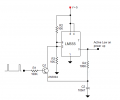
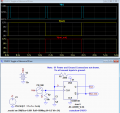
When the trigger voltage goes Low C2 is free to charge up to whatever the output voltage is on pin3 when High.
Next trigger input C2 is connected through Q1 to pin2,6 combo resetting the 555.
When the trigger voltage goes Low C2 is free to charge up to whatever the output voltage is on pin3 when High.
Next trigger input C2 is connected through Q1 to pin2,6 combo resetting the 555.
To clarify I am trying to build a 1 bit storage element (divide by 2) that will act as a am/pm indicator
I suppose it can be rising or falling edge triggered because it's fed from a decade counter (two 4017 cascaded counting 12 bits), it seems it can be at the falling edge of the 11 hour bit or at the rising edge of the 12 hour bit
I had an additional 4017 for this operation but it got ruined, one user recommended a sequential bistable multivibrator that I'm yet to try but I suspect I'll have bouncing problems like I did with the t flip flop I made from nor gates
Two decade counters can count to 100. Two Octal counters can count to 64. One Octal and one Decade can count to 80. One Octal and one DD FF can count to 16 or 32. Of course you need a clock in order to get clock pulses. But in those configurations you can pretty much divide it out fairly easily. There's a binary counter that can count to 12 easily. I believe it's a 4 bit counter.
However, you said you want one hour high and 11 hours low. How does that tell you day from night? (assuming you're trapped in a mine shaft and can't see daylight).
Two decade counters can count to 100. Two Octal counters can count to 64. One Octal and one Decade can count to 80. One Octal and one DD FF can count to 16 or 32. Of course you need a clock in order to get clock pulses. But in those configurations you can pretty much divide it out fairly easily. There's a binary counter that can count to 12 easily. I believe it's a 4 bit counter.
However, you said you want one hour high and 11 hours low. How does that tell you day from night? (assuming you're trapped in a mine shaft and can't see daylight).
Im building a RTC that will shine colours on the wall that only I'll be able to read, an am/pm is almost redundant as I'll never be confused if it's day or night
Without going thru the madness of drawing the schematic: I have a 32k crystal divided to 1hz, then I have decade counters counting to 43,200; adding an am/pm will make it 86,400 or one day
I remember those parties at university at the end of the Easter term, about 7 o'clock, and having to look which direction the sun is shining from in order to work it out.
I think you misunderstood his response question. I think he is saying that if the base is at 5 V (because that is the max voltage available in the circuit no matter what type of device is driving the base, and the emitter is at 5 V (because that is the high output voltage of a CMOS 555), then there is 0 V across the base-emitter junction and thus zero collector current. But there are other problems.
The maximum voltage available at the base is 5 V. If the 555 is the bipolar type, then when the output is high and lightly loaded it *might* reach 4 V. So it appears that there could maybe be 1 V difference to drive current into the base.
BUT ...
Are you saying that the transistor's collector will pull the 555's Threshold input above 3.33 V? If so, how?
No. The transistor acts as an analog switch. C2 will charge to appx 3.7 volts after the first trigger goes Low.
Second trigger will turn Q1 on again and pass the 3.7 volts to pin 6 which resets the 555.
Replace the transistor with a push button switch, works the same way.
Ah yes - a REAL bipolar 555! I gave them up years ago in favour of the CMOS types.
It relies on 4th quadrant operation of the transistor (base positive of emitter, collector negative of emitter)
R1 is critical as current flows through the base-collector junction which must not take threshold/trigger above 2Vcc/3, otherwise it will be stuck low for the length of the trigger pulse.
as you thinking he wants to create an output that is 1:11, while my read of his question is that he has an *input* that is 1:11, and he wants to create an output that is 12:12.

 Facebook
 Google
 GitHub
 Linkedin