555 timer oscillating circuit with PNP transistor trouble

eetech00

Joined Jun 8, 2013
4,705
I don't see anywhere in this thread where its written the type of waveform that is desired.
Square wave? triangle wave? Sawtooth? and at specifically what voltage levels?
 

Thread Starter

Badbusiness

Joined Nov 30, 2023
14
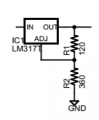
If you use LM317, you don't have to decide on a voltage before you buy. The output voltage is set by 2 resistors.
I apologize for my ignorance but let’s say I want to drop the voltage from my car battery to +5v. How would I choose the 2 resistors?
 

dl324

Joined Mar 30, 2015
18,336
I apologize for my ignorance but let’s say I want to drop the voltage from my car battery to +5v. How would I choose the 2 resistors?
These resistor values assume Vref=1.25V.
\( \large V_{OUT} = V_{REF} (1+\frac{R_2}{R_1}) = 1.25V(1+3) = 5.0V \)
EDIT: corrected typo on R2.
1702917254859.png
Capacitors and protection diode omitted for clarity. They're discussed in the datasheet.

R1 satisfies the minimum load current for the regulator to function without additional load.
 
Last edited:

eetech00

Joined Jun 8, 2013
4,705
I apologize for my ignorance but let’s say I want to drop the voltage from my car battery to +5v. How would I choose the 2 resistors?
The circuit is not drawing alot of current.
You can use zener diode, with series resistor, to keep the supply voltage level at, say, 8 or 9v.

In addition, please reply to post #22
 

Thread Starter

Badbusiness

Joined Nov 30, 2023
14
Team,

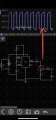
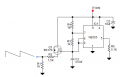
It brings me great joy to share with you the results that I was able to put together after working on this all day changing values around, etc, in order to make to something work in my parameters. I did away with the transistor because I feel it’s too advanced for my understanding haha. Thank you all for your time and help.
 

Attachments

Thread Starter

Badbusiness

Joined Nov 30, 2023
14
Team,

It brings me great joy to share with you the results that I was able to put together after working on this all day changing values around, etc, in order to make to something work in my parameters. I did away with the transistor because I feel it’s too advanced for my understanding haha. Thank you all for your time and help.
Just realized I don’t need the first 22uf capacitor closes to the power supply
 

dl324

Joined Mar 30, 2015
18,336
I did away with the transistor because I feel it’s too advanced for my understanding
The transistor was a current source charging the timing capacitor. That gives you a linear ramp on the charging cycle, but you got an exponential decay on the discharge cycle.

I don't see a triangle wave. What are you trying to drive with this signal?

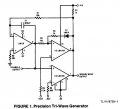
I'd've gone old school and made a square wave oscillator at your desired frequency using 2 comparators and create the triangle wave by integrating the square wave. (Actually, this circuit creates the square wave from the triangle wave.)

This circuit from National Semiconductor LB-23 lets you set the upper and lower range for the triangle wave:
NS-LB-23-triwave.jpg
Since the desired levels were close to ground, I'd substitute LM393 for the LM119 and I'd try to use LM358 instead of LM118 so you don't need a negative power supply.
 
Last edited:

eetech00

Joined Jun 8, 2013
4,705
Team,

It brings me great joy to share with you the results that I was able to put together after working on this all day changing values around, etc, in order to make to something work in my parameters. I did away with the transistor because I feel it’s too advanced for my understanding haha. Thank you all for your time and help.
Thats not a triangle wave...its a squarish wave...:D
 

Thread Starter

Badbusiness

Joined Nov 30, 2023
14
I’ll call it a trapezoid wave. I don’t think the wave form matters much but paranoia has me thinking the ECU might not like seeing only 2 alternating voltages especially 0V. It’s for a sensor that’s no longer there.
 

ericgibbs

Joined Jan 29, 2010
21,448
The power supply is a car battery so 12-15v
Hi Bb,
If the power supply is a car battery you should fit an inline fuse, rated at say 1A to 2Amp, locate it near the positive battery terminal.
E
 
Last edited:
Top