555 PWM with 741: output voltage and current

Thread Starter

darkroom

Joined Oct 30, 2014
18
I've decided to build simple noise-making circuits. I choose the 555 and 741 to make a square wave generator with independent frequency and duty cycle selection, through two pots. My output device is a small speaker, 8-ohm, rated at 0.5W.

Well, after struggling, I built a somewhat working circuit. I'm relatively proud considering my null-knowledge a few weeks ago, but I'm at the point where I need some guidance.

Here's a 555 where the C2 capacitor waveform is feed into the 741 to generate a square-wave with selectable duty cycle using the R6 pot in the divider network.

(using Multisim)
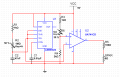
upload_2014-10-30_2-33-25.png

My first humble questions are:

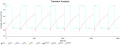
- How I can approx. generate a proper power output for my speaker? I expect the 741 voltage swing to be in the 2VDC-7VDC range for the VDC supply, but I'm getting the following output in the oscilloscope:
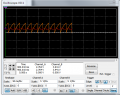
upload_2014-10-30_2-36-9.png

Capacitor waveform is OK for the 555 specs (6V which 2/3VDC) but the 741 output waveform amplitude is too weak (about 1.9 to 2.7 range).

Current is about 20mA at 741 output but I need about 65mA to supply 1/2W to the speaker. I have a few 2n2222's, but I will try that later. Now, I'm looking to fix the 741 output waveform to make it suitable for the speaker.

As a note, my circuit is powered on the breadboard by a 7809 with Input-output capacitors.

Thank you very much for your help!
 

MrChips

Joined Oct 2, 2009
34,879
The 741 op-amp does not work on a single 9V supply.

Why bother to use an op-amp when the 555 timer chip already outputs a square wave on pin-3?
 

Thread Starter

darkroom

Joined Oct 30, 2014
18
The 741 op-amp does not work on a single 9V supply.

Why bother to use an op-amp when the 555 timer chip already outputs a square wave on pin-3?
I thought that using the 741 as a comparator with the capacitor-waveform as a source, I could modify the duty cycle, independent of the frequency, which is impossible with one 555 IC.

Keep in mind that I'm new in electronics, I used the 741 just to start with wellknown op-amps. :)
 

jpanhalt

Joined Jan 18, 2008
11,087
I thought that using the 741 as a comparator with the capacitor-waveform as a source, I could modify the duty cycle, independent of the frequency, which is impossible with one 555 IC.
Here is a popular version of a 555-based PWM generator with stable frequency: http://www.dprg.org/tutorials/2005-11a/index.html
The text explains how that is achieved.

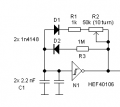
You can also do it with a single Schmitt inverter and two diodes (same concept as with the 555):
Capture.PNG
(Source: http://www.dos4ever.com/flyback/flyback.html#ind2)
Since Dekker's design is for a specific purpose, here's an application note with more general information on that type of oscillator. The Schmitt inverter version is on the last page.

http://www.fairchildsemi.com/an/AN/AN-118.pdf
John
 
Last edited:

AnalogKid

Joined Aug 1, 2013
12,158
As long as you've committed to using multiple IC's, why not two 555's (or one 556), one for freq and one for width? The output stage is stronger than any standard opamp or comparator.

ak
 

Thread Starter

darkroom

Joined Oct 30, 2014
18
As long as you've committed to using multiple IC's, why not two 555's (or one 556), one for freq and one for width? The output stage is stronger than any standard opamp or comparator.

ak
Thanks Ak. I've tried the circuit where a 555-Astable triggers a 555-monostable. The problem is that I want the duty cycle % to stay equal even when I change the square frequency. I didn't manage to achieve that with the dual astable/monostable 555 circuit.
 

Thread Starter

darkroom

Joined Oct 30, 2014
18
It's going well, I've a question about the 555 capacitor discharge voltage, or at least, what the simulator is displaying.

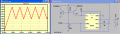
Here's the current circuit:

upload_2014-10-31_13-3-10.png

here's the sawtooth waveform from the C2//(R1+R2) network, and the LM393 output.

upload_2014-10-31_13-6-15.png

Shouldn't the C2 capacitor drop to 1/3VCC instead of 0V ?! It even lowers to negative VCC!

CircuitMarker shows that C2 drops to 1/3 before charging again ... maybe it's a problem with the 555 model in Multisim?
 

Jony130

Joined Feb 17, 2009
5,598
Circuit behave like this because you connected discharge pin directly to C2. And this is why capacitor voltage drop below 0V.
So simply you have a error in your circuit.
 

jpanhalt

Joined Jan 18, 2008
11,087
I am glad it is working for you. If you want to consider one of the 555 circuits for setting the duty cycle, you can use a voltage on pin 5 to control the frequency. The range is limited, but may suffice for your purposes. In other words, instead of using a separate comparator and Key B, you can set the threshold in the 555 itself in the same way. There are a few so-called VCO's based on the 555 and that method on the Internet.

I am not sure the duty cycle would be absolutely stable using that method, but it might be good enough. You could try it on your simulator.

John
 

Thread Starter

darkroom

Joined Oct 30, 2014
18
Also you could try this triangle generator

View attachment 74892
Thank you, I'll check it later but I started the thread with square-wave + duty-cycle independent selection problem.

Circuit behave like this because you connected discharge pin directly to C2. And this is why capacitor voltage drop below 0V.
So simply you have a error in your circuit.
When the voltage across C2 drops < 1/3VCC, the trigger should sense that low state, activate the OUT pin, and start recharging the cap until 2/3VCC, voltage level that, thanks to the THR pin, should open the discharge transistor and initiate the cycle. I'm wrong at this? Why the comparator in the 555 trigger pin in the simulator does not sense < 1/3VCC and allows the C2 to drop to zero?

Other sim offered the correct waveform.

I am glad it is working for you. If you want to consider one of the 555 circuits for setting the duty cycle, you can use a voltage on pin 5 to control the frequency. The range is limited, but may suffice for your purposes. In other words, instead of using a separate comparator and Key B, you can set the threshold in the 555 itself in the same way. There are a few so-called VCO's based on the 555 and that method on the Internet.

I am not sure the duty cycle would be absolutely stable using that method, but it might be good enough. You could try it on your simulator.

John
Thank you John, I'm looking for a frequency range of about 5 KHz, which is quite limited for the 555 frequency capabilities. For duty cycle %, I prefer the full range, if possible.

I 'll google for '555 VCOs', thank you very much.
 

cmartinez

Joined Jan 17, 2007
8,786
Thank you John, I'm looking for a frequency range of about 5 KHz, which is quite limited for the 555 frequency capabilities.
Darkroom, it is my understanding that the newer 555s can work at up to 500 Khz (and the newest at up to 5 Mhz!), and the older ones at 100 Khz, so you should be more than Ok working with a 5 Khz frequency.

Check this one from Maxim, and this one from Texas Instruments.

If you have any other brand, I suggest you check its datasheet.
 

Thread Starter

darkroom

Joined Oct 30, 2014
18
Darkroom, it is my understanding that the newer 555s can work at up to 500 Khz (and the newest at up to 5 Mhz!), and the older ones at 100 Khz, so you should be more than Ok working with a 5 Khz frequency.

Check this one from Maxim, and this one from Texas Instruments.

If you have any other brand, I suggest you check its datasheet.
Sorry cMartinez for my bad phrasing; I was trying to say I know 5KHz is well-below the maximum rated output frequencies for typical 555s.

Thank you!
 

jpanhalt

Joined Jan 18, 2008
11,087
A simple voltage divider like you have for the comparator, but attached to Pin 5 will work of the VCO. Some people add a capacitor to filter noise, but I don't think that will be necessary at all.

John
 

cmartinez

Joined Jan 17, 2007
8,786
darkroom,

It just occurred to me that maybe you could first use a triangle wave generator, and then run its output through a comparator, In the end, the comparator's output would be a square wave.

You could use a simple triangle generator, such as this one or this one, that lets you adjust the frequency. And then you could plug its output to the comparator, using a pot connected as a voltage divider as the comparator's reference. This it would let you adjust the duty cycle completely independent from the frequency, just as you wanted... There would be no need for a 555 chip in the circuit... and maybe you'll end up with something simpler.

Do I make sense, or would you like me to draw you a sketch of the circuit I'm talking about?
 
Last edited:

Thread Starter

darkroom

Joined Oct 30, 2014
18
darkroom,

It just occurred to me that maybe you could first use a triangle wave generator, and then run its output through a comparator, In the end, the comparator's output would be a square wave.

You could use a simple triangle generator, such as this one or this one, that lets you adjust the frequency. And then when you could plug its output to the comparator, using a pot connected as a voltage divider as the comparator's reference. This it would let you adjust the duty cycle completely independent from the frequency, just as you wanted... There would be no need for a 555 chip in the circuit... and maybe you'll end up with something simpler.

Do I make sense, or would you like me to draw you a sketch of the circuit I'm talking about?
Yes, it makes sense of course, thanks! This is one of my first "serious" circuits and I'm learning about the alternatives for generating waveforms. For now, I think I'm ok with the 555 and comparator circuit, but I will take your approach in mind for triangle waveforms.

I didn't know those Schmitt-trigger existed. Interesting component.
 
Top