555 output voltage/current

Thread Starter

PJB

Joined Oct 24, 2019
36
Hi,

I've been reading a high-school level electronics text book and I am unsure about the output voltage and current for a 555 IC.

I've found this on the web:

The standard TTL 555 can operate from a supply voltage between 4.5 volts and 18 volts, with its output voltage approximately 2 volts lower than its supply voltage VCC. The 555 can source or sink a maximum output current of 200mA, (but it may get hot at this level), so the circuit variations are unlimited.

Right, so If my 555 has a supply voltage of 9 Volts does this then mean that the output will be 7 Volts ? I want to attach a buzzer to the 555 output. The buzzer has (I think) a maximum current of 100 mA. Can I use Ohm's Law to calculate the resistor value I need to keep the output current below or equal to 100mA ? I have tried this simple calculation: 7 Volts / 0.1 A (or 100 mA) = 70 Ohms. So will a resistor of, say, 100 Ohms protect the buzzer ?

Thank you.
 

ericgibbs

Joined Jan 29, 2010
21,395
The buzzer has (I think) a maximum current of 100 mA. Can I use Ohm's Law to calculate the resistor value I need to keep the output current below or equal to 100mA ? I have tried this simple calculation: 7 Volts / 0.1 A (or
hi PJB

The buzzer will only draw the current it needs at its rated voltage.
What voltage is the buzzer designed for.?
E
 

Thread Starter

PJB

Joined Oct 24, 2019
36
hi PJB

The buzzer will only draw the current it needs at its rated voltage.
What voltage is the buzzer designed for.?
E
I think I misinterpreted some of the values. I want Vcc to be 9 Volts and according to the datasheet the maximum current for the buzzer at this voltage is 70mA, not 100mA which I originally thought.
 

Ian0

Joined Aug 7, 2020
13,097
I think I misinterpreted some of the values. I want Vcc to be 9 Volts and according to the datasheet the maximum current for the buzzer at this voltage is 70mA, not 100mA which I originally thought.
In which case there isn’t a problem. The buzzer gets 7V, it takes 70mA. That‘s nowhere near the maximum of 200mA. No resistor required.
 

Thread Starter

PJB

Joined Oct 24, 2019
36
In which case there isn’t a problem. The buzzer gets 7V, it takes 70mA. That‘s nowhere near the maximum of 200mA. No resistor required.
HI Ian0

I'm a little confused here. I thought that if the output current from the 555 (pin 3) is 200mA this would be way too much for the buzzer, because the buzzer current maximum is around 70mA. Can you elaborate a little please ?

PJ
 

ericgibbs

Joined Jan 29, 2010
21,395
hi PJB.
I repeat. ;)
The buzzer will only draw the current it needs at its rated voltage.
Like your mains power points at home, you can plug in 100watt lamp or a 2kW kettle.
E
 

BobaMosfet

Joined Jul 1, 2009
2,211
Hi,

I've been reading a high-school level electronics text book and I am unsure about the output voltage and current for a 555 IC.

I've found this on the web:

The standard TTL 555 can operate from a supply voltage between 4.5 volts and 18 volts, with its output voltage approximately 2 volts lower than its supply voltage VCC. The 555 can source or sink a maximum output current of 200mA, (but it may get hot at this level), so the circuit variations are unlimited.

Right, so If my 555 has a supply voltage of 9 Volts does this then mean that the output will be 7 Volts ? I want to attach a buzzer to the 555 output. The buzzer has (I think) a maximum current of 100 mA. Can I use Ohm's Law to calculate the resistor value I need to keep the output current below or equal to 100mA ? I have tried this simple calculation: 7 Volts / 0.1 A (or 100 mA) = 70 Ohms. So will a resistor of, say, 100 Ohms protect the buzzer ?

Thank you.
@PJB _Data sheets_ are your friend!!!

and this may help:

Title: Understanding Basic Electronics, 1st Ed.
Publisher: The American Radio Relay League
ISBN: 0-87259-398-3
 

Attachments

MrSalts

Joined Apr 2, 2020
2,767
I hate this analogy but, it may work for you. If the faucet can supply 200 liters per hour (like the 555 timer output of 200mA), if you put a nozzle on the faucet that reduces flow to 70 liters per hour, no big deal, you only get 70 liters per hour and the faucet is ok with it, no damage to the faucet. Likewise, think of the buzzer as a restriction snd only 70mA of the available flow will come through. You can connect the buzzer to + and 555 output so current will flow when the 555 output is "low"* or connect the buzzer from 555 output to ground and the buzzer will be on while the 555 is "high".
 

MisterBill2

Joined Jan 23, 2018
27,192
HI Ian0

I'm a little confused here. I thought that if the output current from the 555 (pin 3) is 200mA this would be way too much for the buzzer, because the buzzer current maximum is around 70mA. Can you elaborate a little please ?

PJ
The maximum current that the 555 is ABLE TO SUPPLY is 200mA. The load will draw what it requires, and if that is less than 200mA then no damage occurs. That is a MAX rating, if you read all of the fine print.
 

crutschow

Joined Mar 14, 2008
38,326
The current the buzzer will draw is determined by the applied voltage divided by its impedance (Ohm's law) so it will take current based upon that, not how much the 555 can deliver.
The 555's 200mA output rating is the maximum it can deliver, not how much it will deliver no matter what the load.
 

Thread Starter

PJB

Joined Oct 24, 2019
36
@PJB _Data sheets_ are your friend!!!

and this may help:

Title: Understanding Basic Electronics, 1st Ed.
Publisher: The American Radio Relay League
ISBN: 0-87259-398-3
Hi Bobamosfet,

I think I've found the answer to my question in the datasheet link you gave.

Many thanks

PJ.
I hate this analogy but, it may work for you. If the faucet can supply 200 liters per hour (like the 555 timer output of 200mA), if you put a nozzle on the faucet that reduces flow to 70 liters per hour, no big deal, you only get 70 liters per hour and the faucet is ok with it, no damage to the faucet. Likewise, think of the buzzer as a restriction snd only 70mA of the available flow will come through. You can connect the buzzer to + and 555 output so current will flow when the 555 output is "low"* or connect the buzzer from 555 output to ground and the buzzer will be on while the 555 is "high".
HI MrSalts,

Thanks for that analogy, it does make things clearer.

If, like you say above, that I connect the buzzer to +ve and the output pin, the output pin allows current to flow into it and out to 0V. I believe this is called sinking isn't it ?

PJ.
 

Thread Starter

PJB

Joined Oct 24, 2019
36
The maximum current that the 555 is ABLE TO SUPPLY is 200mA. The load will draw what it requires, and if that is less than 200mA then no damage occurs. That is a MAX rating, if you read all of the fine print.
Things are clearer now.

Thanks Guys.
 

dl324

Joined Mar 30, 2015
18,220
I've found this on the web:

The standard TTL 555 can operate from a supply voltage between 4.5 volts and 18 volts
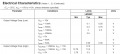
You can't trust everything you find on the internet. 18V is the absolute maximum voltage. The recommended range is 4.5-16V:
Nat Semi:
1646410217187.png
1646409996680.png
with its output voltage approximately 2 volts lower than its supply voltage VCC
Output voltage depends on the load:
1646410044677.png
Worst case is 2.25V from VCC, but most will be higher.
so If my 555 has a supply voltage of 9 Volts does this then mean that the output will be 7 Volts ?
See above.
The buzzer has (I think) a maximum current of 100 mA. Can I use Ohm's Law to calculate the resistor value I need to keep the output current below or equal to 100mA ? I have tried this simple calculation: 7 Volts / 0.1 A (or 100 mA) = 70 Ohms. So will a resistor of, say, 100 Ohms protect the buzzer ?
What is the buzzer resistance? That will determine how much current it will draw. If you operate it at it's recommended voltage range, you don't need to protect it with a resistor.
 

MrSalts

Joined Apr 2, 2020
2,767
What is the buzzer resistance? That will determine how much current it will draw. If you operate it at it's recommended voltage range, you don't need to protect it with a resistor.
Applying an ohm meter to a buzzer may read infinite resistance (or very high resistance) as the oscillator may not engage at the low current supplied by an ohm meter (depending on the operating design of the buzzer).
 
Top