4 quadrant power supply for testing a large, low voltage capacitive load

Thread Starter

RKropp

Joined Jan 5, 2017
6
Surely its "Charge from 0v to +1.5v then discharge to 0v, then charge to -1.5v then discharge to 0v, repeat..."?
This is correct. The device is being used to move ions in water across a membrane, so it behaves kind of like a poorly constructed electrolytic capacitor. We are hoping that the fabricated membrane will have diode-like behavior for conducting ions, so we need to switch the polarity to measure the difference in ionic mobility in each direction.

I like a discrete solution!
Transistors are NPN = BC847B and BCM847B or BC547B
PNP = BC857B and BCM857B or BC557B
MOSFETs are logic level 30V 60A - plenty to choose from
Meanwell make 5V 50A power supplies, or a pair of 6V lead acid batteries is a possibility.

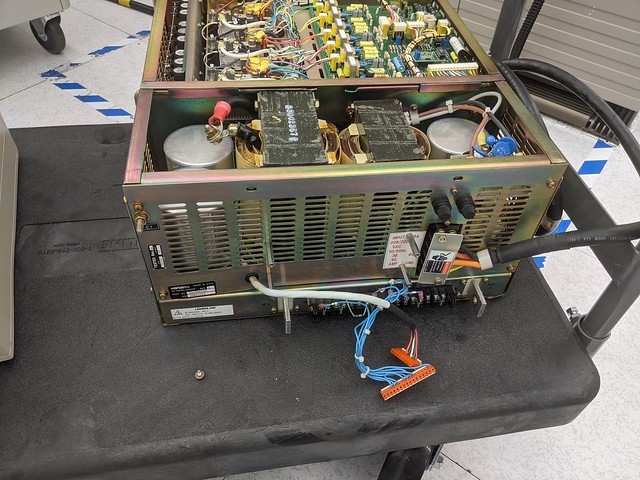
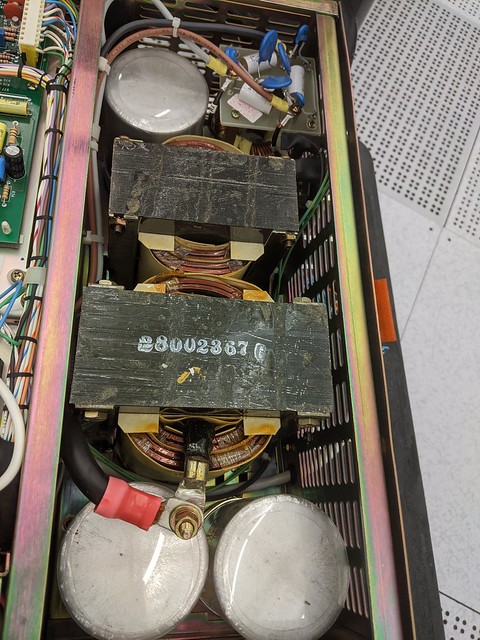
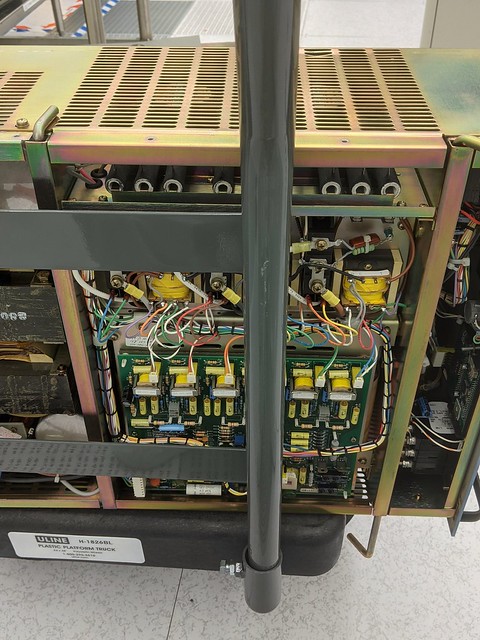
I don‘t know the length of time it has to supply full current. If it can be indefinite, it will need some serious heatsinks.
Input signal is -1.5V to make it charge positive or+1.5V to make it charge negative or discharge positive.
WOW! That was incredibly fast. I will need some time to digest this schematic, maybe take the opportunity to learn LTSpice and play around with simulating it. Thanks so much for a good starting point. I do have some budget for the project, so even if I need to use liquid cooling (water blocks and radiators for DIY computer cooling have gotten so cheap) I will look like a hero. Another member in my group suggested I take a look at Keithley for an SMU, but I don't know if they provide something that will work, and $20K+ in hardware and a new software package to learn is hard to justify.

We are seeing the high current spike for a few seconds when the uncharged capacitor is attached to a 1.2V CV supply, with the current decaying exponentially towards a non-zero current (behaves like a resistor in parallel with the capacitor). The small cell reaches ~5A, so maybe 0.2 Ω ESR (I think that is the right term) for early testing. The intent is to get enough data on small units to improve production and begin developing full size units. I don't foresee currents >10 A until we get some electrical engineering talent on board. Getting this early data should open up some additional engineering resources for a proper design.
 

Ian0

Joined Aug 7, 2020
13,158
. I will need some time to digest this schematic,
It's a circuit I've used previously - last time I used it, it was. . . . a headphone amplifier (with much smaller output devices)
So, when you've finished with it, you can turn it into a nice Class-A audio amplifier. The long-tailed-pair-and-current-mirror is the mainstay of most op-amps and discrete audio amplifiers.
I'd recommend the batteries for the power supply - they can deliver the high currents for a short time and you can recharge them with a small charger. Also, they will be an awful lot quieter, and won't spoil your data with switching noise.
 

Irving

Joined Jan 30, 2016
5,139
A bank of LiFePO4 cells would be ideal as a power source/sink; a pair of 200Ah 3.2v cells will deliver 6.4v essentially flat from 100% down to 25% charge and charge/discharge at 50A for up to 3 hours with a life of >5000 charge/recharge cycles and no thermal runaway issues.
 

Thread Starter

RKropp

Joined Jan 5, 2017
6
It's a circuit I've used previously - last time I used it, it was. . . . a headphone amplifier (with much smaller output devices)
So, when you've finished with it, you can turn it into a nice Class-A audio amplifier. The long-tailed-pair-and-current-mirror is the mainstay of most op-amps and discrete audio amplifiers.
I'd recommend the batteries for the power supply - they can deliver the high currents for a short time and you can recharge them with a small charger. Also, they will be an awful lot quieter, and won't spoil your data with switching noise.
That is a great idea. I was doing an electrochemical process that required 120V DC and typically ran at around 80 Amps but only for a an hour a day. I used a bank of deep discharge lead acid batteries and let them charge the rest of the day. Probably kept the utilities provider happy.

A bank of LiFePO4 cells would be ideal as a power source/sink; a pair of 200Ah 3.2v cells will deliver 6.4v essentially flat from 100% down to 25% charge and charge/discharge at 50A for up to 3 hours with a life of >5000 charge/recharge cycles and no thermal runaway issues.
I had forgotten about those big prismatic cells. That would be a great solution.

As an aside, I bought a LiPo jump starter that looks like an oversized phone charging battery. The manufacturer claims 2000 cranking amps! Even if the real number is half of that, and only for 1 second, I would expect almost any trace in a circuit board to turn into a fusing element.
 

Irving

Joined Jan 30, 2016
5,139
I had forgotten about those big prismatic cells. That would be a great solution.

As an aside, I bought a LiPo jump starter that looks like an oversized phone charging battery. The manufacturer claims 2000 cranking amps! Even if the real number is half of that, and only for 1 second, I would expect almost any trace in a circuit board to turn into a fusing element.
2000A is unlikely, those 200Ah prismatics will do 600A (measured) for 500mS before things start to get hot... even the M6 screw teminal gets hot at that output. The LiPo will probably do 300-400A but the number of times they can do that will be a few tens before the cell is damaged, but then again it is an emergency solution! There won't be any PCB in there, it'll be directly wired, though the cheap ones have massively undersized cabling for the task.
 

Ian0

Joined Aug 7, 2020
13,158
AS you have no weight restrictions, lead acid will perform as well on the current delivery for a much lower price. If you need thousands of charge-discharge cycles, you'll have to buy lithium
 
Top