3v Charging and Power Circuit

badbaud

Joined Mar 5, 2009
26
On that version of the Bally board a 3.6V lithium battery is used to power two RAM chips, a RTC clock chip and a LS74 chip.

If you want to save battery life with the game off simply remove JW20.

These boards were used in casino games and the games were never turned off. The battery drain is only encountered when the game is turned off.

Under normal operation a Lithium battery lasts 5 to 7 years. The more you leave the game off the less time the battery lasts.

Two AA batteries do not provide the voltage necessary to power the RAM chips as the RAM chips only retain memory down to 2.5 volts and there is a in4148 diode in series with the battery voltage so you are starting with 3V - .3V leaving you less then .3v before the RAM do not have enough voltage to keep memory.

I have seen a fresh 3.6V Lithium battery last a couple of years with the game off and much longer with JW20 removed.

There is also a newer set of mains EPROM's that allow you to clear the board without having to remove the mains and inserting clear chips.
They are called "easy clear mains" and turning on the board with DSW- 1 #8 on and holding in the pseudo coin in and test buttons clear the board.

This makes it much easier to get the game back up and running, and even easier because all of the game options are already set via DIP switches. All you lose ion a clear is your credits.
 

AnalogKid

Joined Aug 1, 2013
12,158
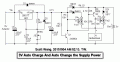
Scott - Nice circuit, but with such a low current load and total control over the source voltage, I don't see why the AC/battery switching can't be two Shottkey diodes OR-ed into the load.

ak
 

ScottWang

Joined Aug 23, 2012
7,501
Scott - Nice circuit, but with such a low current load and total control over the source voltage, I don't see why the AC/battery switching can't be two Shottkey diodes OR-ed into the load.

ak
I was tried to avoid not to drop too much voltage for the battery, when it connect to motherboard, because the mosfet can be as a switch and very less voltage drop, but I just found a problem, so maybe it is still need the Shottkey diode, you can check it what's problem I found.
 

AnalogKid

Joined Aug 1, 2013
12,158
Whether the power switching is done by two diodes, MOSFETs, or a reelay, the holdup calculation is the same. For these conditions:
Holdup time = 1 ms
Voltage sag during holdup = 0.1 V
Holdup current = 1 mA

e x c = i x t --> C = 10 uF per millisecond per milliamp

So 10 uF will hold up a one mA load current for 1 millisecond with 1/10th V voltage drop. This makes estimating real world conditions much easier. For 10 mA, C increases to 100 uF. For 10 mA and 10 milliseconds, C = 1000 uF. Etc.

Still no time to whip up a schematic, still like diode switching. If you don't have a well matched wall wart, like a 3.6 V switching type that is well regulated, then an LM317 front end makes sense.

ak
 
Last edited:

ScottWang

Joined Aug 23, 2012
7,501
Whether the power switching is done by two diodes, MOSFETs, or a reelay, the holdup calculation is the same. For these conditions:
Holdup time = 1 ms
Voltage sag during holdup = 0.1 V
Holdup current = 1 mA

e x c = i x t C = 10 uF

So 10 uF will hold up a one mA load current for 1 millisecond with 1/10th V voltage drop. This makes estimating real world conditions much easier. For 10 mA, C increases to 100 uF. For 10 mA and 10 milliseconds, C = 1000 uF. Etc.

Still no time to whip up a schematic, still like diode switching. If you don't have a well matched wall wart, like a 3.6 V switching type that is well regulated, then an LM317 front end makes sense.

ak
Using a big capacitor for the motherboard could be hold the enough time to changing the supply power from adaptor to battery, if do so then using the relay still can try, but i'm not try this yet, and we didn't know the draw current of motherboard, so it is not easy to do the calculation.
 

Thread Starter

bluline

Joined Aug 3, 2012
8

Thread Starter

bluline

Joined Aug 3, 2012
8
On that version of the Bally board a 3.6V lithium battery is used to power two RAM chips, a RTC clock chip and a LS74 chip.

If you want to save battery life with the game off simply remove JW20.

These boards were used in casino games and the games were never turned off. The battery drain is only encountered when the game is turned off.

Under normal operation a Lithium battery lasts 5 to 7 years. The more you leave the game off the less time the battery lasts.

Two AA batteries do not provide the voltage necessary to power the RAM chips as the RAM chips only retain memory down to 2.5 volts and there is a in4148 diode in series with the battery voltage so you are starting with 3V - .3V leaving you less then .3v before the RAM do not have enough voltage to keep memory.

I have seen a fresh 3.6V Lithium battery last a couple of years with the game off and much longer with JW20 removed.

There is also a newer set of mains EPROM's that allow you to clear the board without having to remove the mains and inserting clear chips.
They are called "easy clear mains" and turning on the board with DSW- 1 #8 on and holding in the pseudo coin in and test buttons clear the board.

This makes it much easier to get the game back up and running, and even easier because all of the game options are already set via DIP switches. All you lose ion a clear is your credits.

I have the new EPROMS, which save the game settings, but not some of the machine settings (wins to credits instead of wins to tray, for example). I can try to 3.6v Lithium, that is a good solution to try.

What does removing JW20 do?

Is that a mains voltage outlet or a low voltage outlet?
Mains
 

Thread Starter

bluline

Joined Aug 3, 2012
8
On that version of the Bally board a 3.6V lithium battery is used to power two RAM chips, a RTC clock chip and a LS74 chip.

If you want to save battery life with the game off simply remove JW20.

These boards were used in casino games and the games were never turned off. The battery drain is only encountered when the game is turned off.

Under normal operation a Lithium battery lasts 5 to 7 years. The more you leave the game off the less time the battery lasts.

Two AA batteries do not provide the voltage necessary to power the RAM chips as the RAM chips only retain memory down to 2.5 volts and there is a in4148 diode in series with the battery voltage so you are starting with 3V - .3V leaving you less then .3v before the RAM do not have enough voltage to keep memory.

I have seen a fresh 3.6V Lithium battery last a couple of years with the game off and much longer with JW20 removed.

There is also a newer set of mains EPROM's that allow you to clear the board without having to remove the mains and inserting clear chips.
They are called "easy clear mains" and turning on the board with DSW- 1 #8 on and holding in the pseudo coin in and test buttons clear the board.

This makes it much easier to get the game back up and running, and even easier because all of the game options are already set via DIP switches. All you lose ion a clear is your credits.
Here is a link to info on the battery usage in the Bally 6000 slot. Seems like the life can be 14 months with a 3.6v. But the better battery may be the best solution.
http://www.casinotech.com/game_mfrs/bally/tips/misc_subassemblies.html
 
Top