30mA @ 90mV ? How ?

Thread Starter

ben sorenson

Joined Feb 28, 2022
181
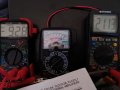
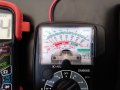
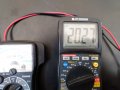
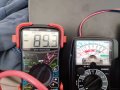
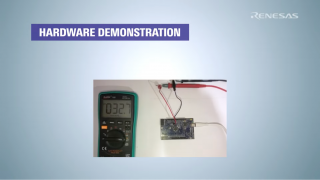
Hello, I am a complete noob to electrical circuits so I apologize in advance for any errors in my thought process. However I am building a power supply device at the moment I am not at liberty to disclose the schematic or show it. But I have performed multimeter measurements with different multimeters both digital and analog and keep coming up with the same numbers. Just a quick question if anyone can answer it. If there is .001 mA in 1Mv how am I measuring 30mA in 90Mv -- ? The measurements in the pictures are slightly lower because I have the analog and digital multimeters connected in parallel.
 

Attachments

Papabravo

Joined Feb 24, 2006
22,082
...
If there is .001 mA in 1Mv how am I measuring 30mA in 90Mv -- ?
...
The above statement is complete nonsense. Where did you come up with this quaint notion?
There are two relationships that you should concentrate on:
  1. Ohm's law. A voltage source connected to a load will have a current through that load that is proportional to the voltage. The constant of proportionality will be the reciprocal of the resistance.
  2. The instantaneous power consumption of a load will be the product of the voltage across it times the current through it.
What you are building does not sound like much of a power supply.
 

MrChips

Joined Oct 2, 2009
34,809
Be careful with your units. If you were measuring 90MV you would not be alive today to post this.
M = 1,000,000
m = 0.001

9 orders of magnitude different.

There could be a number of things wrong which we cannot see from your photographs.

Do you know how to apply Ohm's Law?
I = V / R

Do you know how to measure current with your meter?
Do you know the internal resistance of your meter in voltage mode as well as current mode and the effects they have on measurements?
 

boostbuck

Joined Oct 5, 2017
1,043
As well as an understanding of Ohm's law, I would recommend better test equipment if you wish to accurately prototype in the mV and mA range.

Without seeing the schematic of your device, there is no reason to suppose any non-linearities you measure between voltage and current are in any way unusual.
 

Ya’akov

Joined Jan 27, 2019
10,235
i find it hard to understand how you classify yourself as a "complete noob" yet you are building a critical circuit for a project so secret you can't even reveal what it is to get help.

I promise you this is a bad path. No one cares about your secret circuit and if you don't explain what you are doing it is like giving advice to yourself since you are only telling us what you, a "complete noob" thinks is relevant.
 

MrChips

Joined Oct 2, 2009
34,809
Many of us have been on this planet much longer than you have.
If you want us to help you, you will have to post a circuit diagram.
There is nothing secretive about a power supply or any energy harvesting scheme.

Post a circuit diagram and we can tell you in an instant what you are doing wrong.
 

DickCappels

Joined Aug 21, 2008
10,661
Milliamperes do not covert directly to millivolts.

Amps are a linear function of how many electron pass a point in the circuit per second.

Volts are the “pressure” to push the electrons through a circuit.

Resistance is what you might think: that’s how difficult it is for the voltage to push electrons through a circuit.

The higher the voltage (the harder voltage pushes) through the resistance, the more electrons per second (the more amps) you get.

voltage: E
resistance: R
amps: I

The relationship is Ohm’s Law:
I = E/R

edit: On this site: https://www.allaboutcircuits.com/textbook/direct-current/chpt-2/voltage-current-resistance-relate/
 

Ya’akov

Joined Jan 27, 2019
10,235
Milliamperes do not covert directly to millivolts.

Amps are a linear function of how many electron pass a point in the circuit per second.

Volts are the “pressure” to push the electrons through a circuit.

Resistance is what you might think: that’s how difficult it is for the voltage to push electrons through a circuit.

The higher the voltage (the harder voltage pushes) through the resistance, the more electrons per second (the more amps) you get.

voltage: E
resistance: R
amps: I

The relationship is Ohm’s Law:
I = E/R

edit: On this site: https://www.allaboutcircuits.com/textbook/direct-current/chpt-2/voltage-current-resistance-relate/
It struck me the TS might have been confusing measuring voltage drop over a 1Ω resistor with some sort of equivalence between the units. It is pretty common to use a 1Ω shunt to have a scope read 1:1 mV to mA for current measurements.

Maybe he read, heard, or saw something about that.
 
Top