208VAC and 277VAC ...

Thread Starter

Externet

Joined Nov 29, 2005
2,678
Hi.
1.- Are these "nominal" voltages ± something ?
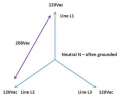
2.- Are these 'split phase' 'center tap' as the typical domestic U.S. 240VAC, or three phase Δ, ϒ, or simple single phase ?
3.- Why do these voltages exist ? What do they power that plain 240VAC cannot fullfill ?
4.- Any residential use for them ?
5.- Do these exist in Europe ?
 

Ian0

Joined Aug 7, 2020
13,291
208V is the phase-to-phase voltage which gives 120V phase to neutral, and it's not used in Europe.
They can power three phase motors, which 240V AC can't.
Residential use? Heat pumps perhaps.
 

panic mode

Joined Oct 10, 2011
5,306
Europe and most of the world has power standardized such that 1P voltage is about 220V and 3P is 400V. (you may see close values such as 380V etc.)

in Americas things are a bit more complicated. single phase is 120V (aka 110V or 115V), there is also split phase (2x120V) which also can be obtained from 3P mains of 208V.
then there is 3P 240V, as well as 480V. in Canada there is 600V (aka 575V). parts of Brazil also have 3P 440V. in Peru 1P can be 120 or 230 depending on where you are.

common tolerances are +/-10% of nominal

and if you travel, you may want to check what voltage and styles of plugs/outlets are used.

https://www.worldstandards.eu/electricity/plugs-and-sockets/
 
Last edited:

schmitt trigger

Joined Jul 12, 2010
2,261
And Japan has a household voltage of only 100 volts. For large domestic loads they have 200 volts split phase.
And at 60 Hz if you’re in Osaka and the Southwest, 50 Hz if you’re in Tokyo or the East.
 
Summary of global power systems from the safety standards point of view.
What you design for in terms of spacings, fuse voltages etc. with them rounded off to simple values.

Most confusing to me, common in North America is "high leg delta" used in commercial/office buildings.
Check that you aren't dealing with that.

IEC61010-1 mains voltages.jpg
 

crutschow

Joined Mar 14, 2008
38,860
It's unfortunate that the US doesn't typically supply 208/120 3-phase to residential homes.
It would reduce the energy cost to run things like AC units, heat pumps, etc., and reduce the amount of copper wiring required for a given power use.
Generally 3-phase motors are cheaper (no capacitor start required), quieter, smoother, and more efficient than the equivalent single-phase motor.
 

MisterBill2

Joined Jan 23, 2018
28,423
208V is the phase-to-phase voltage which gives 120V phase to neutral, and it's not used in Europe.
They can power three phase motors, which 240V AC can't.
Residential use? Heat pumps perhaps.
I have powered quite a few "240 volt" motors with 220 VAC, or sometimes 277 VAC or ??? VAC.
The different voltages are found being related to different measuring conventions, along with other interesting things. When I measure 208 volts between phases I find 120 volts between each phase and neutral (common) which may, or not, be close to "ground."
And caution because that "277" volts is relative to common while being 480 volts from the adjacent phases.

Some newer residential areas DO have 3 phase power, and that is fine. But AC power distribution history started prior to 3-phase and once the first power system was built it is difficult and expensive to change.
Besides that, three phase power would confuse a whole lot of folks a whole lot.
 

crutschow

Joined Mar 14, 2008
38,860
But AC power distribution history started prior to 3-phase
Prior?
In 1891 a 3-phase system sent 175kW of power over 175km of line in Germany.
And according to Google AI:
The Mill Creek No. 1 Hydroelectric Plant near Redlands, California, built in 1893 by Almarian Decker, is widely considered the first commercial three-phase AC power system in the United States.
three phase power would confuse a whole lot of folks a whole lot.
In what way?
 

Jon Chandler

Joined Jun 12, 2008
1,649
I used to live in an apartment that had 3 phase power – the downside of this was instead of 220 – 240 volts, my line-line voltage was ~208 VAC....

Not much of a problem, except in the winter. The crappy undersized Cadet heaters couldn't keep up in cold weather.
 

MaxHeadRoom

Joined Jul 18, 2013
30,850
It's unfortunate that the US doesn't typically supply 208/120 3-phase to residential homes.
It would reduce the energy cost to run things like AC units, heat pumps, etc., and reduce the amount of copper wiring required for a given power use.
Generally 3-phase motors are cheaper (no capacitor start required), quieter, smoother, and more efficient than the equivalent single-phase motor.
When I lived in UK, Homes were fed 1ph by a N and 1ph from a 3ph transformer.
In the 60's, home heating storage heaters came on the scene, the local power co, required that they all be fed with the three phase available from the local transformer.;
 

MisterBill2

Joined Jan 23, 2018
28,423
The reason that we don't have 3-phase home power here is that it adds another wire (connection) to the drop line from the pole to the home, making more expense for the builder. Besides that, at the start of major electification, the major home power loads were electric lights. Then eventually, fans and radios, and a few electric heaters.
IN ADDITION, more transformers on the poles. (some folks will challenge that)
 

Ian0

Joined Aug 7, 2020
13,291
When I lived in UK, Homes were fed 1ph by a N and 1ph from a 3ph transformer.
In the 60's, home heating storage heaters came on the scene, the local power co, required that they all be fed with the three phase available from the local transformer.;
Unfortunately, that aspiration never happened, and homes with storage heaters still had single phase supplies (And insufficient or underperforming storage heaters) More’s the pity as 3-phase supplies would be really useful now that heat pumps are getting popular.
 

crutschow

Joined Mar 14, 2008
38,860
The reason that we don't have 3-phase home power here is that it adds another wire (connection) to the drop line from the pole to the home, making more expense for the builder.
Doesn't seem that running 3 lines rather than 2 would make a significant difference in the cost of the home.
more transformers on the poles.
Why?
It now just a 3-phase transformer instead of a signal-phase transformer.
And it likely could be a smaller transformer for a given power rating.
 

Reloadron

Joined Jan 15, 2015
7,960
Why do these voltages exist ? What do they power that plain 240VAC cannot fullfill ?
The plant I retired from we used 480 Volt Delta and Wye. We used 277 VAC for all of the overhead lighting with the 277 from 3 phase Wye as shown above. That being one example which is common in industrial facilities.

Ron
 

WBahn

Joined Mar 31, 2012
33,260
Doesn't seem that running 3 lines rather than 2 would make a significant difference in the cost of the home.
Why?
It now just a 3-phase transformer instead of a signal-phase transformer.
And it likely could be a smaller transformer for a given power rating.
It isn't the cost of the home itself that is the economic factor, it's the cost of distribution.

A fairly typical suburban distribution station might step down from the HV lines to 12.47 V grounded-Y (7.2 kV phase-gnd) and send that down a main road to serve several hundred homes. Then, down each street, it will send one of the phases, alternative among streets. Along the street there will be single-phase center-tapped transformers to provide 220 VAC split-phase to a group of a half-dozen or dozen or so homes. Distributing 3-phase to every home would thus represent a significant additional cost to the utility, which would have to be born by all of those homeowners for service that the overwhelming majority of them do not need and would not benefit from.

And three-phase transformers are considerable more expensive than comparable single-phase transformers. A single-phase 25 kVA transformer might run $2k, while a 75 kVA three-phase transformer is probably going to run about $15k, or 2.5x the cost per kVA. The cost difference is enough that unless there are actual three-phase loads being connected, such as for commercial buildings or agricultural applications, utilities generally use three single-phase transformers on the same pole to act collectively as a three-phase transformer bank.
 

MisterBill2

Joined Jan 23, 2018
28,423
The plant I retired from we used 480 Volt Delta and Wye. We used 277 VAC for all of the overhead lighting with the 277 from 3 phase Wye as shown above. That being one example which is common in industrial facilities.

Ron
The reason for the higher voltages, and three-phase power, will be clear when you do the math for a 20 HP or a 50 HP electic motor. Use a textbook for the examples, not an online fraudster site.
A revelation: not everything you read on the internet is correct!! In addition, some stuff is totally false.
 

MaxHeadRoom

Joined Jul 18, 2013
30,850
Unfortunately, that aspiration never happened, and homes with storage heaters still had single phase supplies (And insufficient or underperforming storage heaters) More’s the pity as 3-phase supplies would be really useful now that heat pumps are getting popular.
Actually I installed a set in one home of my buddies, the local power informed me to wire up in 3phase, they brought the 3ph supply in and fitted a timer for night operation only.
 

MisterBill2

Joined Jan 23, 2018
28,423
I am not sure how close to me the three phase power comes. The problem is that the cost for the connection gets shared by those connected, and if that were only me, it would be quite a lot.
My complaing about 277/480 3-phase is that a 277 shock HURTS A LOT MORE than a 120 volt shock. I quickly learned many years ago to always avoid being well grounded when doing any live wire work. Most shocks are between a hot wire and ground, so avoiding ground helps. All shock-contacts can be fatal, so not being grounded is not assured safety, but it doubles the odds of survival.
 
Top