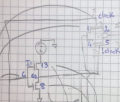
Your schematic is confusing. For TG2, are you using MOSFETs from the same package? Or two different packages? When I made my comments, I couldn't determine which IC's they were coming from and assumed they were from the same package because there were no IC designators.
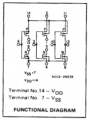
Your text said you need can use 2 CD4007, but you list 3 on your schematic.
I can see how you could make a D flip flop using 2 CD4007, but it won't be edge triggered.
I was confused by your I1, I2, and I3 designations. We sometimes use IC1, IC2, etc as IC designators and I thought you were referring to 3 different chips.
In examining how you have the two devices connected in TG2, the P and N devices must be in separate packages. Is this correct?
You should be able to use N1, P1, N2, and P2 from the same package to make the two transmission gates. Use the inverter formed by N3/P3 for clock/clock#. And make two inverters from the second CD4007.
No need to be sorry. The hardest part is figuring out how to connect the transistors to make the transmission gates and inverters. Wiring should be the easiest part.
To save me the trouble of tracing your breadboard connections, could you list the connections you've made?
Use this format:
IC1(2,8,13),IC2(5) -> this forms one side (right) of TG2 and the connection to the output of an inverter N1/P1 from IC1
IC1(1,5,10),IC2(2,4) - other side of TG2 connected to TG1 and input of inverter
Hopefully I didn't make any mistakes tracing your schematic...
Since the gates of the N2/P2 MOSFETs in the same IC are connected, you need to use N2 from one IC and P2 from the other to make a transmission gate. The other transmission gate will use the remaining N2/P2.
I'm reluctant to show you how to do this because your instructor already did the most difficult part for you.
Regarding how you're drawing the MOSFETs in your schematic.
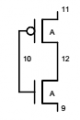
You need to use one of the generally accepted symbols used for P MOSFET and N MOSFET. I prefer to use the symbols used at a major semiconductor manufacturer. We didn't draw the arrows normally used; instead, we used a bubble on the gate of P MOSFETs (denoting low active). We didn't draw explicit bulk connections either. When we drew circuits on whiteboards, we often rounded the corners so we could draw faster.
This is what the unused inverter would look like using this convention.
It's what you're referring to as an N3/P3 inverter.
You need to do something to be able to distinguish between P and N devices, and you need to differentiate between devices in the first or second IC. For brevity, I chose IC designators of 'A' and 'B'.

 Facebook
 Google
 GitHub
 Linkedin