I am asking this because i just learned about negative voltage and ground points, and i want to know how its possible to have a positive current flow with negative voltage?? What path voltage follow , actually does it even have a path?? I dont understand how if you measure from 1 side the voltage is positive but from the other is negative....
I think one aspect of your confusion is caused by the fact that all voltages are relative. There is no absolute voltage.
So you could take any schematic and relabel all the voltages to be 100V less or 1000V more. It would have no impact on the circuit as long as the relative voltages are unchanged, and of course as long as the circuit is isolated from others.
There is no difference between current flowing from 12V to 0V, versus flowing from -12V to -24V. In either case, ∆V is -12V.
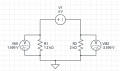
Left side voltage is positive, right side is negative... i dont get why but in the exercise i was doing using ohm law i was always getting positive values
Ah yes. The ground symbol trick. Consider how the circuit is changed by removing the ground symbol. (Hint: It's not. The symbol just provides a reference.)
Voltage (and its polarity) is always measured between two point, such as across a device.
There is no such thing as voltage at a single point or an isolated polarity value.
It's always between two points.
Thus for current going through a resistor from left to right, the left side will be positive with respect to the right side.
Conversely, the right side is negative with respect to the left side.
That is what you see when measuring with a voltmeter.
In the future, please post images instead of linking to some cutesy circuit simulator.
Left side voltage is positive, right side is negative... i dont get why but in the exercise i was doing using ohm law i was always getting positive values
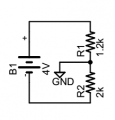
If you drew your circuit more conventionally, it would be easy to see the source of your confusion: EDIT: Attached larger image for readability.
R1 drops 1.5V, R2 drops 2.5V. Depending on how you place the probes of the voltmeters, you can measure positive or negative relative voltages.
That doesn't change the fact that current only flows in one direction and that KVL will be obeyed.
Notice how both meters have the same ground for their reference points. The voltages they report are thus referenced to ground and NOT to the battery's negative pole, which would be the typical reference point in a battery-powered circuit.
Voltage does not "follow a path" or flow. Only current flows or "follows a path". Voltage is electrical pressure. Current flows. It is the flow of electrons.
Notice how both meters have the same ground for their reference points. The voltages they report are thus referenced to ground and NOT to the battery's negative pole, which would be the typical reference point in a battery-powered circuit.
This really interests and confuses the heck out of me. I had thought that the negative of the battery was ground.
Apparently not.
So, in this example, where would I put the other probe for ground.
More confusion, the more that I study.
This really interests and confuses the heck out of me. I had thought that the negative of the battery was ground.
Apparently not.
So, in this example, where would I put the other probe for ground.
More confusion, the more that I study.
Again, the key concept is that all voltages are relative. It is only be convention that we call Earth ground 0V. We could just as well call it 87V or any other number we like.
That symbol in the schematic may not even represent a true Earth ground, but rather an arbitrary point that is defined as zero voltage in the circuit. It may have all made more sense to you if the designer attached the symbol to the negative pole of the battery, but he didn't. And, the meters both use that arbitrary reference point.
This really interests and confuses the heck out of me. I had thought that the negative of the battery was ground.
Apparently not.
So, in this example, where would I put the other probe for ground.
More confusion, the more that I study.
It is all about reference point.
The negative on the battery is the reference point.
This means that positive on the battery is "12" volts higher than the reference.
Meaning, the negative on the battery could be at 1000 volts. Then the positive on the battery is 12 volts above the negative and is 1000+12=1012 volts.
So. When we say ground, we really mean that there is a wire running from a rod that is driven into planet Earth to some terminal on the panel or on din rail or bread board.
When we say ground, we really mean that there is a wire running from a rod that is driven into planet Earth to some terminal on the panel or on din rail or bread board.

 Facebook
 Google
 GitHub
 Linkedin