+/- 12V (or as near as possible) variable voltage source from fixed +/- 12V rails

Thread Starter

RustonyAH

Joined Jul 12, 2019
4
I have built a breadboard power supply based on an ATX PSU, which gives me +/-12V rails, and thought it would be good to also have a variable voltage source that I can adjust to anywhere between -12V and +12V (or as close as is practical).

As far as I can tell, using conventional linear regulators require separate regulators for positive and negative voltages (such as an LM317 and an LM337), which would require a switch or something to switch between positive and negative voltages, and I will be restricted to voltage magnitudes between 1.25V (the minimum available from the regulators) and ~10V (12V minus the dropout voltage), so I am wondering if there are other options.

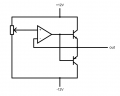
A solution I came up with is to use a potentiometer as a voltage divider between the two rails to create a reference voltage which is buffered by an op-amp, and then a push-pull output with 2 transistors, as pictured below.
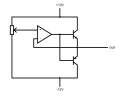
Variable_Voltage.PNG
Are there any significant issues with this circuit? I think the main considerations are:
  1. Voltage Swing: if I use a rail-to-rail op amp, then the output voltage would be able to come to within ~0.7V of either of the rails
  2. Current limit: either driven by the current limit of the voltage rails, or power dissipation in the transistors
    1. Possibly worth putting a resettable fuse on the output?

Are there any particular issues with this solution? I guess I could make it more robust by utilising a voltage reference IC to feed the potentiometer (then scaling/offsetting the voltage to get the correct output voltage) to counter any drift in the +/-12V rails, but I don't think I will need this to be particularly accurate.
 
You can use a common emitters on output instead of voltage followers.
The output cap must be nonpolarised one.
The 10V zeners ensures some small idle current will always flow through output transistor pair, but in reasonable amount.
This current is set by R6 and R7.

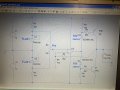
IMG_1872.jpeg
 

crutschow

Joined Mar 14, 2008
38,316
You can use a common emitters on output instead of voltage followers.
That configuration can be unstable due to the added loop gain of the common-emitter circuit.
The zeners ensures some small idle current will always flow through output transistor pair, but in reasonable amount.
That's only needed for Class AB audio amps to minimize crossover distortion, which is not a factor for this DC circuit.

Adding an op amp and another pot to that circuit would give separate +12V and -12V adjustable outputs.
 

Pyrex

Joined Feb 16, 2022
501
I have built a breadboard power supply based on an ATX PSU, which gives me +/-12V rails, and thought it would be good to also have a variable voltage source that I can adjust to anywhere between -12V and +12V (or as close as is practical).

As far as I can tell, using conventional linear regulators require separate regulators for positive and negative voltages (such as an LM317 and an LM337), which would require a switch or something to switch between positive and negative voltages, and I will be restricted to voltage magnitudes between 1.25V (the minimum available from the regulators) and ~10V (12V minus the dropout voltage), so I am wondering if there are other options.

A solution I came up with is to use a potentiometer as a voltage divider between the two rails to create a reference voltage which is buffered by an op-amp, and then a push-pull output with 2 transistors, as pictured below.

View attachment 346954
Are there any significant issues with this circuit? I think the main considerations are:
  1. Voltage Swing: if I use a rail-to-rail op amp, then the output voltage would be able to come to within ~0.7V of either of the rails
  2. Current limit: either driven by the current limit of the voltage rails, or power dissipation in the transistors
    1. Possibly worth putting a resettable fuse on the output?

Are there any particular issues with this solution? I guess I could make it more robust by utilising a voltage reference IC to feed the potentiometer (then scaling/offsetting the voltage to get the correct output voltage) to counter any drift in the +/-12V rails, but I don't think I will need this to be particularly accurate.
In such power supplies, it is quite simple to raise the output voltage by one volt or something like that
 

Thread Starter

RustonyAH

Joined Jul 12, 2019
4
Thanks for the comments.

A couple of clarifications:
  1. Current-wise, I am thinking of the order of a few hundred mA - enough to run a smallish motor.
  2. I am also planning on using it as a variable reference/input voltage, hence wanting to be able to vary it over the full range, rather than having 2 separate positive and negative voltages
  3. I was planning on keeping the +/-12V rails too. Modifying them to give say +/- 15V might be interesting in the future, but his is designed to just plug into a standard ATX PSU and provide the voltages, so at this stage I am not planning on modifying the PSU itself.

Is there any benefit to using the common emitter design compared to what I have already?
I did simulate a version with resistors and diodes to compensate for the distortion when the voltage was set to within ~+/- 0.7V, but this seemed to reduce the voltage swing I could achieve and I didn't see much benefit.

I set the circuit up as I had designed and it appears to be working quite well.
 
With common emitter you are able to go to about 12-0.2V on output. The 0.2V is Bjts CE drop.

With common collector with resistors in front of bases about 12-1V since except Vbe there will be 0.3V drop on Rb resistors:
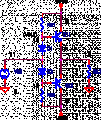
1744751952629.gif

Without resistors (your schematic) the transistors are driven directly from op-amp output and no drop on resistors will be presented so you are getting about 12-0.7V on output:

1744752220537.png
 
Last edited:

crutschow

Joined Mar 14, 2008
38,316
Is there any benefit to using the common emitter design compared to what I have already?
You can go all the way to the 12V rails.
I did simulate a version with resistors and diodes to compensate for the distortion when the voltage was set to within ~+/- 0.7V, but this seemed to reduce the voltage swing I could achieve and I didn't see much benefit.
That is only needed for an AC signal where you want to eliminate cross-over distortion.
It has no benefit for a DC output, as the op amp feedback loop will compensate for the 0.7V Vbe drop.
I set the circuit up as I had designed and it appears to be working quite well.
Can you post a schematic of that circuit?
 

Thread Starter

RustonyAH

Joined Jul 12, 2019
4
It's implemented just as drawn in my first post. The components I have used are
  1. 200k pot
  2. LM358n op amp
  3. TIP 48 npn
  4. TIP 32 pnp

These are just the components I had lying around - probably not the best component choices. The op amp looks to be limited to V+ -2V, which is limiting the upper voltage I can achieve - the lower voltage is about 0.7V above the negative rail as expected.

Regarding the voltage references for the potentiometer, I assume zener diodes would also work (but presumably less stable than than than the voltage references)? I don't have any particular requirements on stability etc.

Are there any particular parameters I need to look out for when selecting the transistors, apart from power dissipation? I assume that the current gain would need to be high enough to ensure it can deliver enough current - looking at the TIP 48 data sheet, the current gain at 1A is 20, so in my configuration to be able to supply 1A the op amp would need to output 50mA (which is greater than the 10-20mA quoted in the data sheet.

I have also tried simulating my configuration and the common emitter configuration in Falstad (link here), and it is showing me that the power dissipation in the transistors and the current draw from the 12V rails is ~ an order of magnitude greater for the in common emitter case (supplying a voltage of -5.75V to a 100Ω resistor). Is this just a property of this type of configuration, or is there a flaw in the simulation?
 

crutschow

Joined Mar 14, 2008
38,316
I assume zener diodes would also work (but presumably less stable than than than the voltage references)? I
Yes, Zeners would work but a voltage reference (such as the cheap TL431) is more stable.
Are there any particular parameters I need to look out for when selecting the transistors, apart from power dissipation?
That and voltage rating.
If you want 1A output using a standard op amp, then you could use a Sziklai pair for each output transistor to reduce the required base current.
It's similar to a Darlington pair, but has an emitter-follower drop near only one Vbe voltage, not two.
it is showing me that the power dissipation in the transistors and the current draw from the 12V rails is ~ an order of magnitude greater for the in common emitter case (supplying a voltage of -5.75V to a 100Ω resistor). Is this just a property of this type of configuration, or is there a flaw in the simulation?
Don't see any reason for that difference.
 
Last edited:
In CE configuration the resistors in front of bases drain the current. Thats the only difference.
I used 100 and 220 ohms (low values) to ensure enough base current for lets say 1A load.
If you plan to use it for lower loads like 100mA you can increase this resistor to 470 and 1k.
 

Thread Starter

RustonyAH

Joined Jul 12, 2019
4
In CE configuration the resistors in front of bases drain the current. Thats the only difference.
I used 100 and 220 ohms (low values) to ensure enough base current for lets say 1A load.
If you plan to use it for lower loads like 100mA you can increase this resistor to 470 and 1k.
Ok, to be honest I'd like to have the flexibility to have larger loads, so if it means I need a higher current draw at all times, I don't think this is worth it for the extra ~0.5V I will get, so I think it is best to stick to the voltage follower configuration.
 
Top