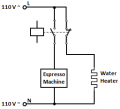
12 amp appliance switch

Thread Starter

JonStef

Joined May 30, 2024
6
I have two 12 amp 110vac appliances that I need to automatically switch between on a 20 amp circuit.
Would a normally closed relay work? Supplying power to the first on the NC side and when the second, on a timer, comes on, it would energize a 110vac coil and automatically disconnect the first. When the timer shuts off the power to the second appliance it would return the coil to the normally closed state re energizing the original appliance.

If I am on the right track, where would one find a relay like this with matching power on both sides… kind of more like a power flow switch I guess.
 

Ian0

Joined Aug 7, 2020
13,097
You need a contactor. You can get them with one n/o contact and one n/c contact. Do you need to switch neutral as well? If so, there are 4-pole contactors with two n/o and two n/c contacts.
 

Thread Starter

JonStef

Joined May 30, 2024
6
Thanks. In researching contactors I do see it is for higher loads. I am designing an espresso cart. What I have is a 12 amp Espresso machine that is timed to turn on and ready when I wake up. The cart has a 12 amp 1.5 gallon point of use Water heater. They cannot both be on at the same time.
The water heater is on the normally closed side of the contractor (to always be keeping the water hot) and when the timer kicked on the Coffee machine it energizes the coil disconnecting the water heater.

Does this sound possible? Correct?
 

panic mode

Joined Oct 10, 2011
4,864
contactors are larger device with different construction and properties that make it suitable for industrial use. in particular inductive loads. in produces they are chosen for switching inductive loads. relays/contactors need to be de-rated to work correctly with inductive loads. also contactors are larger and cost more.
but since your loads are resistive and actual current is not too high. it may be too early to discard relays.
Pretty sure a $3 relay like https://www.azettler.com/pdfs/az2150.pdf will be just fine for what you describe.
it has inverting contact allowing you to switch between two loads.
 

Ian0

Joined Aug 7, 2020
13,097
If you start with a cheap pcb-mount relay, by the time you have made the pcb and added terminal blocks, the price is beginning to get comparable with that of a contactor.
If you are making an electronic timer and putting that on the pcb, then the relay wins. If you have a timer module with mains output and terminal blocks, then the contactor wins, especially if both timer and contactor are DIN-rail mounted.
 

Thread Starter

JonStef

Joined May 30, 2024
6
contactors are larger device with different construction and properties that make it suitable for industrial use. in particular inductive loads. in produces they are chosen for switching inductive loads. relays/contactors need to be de-rated to work correctly with inductive loads. also contactors are larger and cost more.
but since your loads are resistive and actual current is not too high. it may be too early to discard relays.
Pretty sure a $3 relay like https://www.azettler.com/pdfs/az2150.pdf will be just fine for what you describe.
it has inverting contact allowing you to switch between two loads.
Thanks very much. I have emailed
If you start with a cheap pcb-mount relay, by the time you have made the pcb and added terminal blocks, the price is beginning to get comparable with that of a contactor.
If you are making an electronic timer and putting that on the pcb, then the relay wins. If you have a timer module with mains output and terminal blocks, then the contactor wins, especially if both timer and contactor are DIN-rail mounted.
If you start with a cheap pcb-mount relay, by the time you have made the pcb and added terminal blocks, the price is beginning to get comparable with that of a contactor.
If you are making an electronic timer and putting that on the pcb, then the relay wins. If you have a timer module with mains output and terminal blocks, then the contactor wins, especially if both timer and contactor are DIN-rail mounted.
though price point is a factor, simplicity and reproducibility are key. Thanks for the ongoing insight. Constant improvement.
 

panic mode

Joined Oct 10, 2011
4,864
using an industrial panel with DIN rail mounted components certainly can work but it would be a huge overkill for an for an Espresso machine
 

Thread Starter

JonStef

Joined May 30, 2024
6
If you start with a cheap pcb-mount relay, by the time you have made the pcb and added terminal blocks, the price is beginning to get comparable with that of a contactor.
If you are making an electronic timer and putting that on the pcb, then the relay wins. If you have a timer module with mains output and terminal blocks, then the contactor wins, especially if both timer and contactor are DIN-rail mounted.
Agreed. I love the relay (if I can go that route) due to size and price point. (Availability and compatibility with loads and voltage with the application is my limiter. Surely “there is nothing new under the sun” in this regard.

I do appreciate you allowing me to tap into your experience and expertise.
 

MisterBill2

Joined Jan 23, 2018
27,164
contactors are larger device with different construction and properties that make it suitable for industrial use. in particular inductive loads. in produces they are chosen for switching inductive loads. relays/contactors need to be de-rated to work correctly with inductive loads. also contactors are larger and cost more.
but since your loads are resistive and actual current is not too high. it may be too early to discard relays.
Pretty sure a $3 relay like https://www.azettler.com/pdfs/az2150.pdf will be just fine for what you describe.
it has inverting contact allowing you to switch between two loads.
Certainly there are relays available that will be happy to switch 12 amps back and forth all day long. BUT you will not find them at Radio Shack or even Home Depot or Lowes. But Grainger may have them and probably Digikey. OR, if the timer could control a small one-amp contacts relay, any relay intended to control an air conditioner compressor would be adequate, and probably the cheapest way to go. Unfortunately those types usually only have normally open contacts. An industrial electrical supply distributor should have what you require.
 
Last edited:

Thread Starter

JonStef

Joined May 30, 2024
6
Agreed. I love the relay (if I can go that route) due to size and price point. (Availability and compatibility with loads and voltage with the application is my limiter. Surely “there is nothing new under the sun” in this regard.

I do appreciate you allowing me to tap into your experience and expertise.
Let me ask this. The miniature power supply
Agreed. I love the relay (if I can go that route) due to size and price point. (Availability and compatibility with loads and voltage with the application is my limiter. Surely “there is nothing new under the sun” in this regard.

I do appreciate you allowing me to tap into your experience and expertise.
The miniature power relay is rated for 900 watts max switching. Both of my resistive loads are 1400 watts. I will stop by Grainger. Thanks.
 

MisterBill2

Joined Jan 23, 2018
27,164
The "small relay" needed to control the two AC compressor loads will not need to switch more than one amp, because the coils of the AC compressor relays do not draw that much current. If your timer had a normally closed contact, or if the AC compressor relay had a pair of normally closed contacts, then it would be very simple. There is a chance that Grainger might even have such a relay, I have not checked their catalog recently.
 
Top