10 Watt LED Driver

Thread Starter

RodneyB

Joined Apr 28, 2012
698
3rd World Country authorities rip you off at every chance they get. The bank charges alone were 100% more than the cost of the LED's.

But enough of this onward and upward to making and learning more
 

Thread Starter

RodneyB

Joined Apr 28, 2012
698
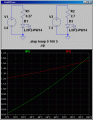
The way I figure this, you have 100k on the collector of Q2. That transistor has to get rid of about .00025 amps. That puts the Vbe a little below .6 volts and you want more than 1 amp in the mosfet.
R= E/I
R = .59V/1.05 amps
R = .562 ohms

As the circuit gets hot, the Vbe will diminish and not cause thermal run-away.
This is a constant current circuit. It has nothing to do with an LED calculator.
Believing an IRF520 is a TO-220 package, I did not assume you had no heat sink on the mosfet. That was at 4 AM for me. Now that the time here is 3 PM I can see that 20+ watts on a TO-220 is not going to work.
(Didn't read the rest of the thread, just answered the question that was put to me.)
Hi

I have clearly not grasped this Resistor calculation for the driver.

I have connected three LED's in Series, they are 3.3 - 3.4 volt 350mA.

I then used the above formula

R=E/I
=.59/320
= 1.84R

I had a 2R resistor so used that!

When testing I had a power output of 5.9 Watts at 0.5 Amps.

I was expecting it to be around 8 watts at 0.320 Amps.

Have no idea where I have gone wrong
 

#12

Joined Nov 30, 2010
18,224
Your first attempt showed a Vbe of .5848 volts. If you want .5 amp, you have to do it like this:
R = .5848V/.5amps and that is 1.17 ohms.
Apparently a 1.2 ohm 1/2 watt resistor or a 1.5 ohm 1 watt resistor (a bit safer) will work for this.
I don't know what you mean by getting an output of 5.9 watts. You should be getting an output made of light.
 

Thread Starter

RodneyB

Joined Apr 28, 2012
698
Your first attempt showed a Vbe of .5848 volts. If you want .5 amp, you have to do it like this:
R = .5848V/.5amps and that is 1.17 ohms.
Apparently a 1.2 ohm 1/2 watt resistor or a 1.5 ohm 1 watt resistor (a bit safer) will work for this.
I don't know what you mean by getting an output of 5.9 watts. You should be getting an output made of light.
Sorry, the LED's do light I have a watt meter its a MASON it shows the output power is 6.9 Watts at 0.5 amps. I thought each LED was 3 Watts so the total power would be 9 Watts. the rating is 350mA but thought it safer to limit the current to 3220mA. That's why I divided the 0.59 by 320mA
 

#12

Joined Nov 30, 2010
18,224
.5848V/2 ohms is 292 ma.
I don't know how you measure the power at 500 ma when that is not what you are applying to the LEDs.
 

Thread Starter

RodneyB

Joined Apr 28, 2012
698
.5848V/2 ohms is 292 ma.
I don't know how you measure the power at 500 ma when that is not what you are applying to the LEDs.
I am totally confused over all this I have attached a photo of the meter showing the results
 

MikeML

Joined Oct 2, 2009
5,444
To provide proper current regulation, the voltage drop across the ballast resistor (unfortunately, also the power dissipated by the ballast resistor) must be much larger, maybe approaching 2 to 3V.

With the tiny voltage drop across the ballast resistor your are using, the slightest change in the forward voltage drop on the LEDs as they self-heat will cause wild swings in the current through them.

The goal of picking a value for the ballast resistor is to make its voltage drop large enough to allow the LEDs forward voltage to change without changing the current much.


Compare these two cases: Note the current regulation through the two 3W LEDs as a function of temperature:

28.gif
 
Last edited:

#12

Joined Nov 30, 2010
18,224
To provide proper current regulation, the voltage drop across the ballast resistor (unfortunately, also the power dissipated by the ballast resistor) must be much larger, maybe approaching 2 to 3V.
I don't think you looked at the circuit, Mike. Go to post #1
 

Thread Starter

RodneyB

Joined Apr 28, 2012
698
To provide proper current regulation, the voltage drop across the ballast resistor (unfortunately, also the power dissipated by the ballast resistor) must be much larger, maybe approaching 2 to 3V.

With the tiny voltage drop across the ballast resistor your are using, the slightest change in the forward voltage drop on the LEDs as they self-heat will cause wild swings in the current through them.

The goal of picking a value for the ballast resistor is to make its voltage drop large enough to allow the LEDs forward voltage to change without changing the current much.
So does this mean a resistor of Value 10K
 

MikeML

Joined Oct 2, 2009
5,444
I don't think you looked at the circuit, Mike. Go to post #1
Ok, so take my point, but substitute (the voltage drop across the NFET plus the drop across the source resistor) for (the drop across just the resistor) in my posting #28. You still need to have enough compliance in the current source to aborb the delta voltage across the LEDs.
 

Thread Starter

RodneyB

Joined Apr 28, 2012
698
Ok, so take my point, but substitute (the voltage drop across the NFET plus the drop across the source resistor) for (the drop across just the resistor) in my posting #28. You still need to have enough compliance in the current source to aborb the delta voltage across the LEDs.
Excuse my ignorance but I don't understand this at all
 

Thread Starter

RodneyB

Joined Apr 28, 2012
698
I am totally confused over all this I have attached a photo of the meter showing the results
I am not sure why a driver is necessary for three of These LED's in series. I have used an 8R2 5 Watt resistor, and the lights come on granted it gets warm but it works.

I would like to know what the advantage of a driver is
 
Top