![]() |
|
|||||||
| The Projects Forum Working on an electronics project and would like some suggestions, help or critiques? If you would like to comment or assist others with their projects, this is the place to do it. |
|
|
|
Thread Tools | Display Modes |
|
#1
|
|||
|
|||
|
HI,
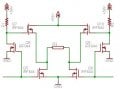
I need to build a 2 H-bridge driver with 4 N-MOSFET to drive a PMDC motor. The motor have rated voltage 24V and rated current 8.5A. So, I choose the IRFP 260 N-MOSFET because it can sustain the current untill 45A in order to protect the MOSFET from over current. But the problems I face now are 1) I don't know how to control or turn on the High side of the H-bridge. The battery I use is 24V. 2) What is the protection circuit to protect the H-bridge, the motor and the the controller which produce the PWM to control the motor speed? As i know, we can use an optocoupler, but how to use it? 3) What others protection do I have to consider in order to protect my controller and the motor? Can someone post a schematic circuit of the H-Bridge driver which is suitable for my project? Thanks. |
|
#2
|
|||
|
|||
|
Hi Chris,
I actually ran into a very similar problem recently. The short answer is that I had to use 2 N channel and 2 P channel MOSFET's. Then you can control the circuit easily with the proper voltages. One issue I had is "shoot-through" which means that if both signals are on, you short circuit the power supply which is very bad. What I did to get over this was to have the two MOSFETs on the left side of the H-Bridge controlled by one signal, and the right side by the other signal. IF you do the truth tables for this, you will see that there is no condition where "shoot through" exists. I do not have a schematic, but it should be fairly simple. |
|
#3
|
|||
|
|||
|
Quote:
Quote:
As Seidleroni mentioned, be careful about how you sequence and handle the turn on/off times. PCH FETs are not as fast as NCH ones (and they have higher RDS_on). |
|
#4
|
|||
|
|||
|
Actually I had test the IRFP260N, but I face a problem which make me very curious about it, that is, when I supply a voltage at drain pin, and the source pin connected to a LED, the LED is light without I apply voltage to the gate pin. Why this happen?
Why the drain and source pin seen short circuited? |
|
#5
|
||||
|
||||
|
The MOSFET is ON by default.
If you drive the gate negative of the drain, it will turn off.
__________________
General info: If you have a question, please start a thread/topic. I do not provide gratis assistance via PM nor E-mail, as that would violate the intent of this Board, which is sharing knowledge ... and deprives you of other knowledgeable input. |
|
#6
|
|||
|
|||
|
Hi SgtWookie, why the MOSFET is ON by default?
To ON a N-MOSFET, we shall apply a voltage MORE positive than Vs at Vg rite? Because the N-MOSFET will be on at Vgs =10V as i look at the datasheet. |
|
#7
|
|||
|
|||
|
Did you connect the MOSFET backwards? There is a body diode. Also if the MOSFET is bad then it will look like a short.
You should have voltage connected through a resistor to the anode of the LED and the cathode of the LED connected to the Drain of the FET and the Source grounded. The Gate should be pulled down to ground via a resistor. JFETs and "depletion-mode" MOSFETs are ON by default. The IRFP260N is an "enhancement-mode" type. |
|
#8
|
|||
|
|||
|
Hi nanovate,
"You should have voltage connected through a resistor to the anode of the LED and the cathode of the LED connected to the Drain of the FET and the Source grounded." Yes, I do what you mention before, but when I turn on the MOSFET, it will stay ON although I remove the apply gate voltage. I apply a 8V to the gate. "The Gate should be pulled down to ground via a resistor." What is this sentence mean? Why the gate have to be pulled down to ground? If the gate is grounded, then the MOSFET is not ON. |
|
#9
|
||||
|
||||
|
In order to answer your question about the MOSFET that will not turn off once it is turned off, I think we are going to need a sketch of the circuit hook up you are using when you encounter the problem you describe.
hgmjr |
|
#10
|
|||
|
|||
|
Quote:
When you take the 8V away is the gate floating? I also am attaching an article that you (and others) might find helpful. It has some good info on designing an H-Bridge circuit. Last edited by nanovate; 12-10-2007 at 02:33 AM. Reason: Added Attachment for Nuts and Volts Article |
|
| Tags |
| build, driver, hbridge, nmosfet |
Related Site Pages
|
||||
| Section | Title | |||
| Worksheet | Stepper motors | |||
| Worksheet | CMOS logic gates | |||
| Worksheet | Servo motor systems | |||
| Worksheet | Insulated gate field-effect transistors | |||
| Worksheet | Bipolar junction transistors as switches | |||
| Worksheet | Advanced electromagnetism and electromagnetic induction | |||
| Worksheet | Mutual inductance | |||
| Textbook | Pulse Width Modulation : Dc Motor Drives | |||
| Textbook | Operational amplifier models : Operational Amplifiers | |||
| Textbook | Introduction : Bipolar Junction Transistors | |||
Similar Threads
|
||||
| Thread | Thread Starter | Forum | Replies | Last Post |
| MOSFET vs. MOSFET Driver?? | theeld | General Electronics Chat | 5 | 10-29-2012 05:25 PM |
| 24-48v mosfet driver circuit | niclatrique | The Projects Forum | 7 | 04-01-2009 01:14 PM |
| H Bridge High Side Mosfet Driver | bigbigblue | General Electronics Chat | 31 | 09-07-2007 10:28 AM |
| Looking for HIP4020 - power bridge driver | pcharters | General Electronics Chat | 4 | 06-29-2007 07:56 PM |
| mosfet driver | Pete51 | General Electronics Chat | 7 | 10-26-2006 08:45 PM |
| Thread Tools | |
| Display Modes | |
|
|