What is the best method to dim my LED bulb?

k1ng 1337

Joined Sep 11, 2020
1,038
Irrelevant just for this original question. I for one have never needed to worry about it. Maybe it would be of importance if you were trying to make some sort of instrumentation, but to just vary the brightness of an LED for indicator, or for some illumination, it does not matter much. You are only talking about a few % difference and most times that would not be detectable by eye anyway. The thread starter has not commented for some time so I think his original question had been answered.
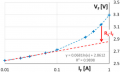
Fair enough but a forum is a forum so the discussion can continue without him. The team was dueling over the characteristics of an LED so I want to see where it goes. I'm willing to make an experiment to attempt to correlate either voltage or current with brightness. I'm interested in this because I've seen many users say a current of less than ~1mA does not light an LED. My experiments prove otherwise so it is useful to me to find a way to correlate the response to what is actually tangible to my senses: brightness.
 

dendad

Joined Feb 20, 2016
4,641
Yes, some LEDs can light with very low current. Do you have a light meter or will you use an LDR, solar cell, or what for your sensor to measure the brightness?
 

k1ng 1337

Joined Sep 11, 2020
1,038
Yes, some LEDs can light with very low current. Do you have a light meter or will you use an LDR, solar cell, or what for your sensor to measure the brightness?
I have an LDR, a solar cell and high power LEDS for the test. I also have an upcoming project to build a spectrometer from a DVD so in time I'll use that as a benchmark. My long term goal is to determine two things about an optical sample in solution:

1) The attenuation factor of the transmitted beam

2) The spectral response of the sample

Both quantities are arbitrary with respect to my home shop so I am not concerned about accuracy, however, I am very concerned about the precision of my results.
 

BobTPH

Joined Jun 5, 2013
11,601
To a good approximation, in the normal range of operation, the light output is proportional to the current. To the eye, doubling the light output looks like a small change in brightness due to its logarithmic response.
 

MrAl

Joined Jun 17, 2014
13,751
It will not. Cutting the resistor in half will not double the current unless the Vf of the LED is 0V.
Yes that was a rough estimate. However, the higher the supply voltage the more accurate that estimate is.
The more accurate value for lower voltages has to be chosen with the PWM at 50% while measuring the average current, which in this case would be 10ma.
 

MrAl

Joined Jun 17, 2014
13,751
Fair enough but a forum is a forum so the discussion can continue without him. The team was dueling over the characteristics of an LED so I want to see where it goes. I'm willing to make an experiment to attempt to correlate either voltage or current with brightness. I'm interested in this because I've seen many users say a current of less than ~1mA does not light an LED. My experiments prove otherwise so it is useful to me to find a way to correlate the response to what is actually tangible to my senses: brightness.
Hi,

I've seen some white LEDs light with very low current even less than 1ma.

Hey is that Columbo? One of my favorite shows.
 

MrAl

Joined Jun 17, 2014
13,751
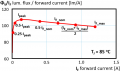
What is not right? I am sure every LED is different, I just picked the first such graph I found. Maybe it is typical, maybe not. But the trend is always downward, lower efficiency at higher current.
Hi,

Thanks for the reply and I appreciate your interest in these topics.
You had said that doubling the current doubles the light output, but that's not quite correct. As you know, the light output decreases from the linear perspective so that double the current almost doubles the light output, but it's actually a little less. I quoted 7/8 times as much which is about 88 percent at around 100 percent input. If it was really double, it would come out to 100 percent. I do agree however that the change may be hard to notice without some careful measurements, unless maybe we were driving a lot of LEDs to form a single light source.
BTW, the right word is "efficacy" when talking about the relationship of one form of energy to another form of energy. "Efficiency" is reserved for times when the form of energy is the same for both input and output. Not a really big deal though, just thought I would mention it.
 

k1ng 1337

Joined Sep 11, 2020
1,038
Hi,

Thanks for the reply and I appreciate your interest in these topics.
You had said that doubling the current doubles the light output, but that's not quite correct. As you know, the light output decreases from the linear perspective so that double the current almost doubles the light output, but it's actually a little less. I quoted 7/8 times as much which is about 88 percent at around 100 percent input. If it was really double, it would come out to 100 percent. I do agree however that the change may be hard to notice without some careful measurements, unless maybe we were driving a lot of LEDs to form a single light source.
BTW, the right word is "efficacy" when talking about the relationship of one form of energy to another form of energy. "Efficiency" is reserved for times when the form of energy is the same for both input and output. Not a really big deal though, just thought I would mention it.
I've been thinking about how to set up an experiment to test this with the equipment I have. I like the LDR idea because the response is apparently a straight line. I'm envisioning a 4 part experiment, tell me what you think:

In each step I'll use an Arduino to sample voltage and current and Matplotlib to graph the output.

1) Plot Resistance vs Lux of LDR

2) Plot Current vs Voltage of 1W White LED

3) Plot Voltage at LDR node vs Voltage at LED Shunt Resistor node

4) Derive Lux vs Current
 

MrAl

Joined Jun 17, 2014
13,751
I've been thinking about how to set up an experiment to test this with the equipment I have. I like the LDR idea because the response is apparently a straight line. I'm envisioning a 4 part experiment, tell me what you think:

In each step I'll use an Arduino to sample voltage and current and Matplotlib to graph the output.

1) Plot Resistance vs Lux of LDR

2) Plot Current vs Voltage of 1W White LED

3) Plot Voltage at LDR node vs Voltage at LED Shunt Resistor node

4) Derive Lux vs Current
Hi,

I suppose you can do that, but you'll have to first do experiments to make sure if you use two LDR's that they are the same, or else apply a correction factor to one of them.
The white LED pattern can be slightly different too, so you'd have to make sure the mounting of the LEDs work right too.
If two LED's are wired in series, they both must have the same current levels.
 

MisterBill2

Joined Jan 23, 2018
27,903
Hi,

I suppose you can do that, but you'll have to first do experiments to make sure if you use two LDR's that they are the same, or else apply a correction factor to one of them.
The white LED pattern can be slightly different too, so you'd have to make sure the mounting of the LEDs work right too.
If two LED's are wired in series, they both must have the same current levels.
CERTAINLY If two LEDs are connected in series they will have the same current. And the LDR devices are fairly linear because ofthe mechanism of the resistance changebeing dpendent on the light energy.
 

k1ng 1337

Joined Sep 11, 2020
1,038
Hi,

I suppose you can do that, but you'll have to first do experiments to make sure if you use two LDR's that they are the same, or else apply a correction factor to one of them.
The white LED pattern can be slightly different too, so you'd have to make sure the mounting of the LEDs work right too.
If two LED's are wired in series, they both must have the same current levels.
I have one LDR and one 1W White LED. I'm willing to bet my results will hold nicely between batches of components but since I don't have more, I'm concentrating on improving the precision of my results. I can't really correlate Lux to a datasheet without sophisticated equipment but if control the other parameters shown in my steps, I think I'll get enough data points to make myself a benchmark for my spectrometer. I can then use my spectrometer to test the (distorted) spectral response between a batch of LEDs.
 

MrAl

Joined Jun 17, 2014
13,751
I have one LDR and one 1W White LED. I'm willing to bet my results will hold nicely between batches of components but since I don't have more, I'm concentrating on improving the precision of my results. I can't really correlate Lux to a datasheet without sophisticated equipment but if control the other parameters shown in my steps, I think I'll get enough data points to make myself a benchmark for my spectrometer. I can then use my spectrometer to test the (distorted) spectral response between a batch of LEDs.
Hi,

Check out an integrating sphere that may help too.
 

MrAl

Joined Jun 17, 2014
13,751
CERTAINLY If two LEDs are connected in series they will have the same current. And the LDR devices are fairly linear because ofthe mechanism of the resistance changebeing dpendent on the light energy.
Hi,

My reply was not directed as much at the linarity as to the absolute measurement accuracy/repeatability. If one reads 4 and the other 4.5, you may want to correct for that.
The linearity may be similar: one reads 4 for one reading and 5 for the other, while the other reads 4.5 for one reading and 5.5 for the other, yet the absolute measurements are not the same.
 

MisterBill2

Joined Jan 23, 2018
27,903
One option is to monitor the LDR resistance as the current in the LED is varied, recording the LDR resistance versus LED current, and then vary the illumination intensity by adjusting the distance between the LED and the LDR. The distance is simple to measure accurately, and the ratio of distances can provide a valid measure of the change in intensity. That will provide a means of evaluating the intensity change with current change without needing an accurate intensity measuring system, but only a repeatable and stable system.
 
Top