The myth of Planned Obsolence in electronics.

Metalmann

Joined Dec 8, 2012
703

MrChips

Joined Oct 2, 2009
35,189
Many moons ago a fellow graduate student bought an inexpensive 4-function pocket calculator. Being the inquisitive type, he opened it only to find that there were key contacts for a few extra buttons. He cut holes in the plastic case and installed his own buttons. The result was an extended function calculator that sold for twice price.
 

#12

Joined Nov 30, 2010
18,224
Every time I see empty spaces on a circuit board I wonder how much quality was removed to lower the cost by 30 cents on a $300 item. Then I find out a new car has 11 microprocessors in it and wonder; if electronics are that cheap, why would anybody need to chisel half a dozen parts out of my new TV?

Oh well. I have never fit in. I remember an E.E. telling me nobody would pay for an emitter follower after a zener diode when I was about 14 years old. Now, people are paying for cell phones, flat screen TV's and GPS devices with color displays after I couldn't get an E.E. to add an emitter follower to a battery eliminator for a cheap radio. The real problem is that I still don't understand how you can say nobody will pay for quality.
 

Georacer

Joined Nov 25, 2009
5,182
...and Rigol did the same thing on their scopes apparently. You pay double for the letter "D"

https://www.youtube.com/watch?v=LnhXfVYWYXE
It's not the letter D you can upgrade onto. 'D' is the logic analyzer series which comes with separate hardware.

The video was about the upgrade from 1052E to 1102E, which has double the bandwidth.
And it's not double the price. 1052E costed my friend 260€ and the 1102E cost me 320€, about two months back.

I don't have a problem with two scopes with different capabilities costing a different amount. And I'm also ok for both scopes to share the same manufacturing line, if that means that they both cost less to the end recepient.
 

tracecom

Joined Apr 16, 2010
3,944
Every time I see empty spaces on a circuit board I wonder how much quality was removed to lower the cost by 30 cents on a $300 item. Then I find out a new car has 11 microprocessors in it and wonder; if electronics are that cheap, why would anybody need to chisel half a dozen parts out of my new TV?

Oh well. I have never fit in. I remember an E.E. telling me nobody would pay for an emitter follower after a zener diode when I was about 14 years old. Now, people are paying for cell phones, flat screen TV's and GPS devices with color displays after I couldn't get an E.E. to add an emitter follower to a battery eliminator for a cheap radio. The real problem is that I still don't understand how you can say nobody will pay for quality.
Now, you are getting to real cause of the problem. I had wanted to post this before, but decided against joining the fray until now.

Cost reductions have become the holy grail of manufacturing, and that attitude is driven by the overwhelming power and greed of huge retail chains.

Big box retailers have such buying power over manufacturers that they can demand and get anything they want. In every product category, there is one person who used to be called the buyer, but now is called the "merchant." That person strikes terror into the heart of his every supplier. A few are reasonable and knowledgeable about products in their category, but most are arrogant, power hungry, and totally ignorant about how the product works.

Here's one example. I once had a "merchant" request a dipstick to be added to the oil fill plug on a small engine. I explained to him that the proper way to check the oil on the engine was to simply place the product on a level spot and remove the filler plug. The oil level should come to within a half inch of the top of the fill hole. He said that people didn't know how far a half inch was, and there should be a dipstick. I said that the distance really wasn't critical, and that if the oil was visible in the neck of the fill hole, there was enough oil in the engine. He insisted, and threatened my company with the loss of our entire product line in "his" stores. Ultimately, I relented, and we designed, tooled, and supplied an oil fill plug with a .75" dipstick.

We lost the business anyway, but that shows the lengths that manufacturers are often put to in order to appease big box retailers. That's just one story of dozens that I could tell to demonstrate the power that the boxes have over manufacturers. They determine the selling prices for the products, and then set the purchase prices for every item they stock. If a manufacturer can't, or won't meet the price demands, the boxes will find a supplier who will.

Thus, manufacturers must either reduce their own costs, or cut their own margins, or lose the business, which often means going out of business. Their only viable option is to take costs out of the product any and every way possible. Engineers that I have worked with don't understand the logic in taking a few cents out of a product when it reduces the quality of the product, and it really doesn't make sense. Sadly, it is required in order to keep the doors open, and the engineers employed.

There are a few manufacturers who have avoided this dilemma. Stihl is the best example. They are able to keep their quality up because they have avoided the big box stores, but they are the exception.
 

strantor

Joined Oct 3, 2010
6,875
That just makes me mad.;)
Why? Did you pay $6k for the E8? That's the only situation in which I'd be mad about it. In my present situation (guy who has no thermal imager but who wants and needs one badly, and wants the best of the best but can't afford it) it makes me happier than a pig in mud. I'm about to pay <$1k for a $6k thermal camera, made the pioneers of thermal imaging; a camera that no other manufacturer can compete with, even in the $6k price range.


I can't help but think they did it on purpose. The "hack" is so pathetically easy, it looks like an intentional weak link. I bet it was planned from the beginning. I bet since news of this "hack" came out, they're making more profit on the E4s than they are on the E5s, E6s, and E8s combined. They're luring in people who otherwise wouldn't have purchased a thermal imager at all, for any price. But when people learn that they can get a high dollar something (anything) for a small fraction of the price, gears start turning.
 

#12

Joined Nov 30, 2010
18,224
That FLIR example is exactly where I get lost like a noob. Both models have exactly the same parts in them, so they cost the same to manufacture. The manufacturer intentionally cripples some of them in their programming and pretends the parts suddenly cost 80% less.

That's right. He wasn't gouging the people that are spending my tax dollars (and therefore, me). They all cost $6000 and he's just investing the extra time to write "cripple code" so he can give them away 'cause he's a swell guy.
 

Georacer

Joined Nov 25, 2009
5,182
I prefer to believe that instead of having a separate production line for two products, each costing $1000 and $3000,
there is one for both, and they now cost $500 and $2500.

Of course, the devil is in the corporate director's budget details.
 

WBahn

Joined Mar 31, 2012
33,206
...and Rigol did the same thing on their scopes apparently. You pay double for the letter "D"

https://www.youtube.com/watch?v=LnhXfVYWYXE
Lots of equipment manufacturers do this. I have an Agilent scope that I didn't pay the extra for the full amount of memory. Any time I want, I can pay the extra and all it gets me is a code that I can enter to tell the software to use the memory that is already in the scope.

While it grates on you from one perspective, if you think about it for a bit you realize that this isn't at all an unreasonable thing for them to do.
 

MaxHeadRoom

Joined Jul 18, 2013
30,813
Big box retailers have such buying power over manufacturers that they can demand and get anything they want. In every product category, there is one person who used to be called the buyer, but now is called the "merchant." That person strikes terror into the heart of his every supplier.
If you get the chance, watch the PBS documentary "Is Wall Mart good for America".
Just about sums it all up.
Max.
 

THE_RB

Joined Feb 11, 2008
5,438
It makes sense to me like installing a variable frequency drive on an air conditioning compressor to limit it to 80% of full capacity unless the customer pays me extra.
There's a word for that type of behaviour. It starts with "e" and ends with "tion"... :)
 

WBahn

Joined Mar 31, 2012
33,206
It makes sense to me like installing a variable frequency drive on an air conditioning compressor to limit it to 80% of full capacity unless the customer pays me extra.
Different situation entirely.

It takes a LOT of money to develop a high-end piece of test equipment or the like. For instance, if you have an ASIC in there and it is in a modern process, just the cost of the masks to produce the first IC can be well over a million dollars. You can easily end up with tens of millions of dollars spent developing a product before you ever produce the first one. The cost of the parts and labor to actually build each unit is often a surprisingly small fraction of the total cost of the program.

To see how it can shake out, let's assume that a company invests $10 million to develop their new Widget and their production costs (including marketing and overhead and all that) per unit is $1000. If they sell it for $6000 each then they have to sell 2000 of them before they realize a penny of return on their investment. But perhaps at that price there is only a market for 1500 of them, which means that they will end up losing $2.5 million. On the other hand, if they sell the unit for $2000 the market would buy 8,000 units, but with only $1000 being used to offset the NRE they would still end up losing $2 million. The point of maximum return might be at a price of $5000 where the market would purchase 3000 units giving them a gross profit of $2 million after their NRE was recovered.

So that would be where they would price the product and you would have to pony up $5000 for a unit, which probably has more capabilities than you need.

Now the company looks at putting in a software downgrade and they come out with the Widget-Lite that is exactly the same unit but has been crippled. If this was the only product they had and they priced it at $2000 the market would support 7000 units (down from 8000 because it's not as capable). But if they also still offer the Widget at $4000 there would be a market of 2500 for that and the market for the Widget-Lite drops to 6000 units because of people that opt to buy the Widget instead (the total market is more than for just the Widget-Lite because of the people for whom the Widget meets their needs but the Widget-Lite doesn't). The company now has a gross profit of $6 million from the Widget-Lite and $7.5 million from the Widget. Neither by itself is enough to offset the NRE, but combined the company realizes a $3.5 million net profit after NRE recovery. Plus, you now get to buy a unit that meets your needs for $2000 instead of $5000. In addition, if you did want to buy the full-up Widget it would only cost you $4500 instead of $5000. The availability of the Widget-Lite has reduced the market for the Widget enough to put downward price-pressure on their own product. But that's fine, because overall their profits go up.

Everyone wins. People that can get by with the Widget-Lite save $3000 (making the purchase even possible for many), people that need the Widget save $500, and the company makes an additional $1.5 million in profit.

The key is that the product differentiation allows you to leverage the larger market for the less capable product and the higher per-unit revenue from the more capable product.

Whether or not this differentiation is the right way to go depends on the shape of the price/demand curve -- something that companies that produce moderate/high volume, high-price tag high-volume items spend a lot of time and effort getting a feel for. For many types of items, such as test equipment, it is often the case that the market size only grows appreciably once the price gets very low but that there is a tail at the high-price end that will still be there until the price gets very high. Those are the cases where this kind of differentiation works out best for everyone.
 

strantor

Joined Oct 3, 2010
6,875
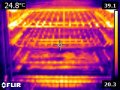
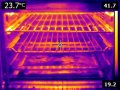
Here's your photgraphic evidence of "planned inferiority." Got my Flir E4 in today and turned it into an E8; care to guess which is which? Note both pics of my toaster over were snapped within seconds of turning the switch on; there is no visible light at all coming from the elements.


I also have lots more cool features now, like automatic hot/cold spot reticules, automatic calculations, and lots of thermography features that aren't even available on the E8 (Maybe Flir is holding out to release an E9?).


Attachments

#12

Joined Nov 30, 2010
18,224
Yep. I'm still running a 1979 clothes dryer, but the last one I tried to fix and sell was so cheap that I couldn't keep it running long enough to sell it.:mad:

(It was a Frigidaire.) They make good refrigerators, but I'm not happy with their laundry equipment.

Edit: One of those links from studiot contains the phrase, "Our relentless demand for cheap household appliances".
I think tracecom did a good job of explaining that it is not us, but the Waltons that relentlessly demand cheaper products.
 
Top