Quick Diode Question

Thread Starter

jegues

Joined Sep 13, 2010
733
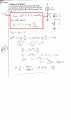
How does he come up with the equation I have put in the red box?

I know the we can write 2 equations for each current and voltage i1 and i2 and divide to two to obtain,

\(V_{2} = V_{1} + nV_{T}ln(\frac{i_{2}}{i_{1}})\)

but how does he obtain that form? It's almost intuitive because its easy to see that the voltages for currents at I=10mA and I=100mA are correct.

Can someone clarify?

Thanks again!
 

Attachments

t_n_k

Joined Mar 6, 2009
5,455
It's almost intuitive because its easy to see that the voltages for currents at I=10mA and I=100mA are correct.
That's the point - it is simple intuition that leads to the result. The numbers have been contrived to suit that end.

At 10mA the voltage is 0.7V. An order of magnitude increase in current increases the voltage by 0.1V. The (base 10) log of a factor of 10 (an order of magnitude) is 1.

You could develop a formal proof of the "transform" from the natural logarithm based form of the Shockley diode equation, if you wished.
 

Thread Starter

jegues

Joined Sep 13, 2010
733
That's the point - it is simple intuition that leads to the result. The numbers have been contrived to suit that end.

At 10mA the voltage is 0.7V. An order of magnitude increase in current increases the voltage by 0.1V. The (base 10) log of a factor of 10 (an order of magnitude) is 1.

You could develop a formal proof of the "transform" from the natural logarithm based form of the Shockley diode equation, if you wished.
So what if the currents and voltages he gave me didn't work out so nicely?

For example, vD= 0.7 @ iD = 50mA, and vD = 0.8 @ iD = 90mA?

Now how to formulate that equation isn't so obvious anymore.

Is it hard to derive from the diode equation?
 

t_n_k

Joined Mar 6, 2009
5,455
One would have to satisfy the relationship

Vd=0.7+K*log(Id/50)

At Id=90mA Vd=0.8

The value of K would be K=0.1/log(90/50)=0.3917

So

Vd=0.7+0.3917*log(Id/50) [with Id in mA]
 
Top