Problem with Thevenin Theorem

Thread Starter

Digit0001

Joined Mar 28, 2010
100
Hi
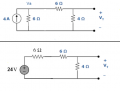
I have two questions I need help on the following. I am suppose to use Thevenin's Theorem but i cannot get the right answers.


Can someone tell me what is wrong with my calculations.
For Question 1

Using Nodal Analysis
2+2 = (V/6 + V)/10
4 = (10V + 6V)/60
240 = 16V
V = 240/16
V_th = 15v

Rth = 3ohms

For Question 2
Using Mesh Analysis
(15-V)/3 + 4 = V/9
15-V + 12/12 = V/9
12V = 9(27-V)
12V = 243 - 9V
21V = 243
V=243/21 = 11.57v

R_th = 3 ohms
P.S
 

Jony130

Joined Feb 17, 2009
5,599
For the first Question
Using Nodal Analysis

4A = Va/6 +(Va-Vth)/6
(Va-Vth)/6 = Vth/4
Or

Vth = 24V * 4Ω/(4Ω+6Ω+6Ω) = 24* 4Ω/16Ω = 6V
 

Attachments

Vahe

Joined Mar 3, 2011
75
2nd problem is the same as the first (in terms of procedure) with different numbers. For the Thevenin equivalent circuit, you turn off all independent sources (voltage sources are set to 0V (short-circuited) and current sources are set to 0A (open-circuited)). Then you calculate the equivalent resistance. For the second problem this is simply 6||(3+3)=6||6=3 ohms.

The open circuit voltage (shown as VT) is being calculated by first simplifying the circuit using source transformation. For example, a voltage source Vx in series with resistor Rx becomes a current source Ix=Vx/Rx in parallel with resistance Rx. Next step is to simplify the circuit by combining resistors in parallel and adding current values in parallel. You can also take current sources in parallel with resistors and make them into voltage sources in series with the resistors -- this should be in your circuits text and you should review it.

So, in the second problem, 15V and the 3ohm can be transformed into the parallel combination of 5A (15V/3ohm) current source and 3 ohm resistor. Now the 5A current source is in parallel with the 4A current source and since they are feeding the same node, they can be replaced by a single 9A current source. Now on the left we have a 9A in parallel with a 3ohm resistor. We can transform this into a 27V (9A*3ohm) source in series with a 3 ohm resistor. The simplified circuit now has a 27 V source in series with a 3ohm resistor and the remaining two resistors R5 (3 ohm) and R7 (6 ohm). So the output voltage can be given by voltage division
\(
V_T = \frac{6}{6+3+3} 27 \text{V} = 13.5 \text{V}
\)

Cheers,
Vahe
 
Top