Problem understanding flux

Thread Starter

activee

Joined Jan 16, 2014
39
Hey, I've trouble to understand what is considered to be the electric flux or why it's relevant. I understand the math behind it. I understand the analogies with water and light and that it is the amount of field line going through it but in reality there is no field line the is just an electric field


If I place a charged plane in a constant electric field, every atom of the said plane will be in that field whatever the said plane's position in space is. So every atom of the plane will experience an electric field and every atom will experience a force regardless of its position. If every point of the plane is subject to the same electric field that means that the amount of electric field going through it is the same whatever the position of the plane is.
So I'm not sure What this is about.

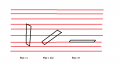
I made a drawing where the flux is 1 and where the flux is 0. When the flux is 0 there is only 1 line going through it but that line is going through the whole plane.
 

Attachments

Last edited:

studiot

Joined Nov 9, 2007
4,998
every atom will experience a force regardless of its position.
Why so? Atoms are electrically neutral.
Further you have drawn a rectangle, not a plane, gettings your terms rights leads to correct answers.

:)

Note1 : Planes and lines are infinite. There is a difference between effects on infinite planes and lines v rectangles and finite lines in field theory.

Note2 : Electric flux, like other field fluxes, is a scalar. Most electric other field quantities are vectors. Since you understand the maths you will understand that the flux is the dot product of two of these vectors.

http://wiki.answers.com/Q/Is_electric_flux_a_scalar_quantity_or_vector
 

Thread Starter

activee

Joined Jan 16, 2014
39
Why so? Atoms are electrically neutral.
Further you have drawn a rectangle, not a plane, gettings your terms rights leads to correct answers.

:)

Note1 : Planes and lines are infinite. There is a difference between effects on infinite planes and lines v rectangles and finite lines in field theory.

Note2 : Electric flux, like other field fluxes, is a scalar. Most electric other field quantities are vectors. Since you understand the maths you will understand that the flux is the dot product of two of these vectors.

http://wiki.answers.com/Q/Is_electric_flux_a_scalar_quantity_or_vector
because I said the plane was charged but forget that.

Yes I do understand it's the dot product and i do understand it a representation of how much field is going through an area. BUT what I don't understand is more fondamental and why we decided to do the dot product. I understand that the dot product will give us the amount of field tho.

I'll try to describe my problem differently:
So if I put my rectangle(as you requested) in an angle of 45° compared to field line; my flux will be less of what it is if it would be perpendicular. My problem is : the full rectangle will still be in that constant electric field. Every point in space will still be in that field.
Yes there is an infinite amount of field line. That means that however i put my rectangle (except with an angle of 0°) there will still be an infinite amount of line.
 
Last edited:

WBahn

Joined Mar 31, 2012
33,186
because I said the plane was charged but forget that.

Yes I do understand it's the dot product and i do understand it a representation of how much field is going through an area. BUT what I don't understand is more fondamental and why we decided to do the cross product. I understand that the cross product will give us the amount of field tho.

I'll try to describe my problem differently:
So if I put my rectangle(as you requested) in an angle of 45° compared to field line; my flux will be 1/2 of what it is if it would be perpendicular. My problem is : the full rectangle will still be in that constant electric field. Every point in space will still be in that field.
Yes there is an infinite amount of field line. That means that however i put my rectangle (except with an angle of 0°) there will still be an infinite amount of line.
You are bouncing around all over the place. You first mention dot product and then switch to cross product.

Also, why would the flux be 1/2 when the angle is 45°?

I think part of your problem is that you are thinking in terms of the wrong analogy. If you put a charged rectangular plate in a uniform electric field then the angle of the plate doesn't matter and the total force will be the same regardless of the angle. The flux has nothing to do with this phenomenon, so trying to use it as an example to understand the role of flux will lead you down the wrong path.

What you need to do to understand the fundamentals is to work with the fundamentals and not just the equations that come from them. So go back to the starting point, namely Coulomb's Law, and work up from there being sure that you understand the concepts behind each evolution.
 

Thread Starter

activee

Joined Jan 16, 2014
39
The teacher said <<the flux is basically the strength of the field going through a given area.>>

Now if I've a constant electric field of value 3 going on the î axis. A given area vector of 3 m² in the î axis aswell my flux will be 9. Now I rotate the same area 45°. my area vector is now equal to : A = 2,12 î + 2,12 ê. My flux is now 6.36: less than before but the electric field going through that given area is not any less strong. I understand that "less field lines go through it" if that makes sens..
 
Top