I worry that the RS relay linked to by tcdk does not have sufficient current rating (2A) for the actuator. We need tcdk to link to the data sheet for the motor/actuator to be sure.
Mike explained that in post #20. You have a single relay output SPST (Single Pole Single Throw) which does not make up a heating/cooling controller. You can use it to heat or use it to cool but it was never designed to do both at the same time. You have a single set point single loop controller.
Temperature Controllers
A temperature controller produces an output action based on the input signal received from a sensor. Controllers used in cooling applications are called direct acting. Controllers used in heating applications are called reverse acting. Depending on the controller, output actions can control a heating or cooling device, or some other aspect of a process (ratio mixing, conveyor speed, etc.).
Temperature controllers are either single-loop or multi-loop. Single-loop temperature controllers are good for basic temperature control. Various levels of sophistication can reduce temperature under- and over-shoot, produce alarm actions and perform data logging functions as well as serial communications.
Multi-loop temperature controllers (also called process controllers)are good for applications where temperature and other process variables need to be controlled in a coordinated fashion.
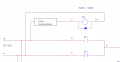
Now if your set on using both pins 1 and 3 to open and close the windows then rather than a single external relay solution you can use 2 relays (SPST) with 24 VDC coils or you can use an H-Bridge circuit to reverse motor polarity. That is as good as it gets.
Your controller has 2 outputs that are inverse of each other. In other words it has two states, like this:
State 0: Terminal 1 OFF, Terminal 3 ON
State 1: Terminal 1 ON, Terminal 3 OFF
Your "cooling" state is not really a cooling state, it's just a "not heating" state.
You would choose to use terminal 1 or 3 depending if you want your device to turn ON above a certain temperature, or below a certain temperature.
A controller with legit heating and cooling outputs would has 3 states:
State 0: Terminal 1 OFF, Terminal 3 OFF
State 1: Terminal 1 ON, Terminal 3 OFF
State 2: Terminal 1 OFF, Terminal 3 ON
With this type of controller, you could for example set your heating temp for 60deg and your cooling temp for 90deg.
So in the morning when it's cold, (<60deg) the windows will be closed. when temp goes >60, windows open.
If during the day the temp goes >90deg you could turn on a fan.
In this way, with two outputs and two control mechanisms, you can keep the temp within a desired range.

 Facebook
 Google
 GitHub
 Linkedin




 Can't help those who fail to provide needed information.