@Juicyblunts Please stick to one thread on the same topic otherwise life on AAC will quickly become very confusing.
Moderator action: merged new thread into existing thread.
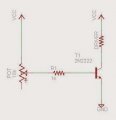
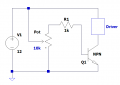
Sounds like something is wired wrongly. If you have the 1k (confirm it really is 1k) base resistor in place and the pot correctly wired then the maximum current through any section of the pot track will be <12mA and the maximum power dissipation in the pot will be ~40mW. Unless the pot is tiny it should get slightly warm but not excessively so.the pot gets really warm
The multimeter still works on the voltage measurement function. There is no protection fuse. Why is that?I'm interested. . .
That's great info thanks! It's also the same reason I used 2 resistors when testing the battery isolated from my EL circuit, as 1/2 the voltage should be dropped across one resistor, though I'll be honest I didn't take into consideration calculating total resistance, I just wanted some kind of reading, even a blown fuse would have been preferrable to the 0.00 (had I only known the fuse was missing!!!). So what is with the pot getting hot?The multimeter still works on the voltage measurement function. There is no protection fuse. Why is that?
It all comes back to the all important Ohm's Law which states that the current in a circuit is directly proportional to the applied voltage and inversely proportional to the resistance.
In simple mathematical terms, we say
I = V/R
The resistance of a voltmeter is very high, typically 10MΩ. Hence typically, a voltmeter can be subjected to 1000V and experience no damage.
In such a situation, the voltmeter is seeing 1000V/10MΩ = 100μA
The manufacturer of a testmeter wisely installed a protection fuse in the ammeter function of the testmeter. Typically, this is a 300mA fuse. Why did they go to the trouble of protecting the ammeter. Because they know that someone is going to do something stupid and blow the meter. The manufacturer would love you to have to buy a new meter. Of course, replacing a fuse is a lot cheaper than replacing a DMM.
The resistance of an ammeter is very low. Let us say the resistance is 30Ω. With a 300mA protection fuse, V = I x R = 0.3 x 30 = 9V.
10V across the ammeter will blow the fuse.
Why is the resistance of the voltmeter very high,10MΩ, while the resistance of the ammeter is very low, say 30Ω?
That is because when the voltmeter is trying to measure voltage across two points, you want the voltmeter to take as little current as possible. That is, you do not want to disturb the circuit you are trying to measure. An ideal volt meter should have infinite resistance and should look like nothing is connected to the circuit.
When the ammeter is inserted in-circuit to measure current, you want the voltage across the ammeter to be as little as possible. Again, you do not want to disturb the functioning of the circuit. An ideal ammeter would have 0Ω resistance.
The bottom line:
To measure current in a circuit, you must break the circuit and insert the leads of the ammeter where you made the break. What is protecting the meter is the total resistance of that part of the circuit. If the circuit resistance is too low you will blow the fuse.
(It is very likely someone blew the fuse in the past and didn't bother to replace the fuse because they did not have any at hand. Always keep a stock of meter fuses. Been there, done that. We all make mistakes too.)
If you are comfortable with this we can move on to why your pot is getting hot, and that is for the same reason, Ohm's Law.
Potentiometers are known by various names, pot for short, variable resistor, voltage divider, rheostat, volume control, taper, fader, pad, trimmer, slider, etc.That's great info thanks! It's also the same reason I used 2 resistors when testing the battery isolated from my EL circuit, as 1/2 the voltage should be dropped across one resistor, though I'll be honest I didn't take into consideration calculating total resistance, I just wanted some kind of reading, even a blown fuse would have been preferrable to the 0.00 (had I only known the fuse was missing!!!). So what is with the pot getting hot?
Yes take me to school on this lol. I got the lights to work, but now the pot is still getting hot so I'll wait to see what more you can teach me about this before I destroy anything.Potentiometers are known by various names, pot for short, variable resistor, voltage divider, rheostat, volume control, taper, fader, pad, trimmer, slider, etc.
Essentially, it is a fixed resistor with a wiper or slider that slides along the body of the resistor.
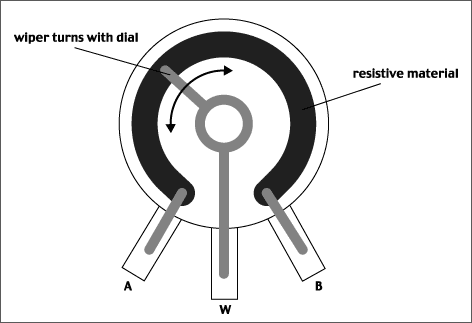
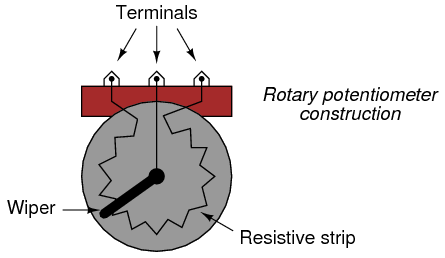
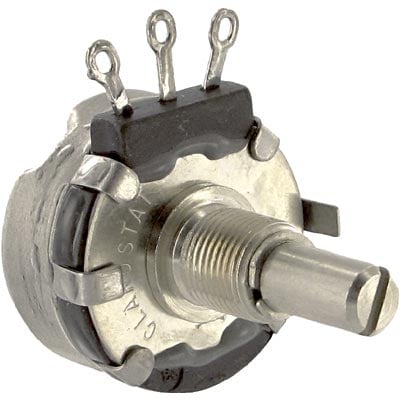
Diagrammatically, it looks like:
![]()
![]()
![]()
![]()
A pot is a three terminal device. The total resistance is the resistance from end to end, A to B as shown in the diagram above.
For example, if the pot is specified as a 10kΩ pot, then the total resistance from A to B is 10kΩ.
If you connect a 12V source across the A and B terminals, the current through the pot is I = V/R = 12V/10kΩ = 1.2mA.
There are three ways to calculate the power dissipated by the pot.
P = I x V
P = V x V / R
P = I x I x R
All three formulas will arrive at the same answer.
In this example, P = I x V = 1.2mA x 12V = 14.4mW
The pot would not even get warm.
Some folks may attempt to connect the pot as a variable resistor by using terminals A and W alone, or B and W alone.
This works fine so long as you do not turn the pot to its minimum setting.
Suppose you dial the pot from its maximum resistance of 10kΩ down to 10Ω. With a 12V source, you have increased the current from 1.2mA to 1.2A!!!
Potentially, that is equivalent to 14W. At that point you will smoke the pot, burn out the resistance track at that end of the pot, in effect destroying the pot.
Bottom line
Limit the maximum current the pot will ever have to conduct for all positions of the dial.
Are you ready for the next lesson on how to create a current regulator for your EL lighting?


| Thread starter | Similar threads | Forum | Replies | Date |
|---|---|---|---|---|
| 4 | kitchen timer circuit not working | Digital Design | 4 | |
| J | How important is a UL listing on a kitchen appliance | General Science, Physics & Math | 22 | |
| B | Kitchen lighting | General Electronics Chat | 20 | |
|
|
Fixing my kitchen oven. The panel fuse keeps opening. | General Electronics Chat | 10 | |
|
|
Kitchen Chimney Circuit Board Failure | Technical Repair | 22 |