Is the American 120/240 volt system single phase or two phase?

MaxHeadRoom

Joined Jul 18, 2013
30,771
Someone tell me hos a transformer can create poly phase?
Ron
And I go back to my previous post where technically a three phase transformer does not exist. ;)
It is just three 1ph versions on a common frame.
As is often done in a pinch where only 1ph versions are avaialble.:cool:
Max.
 

Reloadron

Joined Jan 15, 2015
7,898
And I go back to my previous post where technically a three phase transformer does not exist. ;)
It is just three 1ph versions on a common frame.
As is often done in a pinch where only 1ph versions are available.:cool:
Max.
Yep and that is what we did. Doesn't take much to see that a transformer labeled 3 Phase is really only 3 single phase transformers inside the box. :)

Ron

Ron
 

schmitt trigger

Joined Jul 12, 2010
2,171
Speaking from personal experience;

Back in the early 1930s my grandfather was an engineer at the original power station in Monterrey, Mexico.
Back then, all the utility companies were built and owned by foreign companies. In this particular case, the owner was a Canadian company and it had built a true two-phase system.
Mexico's power grid was all fragmented like that, famously Mexico City's utility was the only one in the whole country to run at 50 Hz, for instance.

After the end of WW2, the Mexican government decided to standardize and interconnect all the disparate systems across Mexico, a monumental task that took over 30 years.

Why am I telling this story? Because in order to standardize and interconnect to the three-phase 60 Hz (identical to the United States) system, the original Monterrey utility had to invest in Scott transformer interconnects.
And the only way a Scott transformer can convert from two phase to three phase, is that the two phase had to be 4 wire, 90 degree phase displacement.

Another data point: just like nowadays a three phase wiring is identified as U,V,W or Black, Red, Blue or L1, L2, L3; in the two phase system they were labeled North, South, East, West, which clearly indicated the quadrature components between the two phases.
 

WBahn

Joined Mar 31, 2012
33,063
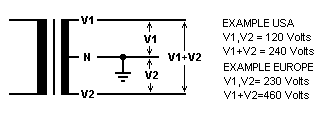
Someone tell me hos a transformer can create poly phase? Now if a transformer can create poly phase they why, going back in time, did we have motor generators like the old KATO units to create poly phase, for example run three phase motors? Why wasn't just a transformer used? A single-phase transformer (primary) with a series/parallel 120/240V secondary winding has two separate 120V secondary windings and is usually connected into a 3-wire system. This is why I can't refer to my residential power as two phase and refer to it as 240 VAC "split-phase". Transformers cannot convert a single-phase source to a three-phase source or for that matter a two phase source. That's my story and I am sticking to it. Possibly the poster who mentioned this could elaborate on why they feel the way hey do?

Ron
The comeback would be why do the words "two phase" (or polyphase, for that matter) intrinsically imply the ability to do some particular thing with a transformer?
 

nsaspook

Joined Aug 27, 2009
16,428
The comeback would be why do the words "two phase" (or polyphase, for that matter) intrinsically imply the ability to do some particular thing with a transformer?
Yes they do mean something intrinsic about the inability of a transformer to provide output pair taps that have unique rotational torque wiring configurations simply from the conversion of mechanical or electrical energy within the transformer.

https://www.peco.com/SiteCollectionDocuments/current_elec_supplier_tariff_eff_July012016.pdf
Separate EGS Billing - Billing provided by an EGS as provided for in the Electric Generation Supplier Coordination Tariff. Service -
The distribution of energy for use by the customer, including all things done by the Company in connection with such distribution. • standard single-phase secondary: alternating current, 60 hertz:
(a) nominally 120/240 volts, 3 wires;
(b) nominally 120 volts, 2 wires to installations consisting of not more than two 15-ampere branch circuits;
(c) nominally 120/208 volts, 3 wires, for residential service, where available in conjunction with standard polyphase secondary 120/208 volts, 3-phase, 4 wires. • standard polyphase secondary; alternating current, 60 hertz.
Only one service is available to a building. For purposes of determining service capacity limits, a building is defined as a structure, separated from other structures, or a portion of a contiguous structure separated from the remainder of the structure by approved firewalls. When demand or service voltage requires the installation of transformation equipment on the owner's premises, the transformation shall consist of a pad mounted transformer installed at a location provided by the owner and approved by the Company outside the building or a transformer bank installed inside the building in a vault located on the ground floor or one story below grade, meeting National Electrical Code requirements.
The Company will not install, own or maintain any conductors inside or beneath a building nor install indoor transformation in areas supplied by or designated to be supplied at 33,000 volts or greater.
(a) nominally 120/240 volts, 2-phase, 5 wires; only available in areas supplied by 2-phase distribution facilities located along public highways or private rights-of-way and limited to service capacities of 100 kVa or less;
(b) nominally 240 volts, 3-phase, 3 wires; a fourth wire neutral will be extended for the supply of 120/240 volt single-phase equipment in combination with the service where the service capacity required does not exceed 15 kVa on any one of the phases. Where the demand to a single premises exceeds 100 kVa, transformers will be installed on the premises at a suitable location provided by the owner. The service capacity is limited to 300 kVa for transformers located inside the building and 500 kVa for transformers located outside the building.
(c) nominally 120/208 volts, 3-phase, 4 wires, (where 3-phase distribution is available) for the exclusive supply of secondary service to a building or group of contiguous buildings occupied by one or more than one customer, with transformers and secondaries installed on the premises at suitable locations provided by the owner. The service capacity is limited to 750 kVa for transformers located either inside or outside the building. When the service capacity exceeds 750 kVa for transformers located either inside or outside of the building the only rate option available to the customer will be Rate HT. When a suitable transformer location is not reasonably available on the premises and the demand does not exceed 100 kVa, service may be supplied at the Company's discretion from aerial distribution facilities located along public highways.
(d) nominally 277/480 volts, 3-phase, 4 wires (where 3-phase distribution is available) for the exclusive supply of secondary service to a building occupied by one or more than one customer with transformers and secondaries installed on the premises at suitable locations provided by the owner. The service capacity is limited to 750 kVa for transformers located inside the building and 1,500 kVa for transformers located outside the building. If the service capacity exceeds 750 kVa for transformers located inside the building or 1,500 kVa for transformers located outside the building the only rate option available to the customer will be Rate HT.
 
Last edited:

WBahn

Joined Mar 31, 2012
33,063
Yes they do mean something intrinsic about the inability of a transformer to provide output pair taps that have unique rotational torque wiring configurations simply from the conversion of mechanical or electrical energy within the transformer.

https://www.peco.com/SiteCollectionDocuments/current_elec_supplier_tariff_eff_July012016.pdf
There's nothing intrinsic about that at all. That is the meaning that WE have arbitrarily associated with that term based on the evolution and development of OUR power systems. It is what we have decided it means to US and is not based on what the words, themselves, mean. You need to dissociate the connotation from the denotion of the words.
 

nsaspook

Joined Aug 27, 2009
16,428
There's nothing intrinsic about that at all. That is the meaning that WE have arbitrarily associated with that term based on the evolution and development of OUR power systems. It is what we have decided it means to US and is not based on what the words, themselves, mean. You need to dissociate the connotation from the denotion of the words.
Most electricians and EEs will rightly and justifiably laugh at you for calling a NA single phase 240/120 feed two phase. I just think it's misleading at best.

The meaning of the term(s) is clear from the aspects of science, engineering and the few utility supply tariffs that support the service today. Semantical word games only serve to obscure the historically valid reasons Tesla, Charles P. Steinmetz and the engineers of the day specifically used two-phase (polyphase) as a unique descriptor for alternating currents out of step in patents for the electrical systems of the day.

https://pdfslide.net/documents/the-...k-at-two-phase-power-for-ac-distribution.html
 
Last edited:

Reloadron

Joined Jan 15, 2015
7,898
I won't pursue a foolish argument here anymore than the which way does current flow nonsense. Post #47, a single post started this in a thread which was how old? Sorry but I figure I am in good company with how I see it and I will let it go at that. By the way, post #47 has yet to say another word and my personal policy prohibits feeding the trolls. :)

Ron
 
The utility delivers single phase to the transformer in NA usually. True two phase did exist. the split-phase just delivered to the panel just makes the power a bit safer and adds more cost with the having to fuse L1 and L2.

People are dumb. No question about it.

It's "single phase just like "paper is an insulator" except when you can place probes on paper and measure the conductance.
A wire moving in the earth's magnetic field is a generator too. A wiggling wire generates electricity too and three 1K resistors in series sometimes isn't 3000 ohms either.

Heck, the local LE measures time in Siemens. e.g. 0.4S and not 0.4s. They seem to belong in someone's pet rock collection. Does anyone care?
 

Definca

Joined Jun 6, 2020
2
Well THAT was refreshing. It would seem we have made SOME headway boys. Apparently, there is some agreement in upgrading the definition of "single phase" 240vt, (which it ain't) to the new more accurate distinction "split phase" . Some things are obvious to the casual observer. It would seem that the term two phase is uncommonly heard these days, sort of abandoned, by unpopular attempts of its use. If only Michael Keaton could have said "yeah, 220, 221, whatever it takes,....you know, two phase".
 

Attachments

nsaspook

Joined Aug 27, 2009
16,428
Sure, a split of a single phase feed into voltages split from a transformer secondary center tap neutral into two equal lower voltages (that can be in or out of a single phase depending on the wiring of the center taps) of the same single phase seems right. :rolleyes:


split-phase

Fig. 2 illustrates the phasor diagram of the output voltages for a split-phase transformer. Since the two phasors do not define a unique direction of rotation for a revolving magnetic field, a split single-phase is not a two-phase system.
 

Reloadron

Joined Jan 15, 2015
7,898
Well THAT was refreshing. It would seem we have made SOME headway boys. Apparently, there is some agreement in upgrading the definition of "single phase" 240vt, (which it ain't) to the new more accurate distinction "split phase" . Some things are obvious to the casual observer. It would seem that the term two phase is uncommonly heard these days, sort of abandoned, by unpopular attempts of its use. If only Michael Keaton could have said "yeah, 220, 221, whatever it takes,....you know, two phase".
Beats the hell outta me. Figure I am now 70 years old and referred to it as split phase my entire adult (some juvenile time tossed in) as split phase. Doesn't seem to me as "new". :) Much like the direction of electron (or hole) flow. During an entire career I never needed once to know. I learned electron flow was neg to pos and it matters not to this day to me and with a career spanning over 40 years it never mattered.. I figure there will always be certain things the hopeless pedantic will cling to and by now I am too old to be a hopeless pedantic. :)

Ron
 
Since I studies solid state physics and worked in the industry it mattered "sometimes". In electro-chemistry class I found out it mattered.

I learned electron circular orbits and then the probability of finding an electron. The s and p orbits.

When you really need the "split-phase" terminology, you use it. Usually, your dealing with two wires and ground. now, in many cases whe have to deal with four because of the 120 V stuff with our stoves and dryers.
 
Last edited:

Reloadron

Joined Jan 15, 2015
7,898
Since I studies solid state physics and worked in the industry it mattered "sometimes". In electro-chemestry class I found out it mattered.

I learned electron circular orbits and then the probabability of finding an electron. The s and p orbits.

When you really need the "split-phase" terminology, you use it. Usually, your dealing with two wires and ground. now, in many cases whe have to deal with four because of the 120 V stuff with our stoves and dryers.
That's where it actually matters.

Ron
 
Top