Hybrid parameter model - common emitter

Thread Starter

mentaaal

Joined Oct 17, 2005
451
Hey guys, just wandering something before my analogue test tomorrow, in the hybrid parameter model given in the attachment by our teacher, he says that the output impedance is 1/hoe (this is Zo) in parallel with Rload. But to me it looks more like it should be Zo//Re + Rload. As Re is in series with Rload and Re + Rload is in parallel with Zo. Could someone please tell me whats going on?


Attachments

mik3

Joined Feb 4, 2008
4,843
Hey guys, just wandering something before my analogue test tomorrow, in the hybrid parameter model given in the attachment by our teacher, he says that the output impedance is 1/hoe (this is Zo) in parallel with Rload. But to me it looks more like it should be Zo//Re + Rload. As Re is in series with Rload and Re + Rload is in parallel with Zo. Could someone please tell me whats going on?


Re is not in series with Rload. Now if Re is bypassed by a capacitor then we assume the capacitor as a short circuit at AC signals so the output impedance is as your teacher says. if not is more complicated.
 

Thread Starter

mentaaal

Joined Oct 17, 2005
451
Hi mike, thanks for the very very quick reply, could you please explain why Re is not in series with Rl? If hfe is regarded as being a current source then current can go through 1/hoe or through Re+Rl making them in parallel. Or at least thats how I see it. Could you point out where i am wrong please?
 

mik3

Joined Feb 4, 2008
4,843
Hi mike, thanks for the very very quick reply, could you please explain why Re is not in series with Rl? If hfe is regarded as being a current source then current can go through 1/hoe or through Re+Rl making them in parallel. Or at least thats how I see it. Could you point out where i am wrong please?
Now i am confused too!!!
 

mik3

Joined Feb 4, 2008
4,843
Hi mike, thanks for the very very quick reply, could you please explain why Re is not in series with Rl? If hfe is regarded as being a current source then current can go through 1/hoe or through Re+Rl making them in parallel. Or at least thats how I see it. Could you point out where i am wrong please?
The current through Rload and Re is not the same. Re carries a bit more current than Rload because of the input voltage so they are not in series.
 

Thread Starter

mentaaal

Joined Oct 17, 2005
451
The current through Rload and Re is not the same. Re carries a bit more current than Rload because of the input voltage so they are not in series.
True, Re carries base current as well as collector current but from the current source's perspective, that shouldnt change my notion that 1/hoe // with Rl + Re?? The current that the current source motivates in the model that goes through Re goes through Rl as well so Re should be in series with Rl.....
 

Thread Starter

mentaaal

Joined Oct 17, 2005
451
Could this case be only with the assumption that a bypass capacitor has been placed across the emitter resistor? Perhaps my lecturer means this because its such common practice? I would just ask him but i dont have him anymore this semester as the semester is over...
 

The Electrician

Joined Oct 9, 2007
2,986
To find the output impedance of the full circuit you need to do a full nodal analysis. The existence of a non-zero value for hre (reverse voltage transfer ratio) causes some of the output voltage to be fed back to the base, and then the presence of Rsignal and Rbase allows a current on the base side, which complicates the output impedance expression.

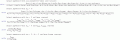
The attachment shows the output impedance for the full circuit and then for several simplifications such as setting hre to zero, removing Rsignal and Rbase, and finally removing re, which for ac signals would be the same as bypassing it with a capacitor.

The last impedance shown is in fact just 1/hoe in parallel with Rload.

The output impedance with all the parameters in place is probably not much different than 1/hoe || Rload, but you would have to evaluate the more complicated expressions with numerical values to find out.
 

Attachments

Top