How to match audio o/p from a radio to another voice distribution unit

Thread Starter

Salim.khan

Joined Nov 7, 2016
5
Hello
I want to make an audio matching circuit, i.e. taking audio from a device (e.g. Radio) and feed it into a voice distribution (kind of intercom) system. So how to make/design matching circuit? How to calculate the value of transformer coil? Can you help ?

Also How to test and measure SMD transformer for audio matching circuit ?

Thanks
 

crutschow

Joined Mar 14, 2008
38,463
The only matching you need for audio is the signal voltage level.
If it's too low, you may need a small amplifier or transformer.
If it's too large, you can reduce it with a resistive divider or a pot.

What is the radio and where will the output be taken?
 

Thread Starter

Salim.khan

Joined Nov 7, 2016
5
Dear Crutschow

Thank you very much for you Answer, You are right .

The 'Radio ' is a UHF radio, and the output from the audio socket will be taken to a intercom system, hence somany users can listen and reply to the UHF Trx.

Thanks again for your reply, i appreciate you heartily.
I will read to understand how to measure audio voltage level and what level is required for the intercom unit.
Best Regards

Salim
The only matching you need for audio is the signal voltage level.
If it's too low, you may need a small amplifier or transformer.
If it's too large, you can reduce it with a resistive divider or a pot.

What is the radio and where will the output be taken?
The only matching you need for audio is the signal voltage level.
If it's too low, you may need a small amplifier or transformer.
If it's too large, you can reduce it with a resistive divider or a pot.

What is the radio and where will the output be taken?
 

crutschow

Joined Mar 14, 2008
38,463
Chances are the audio output voltage will be of a proper voltage to drive the intercom.
It's difficult to measure voice signals with a digital meter, but an analog AC voltmeter or oscilloscope should work.
Generally audio inputs run around a half volt to a volt or two of AC voltage (not a mic input which normally takes a lot less).

The worst that can likely happen if the voltages are mismatched is you will get a lot of distortion.
 

Thread Starter

Salim.khan

Joined Nov 7, 2016
5
Chances are the audio output voltage will be of a proper voltage to drive the intercom.
It's difficult to measure voice signals with a digital meter, but an analog AC voltmeter or oscilloscope should work.
Generally audio inputs run around a half volt to a volt or two of AC voltage (not a mic input which normally takes a lot less).

The worst that can likely happen if the voltages are mismatched is you will get a lot of distortion.
Thanks again

May i have your email ID, so i can ask you progress of this project, and some relevant things.

Thanks again and Best Regards.

my email is <SNIP>

Moderators note: removed email address to avoid spammers
 
Last edited by a moderator:

drc_567

Joined Dec 29, 2008
1,156
Just curious as to what the audio output terminal looks like. It's physical characteristics and appearance may give a clue as to what type of cable or connector to use.
 

Thread Starter

Salim.khan

Joined Nov 7, 2016
5
Just curious as to what the audio output terminal looks like. It's physical characteristics and appearance may give a clue as to what type of cable or connector to use.
The audio output terminal is the 7-pin socket to connect PTT mic &speaker
 

crutschow

Joined Mar 14, 2008
38,463
The audio output terminal is the 7-pin socket to connect PTT mic &speaker
That could pose a problem if the speaker output is a floating (bridge-type) output.
If so you would need an audio transformer or other way to isolate the ground.
Do you have any info on the radio?

The safest might be just to use a 1:1 600 ohm audio transformer for isolation such this.
 
Last edited:

dendad

Joined Feb 20, 2016
4,636
ExtractAudio.jpg
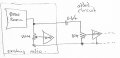
In the "Old days", all you needed to do was to take a signal from across the volume pot. Use a shielded cable, shield to the low end of the pot, and the center conductor, via a DC blocking capacitor, maybe 0.1uF poly capacitor, from the other end. Do not connect to the wiper. Then feed the extracted audio to the external amp or whatever via another potentiometer so both outputs have independent controls. That works well.
But nowadays, the potentiometer may not have audio on it at all, just some control signal to talk to the CPU in the device.
 
Last edited:

AnalogKid

Joined Aug 1, 2013
12,110
That could pose a problem if the speaker output is a floating (bridge-type) output.
The safest might be just to use a 1:1 600 ohm audio transformer for isolation such this.
I disagree about the output. If it is BTL (bridge-tied load), then both output pins have the complete audio signal sitting on some DC. Either one can be used for the signal output with just a coupling capacitor (assuming the level AC level is ok).

I agree that a 1:1 transformer, like one salvaged from an old modem board, is the safe way to start. But it is not required based on what we know so far.

ak
 

Thread Starter

Salim.khan

Joined Nov 7, 2016
5
That could pose a problem if the speaker output is a floating (bridge-type) output.
If so you would need an audio transformer or other way to isolate the ground.
Do you have any info on the radio?

The safest might be just to use a 1:1 600 ohm audio transformer for isolation such this.
What info do u need about the radio ? how to test/measure these audio transformer ?
 

crutschow

Joined Mar 14, 2008
38,463
What info do u need about the radio ? how to test/measure these audio transformer ?
A schematic or any info on the audio output.
Is the audio two separate outputs to the speaker or one output to ground?

If you have an audio transformer you don't have to test it.
Just hook it up and see if it works.
 
Top