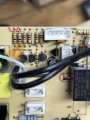
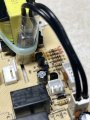
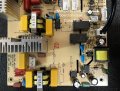
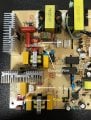
Here’s ANOTHER failure… ultrasonic cleaner

Thread Starter

robismod

Joined Sep 22, 2015
357
Hi,
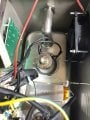
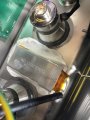
Earlier, I mentioned a thermal fuse, It's cable tied to a transformer. Two thick black cables with a plug on the end of it.
A simple check, unplug it and test for continuity . e.g. it should show a short circuit if it's good.
I appreciate all this stuff is blowing your mind. Anything you don't understand, just ask the forum
Thanks SO much for your patience and understanding. Being the jack-leg “technician” that I’ve been for many years I’ve had good luck with fixing many things. And that sense of accomplishment—you just can’t beat it. But sadly I’m realizing the depth at how things have changed so much and even farther above my head. Yes, I’ll be the first to say “I shouldn’t be messing with things that can be really dangerous, without the training…” but you can’t change a hard head. I do, however, try my best to take precautions—I HATE getting zapped! It gets my attention and HOW! But I keep doing it. It’s just in my 65 YO DNA.
It’s very frustrating—I take this board out and look it over, hoping for something obvious. (like in other things) But when it’s not then I realize I really need to understand what’s going on within the boards, what the parts do and how they contribute to the end functions. That’s fascinating too. And it looks like it should be so simple to figure out what’s not happening. LOL I know better but I can’t help thinking it. I believe it’s because I’ve witnessed guys that make it look so easy to track down problems. I realize there’s years of training/experience behind that and here I have been for many years hoping I could stumble upon the “secrets” and “shortcuts” that would let me sort-of compete… I know better but a fellow can dream, huh? Luckily, guys here and other types of forums have been very helpful and non-judgmental, and with that have given me much success. Most times, it’s as if they (y’all) love to teach your talents and enjoy seeing others win in their efforts. Lord knows it seems that we are seeing a decline in folks that can fix things and that’s sad…(sorry about the long-winded response… I get a little passionate )
Hopefully later tonight I’ll dig back into that board and into that specific area you mentioned. And I’ll look those things up to learn a little more.
Another side note: would it be a terrible idea to suggest an occasional board be posted, with and without schematics, and then you guys might have some time to give a synopsis of what the board should do, how it goes about it, maybe ID the parts, and possibly using your skills detail how the signals move through the board to get their desired result? That’s a tall order I know. On this particular board of mine, I figure 1. It takes normal house current in, then changes it in some places for different functions, (rectifiers, transformers) converts to some signal that feeds the transducers that sort-of vibrate the bowl of fluid, supplies power to turn on a heater for the fluid, etc. Sadly, I’m just too old to go “back to school” and hit the books—too many other issues to deal with around me, and my mind can’t settle down long enough for that kind of learning.
Again, many thanks
 

MrChips

Joined Oct 2, 2009
34,851
Here is my take on this.

There are simple boards. There are complex boards. And there are super complex boards.
Some simple boards you can diagnose without having access to a schematic. Beyond that, you are driving in the dark in unknown territory without a roadmap.

I have searched and searched and searched and there is no technical data or reference to be found. The only thing available are lots of videos on how to use an ultrasonic cleaner to clean your carburetor. Ha, ha!

The design of an ultrasonic cleaner power supply is not complex. It is basically, a transformerless AC to DC convertor with a high power DC oscillator in the output stage. Having said that, I generally stay away from transformerless power supplies and DC-to-DC converters. Why? Because they are lethal!

So where do you go from here?

You can buy a replacement board that will be different from the original one. Then you have to figure out how to wire it up. And the replacement will likely cost you as much as buying a new ultrasonic cleaner.

Another option is to reverse engineer what you have. How does one go about doing this? You take photos of both sides of the board (which you have already done). Then you try to draw all the electrical connections on the board. Next, you try to lay out the diagram in a fashion that closely resembles an existing circuit design.

Next, you have to run a computer simulation to reveal the expected voltages at all the components and connections. Only then can you start probing the faulty board with a DMM and oscilloscope in order to locate the fault.

If this sounds difficult and a lot of work, well, it is. I have had to do this a few times when there is no other option left but to toss it out.
 

MrChips

Joined Oct 2, 2009
34,851
But sometimes one gets lucky.

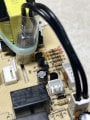
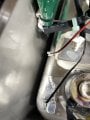
For starters, at the very least, unplug this connector and test for continuity across the two black wires in the plug.
That is your first step.

Central Machinery Ultrasonic Cleaner thermal fuse.jpg
 

MrChips

Joined Oct 2, 2009
34,851
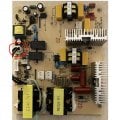
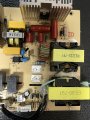
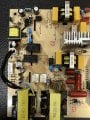
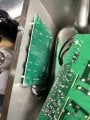
Your next task is to take another photo of the top side of the board. This time, we want to be able to read the print on the board so that we can identify the parts and connectors by their labels.

Finally, for now, I would like to know which cable goes to where on both ends of the cable. For example, what are these two connectors, white and red on the lower right corner of the photograph?

Central Machinery Ultrasonic Cleaner board.jpg
 

Thread Starter

robismod

Joined Sep 22, 2015
357
Your next task is to take another photo of the top side of the board. This time, we want to be able to read the print on the board so that we can identify the parts and connectors by their labels.

Finally, for now, I would like to know which cable goes to where on both ends of the cable. For example, what are these two connectors, white and red on the lower right corner of the photograph?

View attachment 346770
Very cool MrChips! And I’m completely with you on your take on “repairs”. Truly out of my range for the most part. But, see how you did that? You are telling the truth on all it encompasses as well as the dangers, but yet you allow for some “tinkerers” like me, to dig in a little. Just enough to whet our whistle, and maybe, and sometimes we might get lucky. I’m just about ready to give in and buy another one, but not without digging in just a little. Thanks for your guidance, and I will look into that as well. It’s much appreciated.
 

Thread Starter

robismod

Joined Sep 22, 2015
357
Hi,
Earlier, I mentioned a thermal fuse, It's cable tied to a transformer. Two thick black cables with a plug on the end of it.
A simple check, unplug it and test for continuity . e.g. it should show a short circuit if it's good.
I appreciate all this stuff is blowing your mind. Anything you don't understand, just ask the forum
That little set of wires comes from a “pad” that’s held against the side frame of that transformer and is wrapped in a plastic sleeve? Unplugged and put probes across both wires and I get the tone for continuity.
 

Attachments

Thread Starter

robismod

Joined Sep 22, 2015
357
My mind is like a scrambled egg at this moment trying to grasp some of this…
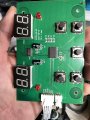
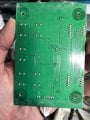
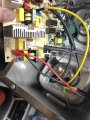
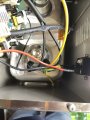
Something just popped into my mind…what if could be in the little control board circuit—maybe power getting to it but stopped before it gets to the point of lighting the LEDs or affecting the control buttons? Can I apply 110v to the two input terminals (all carefully) and then see about getting a read at the control board connector in the PCB? Or am I on the wrong path? Pics attached:
 

Attachments

Thread Starter

robismod

Joined Sep 22, 2015
357
@SamR
That trace on back of the board appears on—still have to look at other spot.
Also, the DB20 is actually a DB207 and best I can tell seem to be ok, but I wouldn’t swear to it—my testing method may be wrong…
 

MrChips

Joined Oct 2, 2009
34,851
Applying 110 V anywhere is not a good thing. Poof! Everything goes up in smoke.

Let's slow down, stop, and back up for a minute.
Let's examine the history and symptoms first.

1) You stated that the timer lights were working but there was no sense of vibration from the cleaner.

2) Then you brought it into the house, and nothing. Dead as a doornail.

To me, that indicates two separate problems. Are they related? At this point. I don't know.
The 2nd symptom tells me that the power supply is dead. Hence that would be where I would begin.

We need to know (and see) where is the AC power cable. Without plugging in anything, we want to check the integrity of the input cables.

  1. Is the plug good?
  2. Where does the cable go?
  3. Is there a fuse on the input?
  4. Is there a hard power switch?
  5. Where does AC power enter the board?
  6. What components are associated with the input AC power?

By the way, thanks for the new set of photos. It will take some time to analyse these.
 

Thread Starter

robismod

Joined Sep 22, 2015
357
Applying 110 V anywhere is not a good thing. Poof! Everything goes up in smoke.

Let's slow down, stop, and back up for a minute.
Let's examine the history and symptoms first.

1) You stated that the timer lights were working but there was no sense of vibration from the cleaner.

2) Then you brought it into the house, and nothing. Dead as a doornail.

To me, that indicates two separate problems. Are they related? At this point. I don't know.
The 2nd symptom tells me that the power supply is dead. Hence that would be where I would begin.

We need to know (and see) where is the AC power cable. Without plugging in anything, we want to check the integrity of the input cables.

  1. Is the plug good?
  2. Where does the cable go?
  3. Is there a fuse on the input?
  4. Is there a hard power switch?
  5. Where does AC power enter the board?
  6. What components are associated with the input AC power?

By the way, thanks for the new set of photos. It will take some time to analyse these.
Yes, all indicators were lit and function buttons worked—but the usual vibration noise was very low. I didn’t really notice until after the 20 times minutes had run down and then lifting off the lid I didn’t feel any normal heat. The fluid was cold. Tried it again, and same result. Drained it—the ball valve on the end of the tank I found clogged, so I tipped the tank over and poured into a container. I then carried it to an outside spigot to spray a little pressure into the drain which then blew out the clog through the valve drain. (probably at this point some moisture got into the the board area)
Carried into the house, plugged in and nothing then.
*cable plug good—even tried another
*checked fuse built into the case-mounted AC inlet/On-Off switch—OK
*from that AC inlet, two wires feed into the board onto that connector labeled Power In on one pic

(HMMMM…you know, I don’t recall checking the simplest thing first—is the power getting past the main OnOff switch I’ll check that shortly) OOOPS! My memory isn’t what it was…the On/Off switch is actually a push pad on the front control panel…

Im going to go ahead and order another unit in the meantime…I really need to get a carburetor back together! But I’ll go as far as I can with this unit.
Again, many thanks for putting up with my mess.
 
Last edited:

Thread Starter

robismod

Joined Sep 22, 2015
357
Well…as I said just a bit ago I’d likely do—I ordered another unit. This time it’s a Vevor, and it was a little over 80 bucks shipped, compared to 179 regular priced Harbor Freight model. But, other than getting it out of the box and set up in the shop, I’ve yet had time to give it a workout…
I’m still curious about what let go on the old board and still want to tackle finding it. On one hand it seems like it’s not that complicated—fewer components compared to so many other boards, but on the other hand I know there’s soooo much I don’t even begin to know about circuits and parts. But again my hardheadedness leads me into uncharted waters LOL.
@MrChips said:
“For starters, at the very least, unplug this connector and test for continuity across the two black wires in the plug.
That is your first step”
I did test this, and I got the continuity tone. What’s that telling me? Trouble before this point?
And I’m thinking that instead of my potentially dangerous way of testing with 110v powering it up, that I should have a power supply of some lower level, and maybe a variable rheostat to supply? I read in many places where that’s being done, but I’m wondering if certain parts/functions have to have a certain amount feeding them? (I also know how well a schematic can help)
Again, many thanks.
 
Top