For debjit

Thread Starter

studiot

Joined Nov 9, 2007
4,998
Here is a nice little problem that was posted on another forum.

enjoy


Person A left Town X at 10:18 am. He walked at a constant speed and arrived at town Z at 1:30 pm. On the same day, Person B left town Z at 9 am. Person B walked the same route in the opposite direction at a constant speed. Person B arrived at town X at 11:40 am. The road crosses a wide river. By coincidence, both arrived at the bridge on opposite sides of the river at the same instant. Person A left the bridge 1 minute later than Person B. At what time did they arrive at the bridge
 

Thread Starter

studiot

Joined Nov 9, 2007
4,998
How fast was person B walking if the bridge is 1/4 mile wide?
Why do you want to know that? Person B walks just fast enough to cross the bridge in 5 minutes. That is calculable from the information given.
 

WBahn

Joined Mar 31, 2012
33,016
Why do you want to know that?
I already know it. I was throwing it out as a confirming question.

I don't want to just give the answer and spoil other people's fun, particularly if you were posing it specifically to one person as a challenge of some kind.

So by answering my question, and coming up with a nice round exact answer, it provides strong evidence that I actually did solve the problem. Of course, my answer involving the clock bells also does this -- the two combined make it pretty much a sure thing.
 

Thread Starter

studiot

Joined Nov 9, 2007
4,998
Yes I think you have it.

I understand the question was posed at a conference for high school physics teachers.
 

WBahn

Joined Mar 31, 2012
33,016
It's a nice question, with a lot of interesting variants. Not too hard to set up correctly and not too hard to solve once you do. But fairly easy to mess up if you don't think through it with some care.
 

MrChips

Joined Oct 2, 2009
34,974
Very intriguing. I don't know if there is quick solution but it took me awhile (about an hour) doing it graphically.

(The length of the bridge is irrelevant).

Here is another question: At what time do they meet?
 
Last edited:

WBahn

Joined Mar 31, 2012
33,016
2 min 44 & 4/9 seconds after they reached the bridge.

I solved in about 10 minutes algebraically, but part of that is probably because I caught what I thought was an inconsistency in the problem, namely that one person left the bridge a minute after the other person did, but yet it stated that they were moving at a constant speed for the entire trip. So it very quickly donned on me that the difference had to be related to how long it took each to cross the bridge. So I first solved for how long that was (which is two lines of algebra). With that, the two simultaneous equations can be written down pretty much by inspection and then five lines of algebra and then plugging about eight numbers into a calculator.
 

debjit625

Joined Apr 17, 2010
790
Sorry for late response as last weak I was very busy with my own studies.
The question is very interesting and thanks to studiot .Obviously it was for me as I think I am only the Debjit in AAC,so I am going to answer it I guess. I will try to explain it very well as many students may have problem solving this.

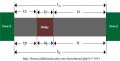
Here is the picture ,which describes almost every thing...


As you can look at the picture what I have did, their is two town 'X' and 'Z' in between their is a bridge, now the total time taken by person 'A' to walk from town 'X' to 'Z' is \(t_A\) which is given its from 10:18 am to 1:30 pm i.e.. 192 min,the total time taken by person 'B' to walk from town 'Z' to 'X' is \(t_B\) ' which is also given 9:00 am to 11:40 am i.e.. 160 min.

\( t_A = 192 \)

\( t_B = 160 \)

Now as
speed/distance and time are involved we could write it like this...
Now both covers the same distance 'D' at their respective speed \(S_A\) is the speed for person 'A' and \(S_B\) is the speed for person 'B'.

\(S_A = {D \over t_A} \)

\(S_A = {D \over 192} \)

\(D = S_A * 192 \)
And

\(S_B = {D \over t_B} \)

\(S_B = {D \over 160} \)

\(D = S_B * 160 \)

or

\(S_B * 160 = S_A * 192\)

\({S_B \over S_A}= {160 \over 192} = {6 \over 5}\)

The ratio describes that the speed of person 'B' is 6/5 times faster than the speed of person 'A'.
As in question and by looking at the picture it says person 'B' took \(t_q\) time to cross the bridge and person 'A' took \(t_y\) time to cross the bridge or its also given person 'A' took 1 min extra to cross the bridge so we can write

\( t_y = t_q + 1\)

Now in the whole journey both the person maintained same speed so at the bridge also they maintained the same speed,let be the distance of the bridge be \(D_B\) ',then we can write

\(S_A = {D_B \over t_q + 1}\)

\(D_B = S_A*(t_q + 1)\)

and
\(S_B = {D_B \over t_q}\)

\(D_B = S_B*t_q \)
or

\({S_B\over S_A} = {(t_q + 1) \over t_q}\)

\({6\over 5} = {(t_q + 1) \over t_q}\)

\(6t_q = 5t_q + 5\)

\(t_q = 5 min\)

then

\(t_y = 6 min\)

Now in the picture its clear the total time (which is given) taken by each person is divided into three parts,for person 'A' its \( t_x , t_y , t_z \) and for person 'B' its \( t_p , t_q , t_r \) , from these information we can write some equations...
For person 'A'

\( t_x + t_y + t_z = 192 \)

\( t_x + t_z = 186 \)

For person 'B'

\( t_p + t_q + t_r = 160 \)

\( t_p + t_r = 155 \) ------ Eq 1

Now above both the equation describes the same thing so its means we have our first equation but we need to find some other equation form the same event.

Well we can say this as per the question, that the real clock time taken by person 'A' to walk from town 'X' to the one end of the bridge is the sum of the time when he started (10:18 am) and \( t_x \),and it is equal to the real clock time taken by person 'B' to walk from town 'Z' to the other end of the bridge is also the sum of the time when he started (9:00 am) and \( t_r \).We can write it like this...

\( 10:18 am + t_x = 9:00 am + t_r \)

Converting the real clock time to min for calculation

\( 618 + t_x = 540 + t_r \)

\( t_x - t_r= -78\)

We can write \(t_x\) as

\( {6 \over 5} t_p - t_r = -78 \)

\( 6t_p - 5t_r = -390 \) ----- Eq 2

So we got 2 equations ,now we can solve it

\( t_p + t_r = 155 \) ------ Eq 1

\( 6t_p - 5t_r = -390 \) ----- Eq 2
Multiply equation 1 with 6

\( 6t_p + 6t_r = 930\) ------ Eq 1

\( 6t_p - 5t_r = -390 \) ----- Eq 2

Subtracting eq 2 from eq 1
\( 11t_r = 1320 \)

\( t_r = 120 min \)

And
\( t_x - t_r= -78\)

\( t_x = 42 min\)

So person B started at 9:00 am and after 120 min he reached the bridge i.e.. 11:00 am and person A started at 10:18 am and 42 min he reached at bridge i.e.. 11:00 am.

Good Luck
 

Attachments

debjit625

Joined Apr 17, 2010
790
2 min 44 & 4/9 seconds after they reached the bridge.

I solved in about 10 minutes algebraically, but part of that is probably because I caught what I thought was an inconsistency in the problem, namely that one person left the bridge a minute after the other person did, but yet it stated that they were moving at a constant speed for the entire trip. So it very quickly donned on me that the difference had to be related to how long it took each to cross the bridge. So I first solved for how long that was (which is two lines of algebra). With that, the two simultaneous equations can be written down pretty much by inspection and then five lines of algebra and then plugging about eight numbers into a calculator.
Sorry its not the correct answer... it will be 11:00 am
 

WBahn

Joined Mar 31, 2012
33,016
Sorry its not the correct answer... it will be 11:00 am
Different question. I got the 11:00am, but didn't want to post it and spoil your fun outright. The indication that I actually did get the right answer is that I said that they got there just as the clock struck a new hour. The only new hour at which they were both on the road was 11:00am.

The answer in your quote was for a follow-up question by MrChips, namely when do they actually meet. So this answer is relative to the undisclosed time at which they both arrive at the bridge.

Here's how I did it:

Preliminaries:

The total distance traveled by each is D.
Person A takes a total of 3h 12m = 192min
Person B takes a total of 2h 40m = 160min
Person A leaves their side 78min after Person B leaves theirs.

Thus
Person A is walking at a speed of Va = D/192min
Person B is walling at a speed of Vb = D/160min

If the bridge has a length B, then the time it takes each person to walk this is:
Person A: Ta = B/Va
Person B: Tb = B/Vb

Thus, Ta = Tb(Vb/Va) = Tb((D/160min)/(D/192min) = (6/5)Tb

It is given that Person A takes 1min longer, hence:

Tb = Ta - 1min = (6/5)Tb - 1min
Tb = 5min

Now for the main event:

The distance away from City X is X and, for each person this is given by:

Xa(t) = Va*(t-78min)
Xb(t) = D-Vb*t

where 't' is the time since 9:00am.

If we were looking for the time at which they meet, we would be looking for the time such that Xa(t) = Xb(t). However, because we are looking for the time at which they get to their respective sides of the bridge, we are looking for t such that Xa(t) puts Person A at their side of the bridge and Xa(t+5min) puts Person B at that same side (Person A's side).

Thus
Xa(t) = Xb(t+5min)
(D/192min)*(t-78min) = D-(D/160min)*(t+5min)
(1/192min)*(t-78min) = 1-(1/160min)*(t+5min)
t-78min = 192min - (192/160min)*(t+5min)
t = 270min - (6/5)*(t+5min) = 264min - (6/5)t
(11/5)t = 120min

Thus, the time at which they both arrive at their ends of the bridge is

T = 9:00am + 120min = 11:00am
 

debjit625

Joined Apr 17, 2010
790
WBahn said:
The answer in your quote was for a follow-up question by MrChips, namely when do they actually meet. So this answer is relative to the undisclosed time at which they both arrive at the bridge.
My bad I didn't noticed...

MrChips said:
Here is another question: At what time do they meet?
Well the answer is already given,but its not explained I will do that...
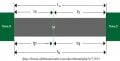
The process will be the same...here is another diagram

Let 'M' be the place where they meet or cross each other,and \(t_x\) be the time taken by person 'A' to walk from town 'X' to 'M' and \(t_y\) be the time taken by person 'A' to walk from 'M' to town 'Z'.
On the other hand \(t_q\) be the time taken by person 'B' to walk from town 'Z' to 'M' and \(t_q\) be the time taken by person 'B' to walk from 'M' to town 'X'.
Many values we already have from earlier solution...like

\( t_A = 192 min \)

\( t_B = 160 min \)

and the speed of person 'B' is 6/5 times faster than the speed of person 'A'.
So we can write

\( t_x + t_y = 192 \) --- Eq 1.1

\( t_p + t_q = 160 \) --- Eq 1.2

We can say this as per the question, that the real clock time taken by person 'A' to walk from town 'X' to 'M' is the sum of the time when he started (10:18 am) and \(t_x\),and it is equal to the real clock time taken by person 'B' to walk from town 'Z' to 'M' which is the sum of the time when he started (9:00 am) and \(t_q\).We can write it like this...

\(10:18 am + t_x = 9:00 am + t_q\)

Converting the real clock time to min for calculation

\(618 + t_x = 540 + t_q\)

\(t_x - t_q = -78\)

\({6 \over 5}t_p - t_q = -78\)

\(6t_p - 5t_q = -390\)---- Eq 1.3

Multiply 6 with Eq 1.2

\( 6t_p + 6t_q = 960 \) --- Eq 1.2

Subtract Eq 1.3 from Eq 1.2

\( 11tq = 1350\)

\( tq = 122.{\overline{72}}\)

In hr/min/sec format \(t_q\) is approx 2hrs , 02 mins and 44 sec

So it will be around 11:02:44 am when they both meet.

Good Luck
 

Attachments

Last edited:

MrChips

Joined Oct 2, 2009
34,974
On the original question, I did mine graphically.


The time scale is referenced to 9:00am. Hence B starts out at time 0.
A starts out 78 min later.

They both travel the same distance D. The actual distance is irrelevant. So I use arbitrary units where D = 160. This simplifies the math.

B reaches his destination 160 min later (red line).

while A reaches his destination at time 270 min (blue line).

B takes 160 min while A takes 192 min.

The speed of A = D/192
The speed of B = D/160
The ratio of A's speed to B's speed is 5:6

If A took 1 more minute to cross the bridge, then A took 6 minutes to cross the bridge while B took only 5 minutes.

So what we do is make A start off 6 minutes earlier, that is we shift A's line early by 6 minutes (purple line).

Where the red and purple lines intersect is the time when they both reach the bridge at the same time. This is solved by straight forward geometry.
 

WBahn

Joined Mar 31, 2012
33,016
tex] tq = 122.{\overline{72}}[/tex]

In hr/min/sec format \(t_q\) is approx 2hrs , 22 mins and 44 sec

So it will be around 11:22:44 am when they both meet.
Just a boo-boo, since the time in minutes is correct. But it does underscore the utility of always asking if the answer makes sense, something that I, too, could have done better on a couple of posts in the last few days.
 
Top