Fast switching 300V

Thread Starter

wcasper4

Joined Dec 11, 2013
38
Hello,

I am trying to switch 300V to 0V in 1μs. I have designed the following circuit. Basically I have a TTL signal in to the two optoisolators wich drive the gates on the P and N mosfets. The P side is floating at 300V.


It works when testing with a 40V DC supply at 0.5A.

The 300V supply I am using is http://www.emcohighvoltage.com/pdfs/cseries.pdf it has an output of 3.3mA .

This is the output I get on the scope, I can only get ~100V to switch on 1.8μs


The rise time is very slow and I don't get to 300V until about 700μs later.


Any idea on what I could improve or why this is not working?

Also (a less significant issue I think) on my scope I see some distortion to my TTL signal that I am inputting to the optoisolator. Why would the signal at the MOSFETS be distorting my input on the optoisolator?
 

Papabravo

Joined Feb 24, 2006
22,083
Yeah. The gates of the MOSFETS are like big capacitors and show the characteristic time it takes to charge the gate capacitance.

Optos have lots of delay and output transistors with their own problems.

AND why is +300V connected to the "zero" input on the DC-DC converter?
AND why is the -12 input of the DC-DC converter connected to GND?
 

Papabravo

Joined Feb 24, 2006
22,083
Change the drive from a voltage source to a current source, and lose the optos since you've got everything connected to a common ground anyway.
 

Thread Starter

wcasper4

Joined Dec 11, 2013
38
Ok, I'm still a beginner here. What would be an example of a current source that I could drive the gates with on that 1us time scale? And still control with a TTL signal?
 

Thread Starter

wcasper4

Joined Dec 11, 2013
38
Thanks, I'll read through this, hopefully figuring out the better way to do this and learn something along the way.
 

Papabravo

Joined Feb 24, 2006
22,083
Yes they can. IIRC they can move 300V in 7-10 nanoseconds. The original computers were build with vacuum tubes and they did alright for their time.
 

Thread Starter

wcasper4

Joined Dec 11, 2013
38
hmm okay. i will read up both on the current source and these tubes then. I really don't care how I switch 0/300V as long as it is fast and reliable.
 

Thread Starter

wcasper4

Joined Dec 11, 2013
38
Sorry, I honestly did not see them the first time I read your reply. Was it edited?

The +300V is connected to the 0 to float that 15V DC/DC - I don't recall why we decided that side should be floated off the 300. Perhaps because it's connected with the P-MOSFET that is switching the 300V

That's mislabeled, it needs 12VDC input. It needs +12 and 0V.
 
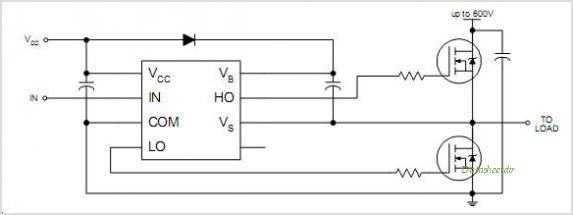
The IR2111 is a readymade mosfet halfbridge driver with the necessary deadtime ciruitru already built in, all you need to do is to supply your PWM signal and you will get a 0-300V output.

Using separate drivers like you are, you will need more circuitry to generate some deadtime to avoid shoot through/cross conduction in your mosfets which will cause EMI to be radiated as well as heating of the mosfets.
 

Papabravo

Joined Feb 24, 2006
22,083
Sorry, I honestly did not see them the first time I read your reply. Was it edited?

The +300V is connected to the 0 to float that 15V DC/DC - I don't recall why we decided that side should be floated off the 300. Perhaps because it's connected with the P-MOSFET that is switching the 300V

That's mislabeled, it needs 12VDC input. It needs +12 and 0V.
There was an edit that I thought took place before I saw your reply. That must be the reason.

So I understand that you are floating the DC-DC converter, but I still don't understand why you are using optos with everything connected to a common ground. Is this impression due to using "paint" to do schematics?
 

Thread Starter

wcasper4

Joined Dec 11, 2013
38
The IR2111 is a readymade mosfet halfbridge driver with the necessary deadtime ciruitru already built in, all you need to do is to supply your PWM signal and you will get a 0-300V output.

Using separate drivers like you are, you will need more circuitry to generate some deadtime to avoid shoot through/cross conduction in your mosfets which will cause EMI to be radiated as well as heating of the mosfets.
I see what you are saying... this is the circuit I see with the datasheet. This diagram can do exactly what I want I think?


Thread Starter

wcasper4

Joined Dec 11, 2013
38
There was an edit that I thought took place before I saw your reply. That must be the reason.

So I understand that you are floating the DC-DC converter, but I still don't understand why you are using optos with everything connected to a common ground. Is this impression due to using "paint" to do schematics?
I am using circuitlab.com to draw and simulate everything. I am trying to learn all this as I go along having not much of a background in EE. This has proven to be useful to me as I can mix and match and design the circuit and test it all at the same time at my computer before I sit down and build it.

What other ground should everything else be connected to? Or is my schematic just not showing it correctly.

Out of curiosity for a second opinion, do you support what Experimentonomen has proposed? I am curious because of what you explained to me as a current source issue with the optoisolators or do the specific IC's he suggested not suffer from the same issue as I was experiencing.
 

AnalogKid

Joined Aug 1, 2013
12,140
To get faster risetime you need to turn on M6 fast, which means driving its gate below its source with something that can more some current. It is not clear how that is being done because the "opto" boxes need more detail. In, Out, and Ref are not normal optocoupler terms, so what are these devices?

ak
 

Papabravo

Joined Feb 24, 2006
22,083
Normally when you use optos you want to provide one ground on the input side and a separate ground on the output side. In addition there can be a potentially large potential difference between the two grounds.

In any design where you have a single common ground, optos don't make much sense because in that case they provide very little benefit and introduce some substantial problems.
 
Top