Danger of probing across a transformer

Thread Starter

umichfan1

Joined Jun 16, 2012
32
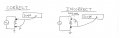
In p. 77 of the 1989 version of "The Art of Electronics" (scan attached), it warns about connecting the ground lead of the scope to one side of the secondary. Why is this? I've been told it will somehow create a short, but I don't understand why a short will be created in this situation but not others.
 

Attachments

#12

Joined Nov 30, 2010
18,224
You have a declared ground on one end of the bridge rectifier. If you also ground one lead of the transformer, you have a short across one of the diodes.
 

Thread Starter

umichfan1

Joined Jun 16, 2012
32
I see. So if you just used one probe to measure the voltage across the transformer's secondary and did nothing with the other probe, it would be fine. The problem arises when you use two probes at the same time and define their grounds differently. Thanks for the explanation.
 

MrChips

Joined Oct 2, 2009
35,180
Not quite right. It has nothing to do with one or two probes.

Your scope is already grounded.

You should NEVER connect the GROUND clip of the probe to any point of the circuit
unless you are certain that point on the circuit is also at chassis GROUND or is FLOATING.

If the circuit is connected to GROUND you may connect either of both GROUND clips to GROUND. You cannot connect the GROUND clips to anything else except GROUND.

If the circuit is FLOATING, you must connect one or both GROUND clips to the SAME reference point.

Always REMEMBER, both GROUND clips on the probes are at the same potential and connected to GROUND.
 

Thread Starter

umichfan1

Joined Jun 16, 2012
32
Thanks, Mrchips, that makes a lot of sense. I just have one follow-up question that has really got me stumped. I explored what you said by seeing what would happen if I set up just about the simplest circuit possible (a wave function generator attached to one resistor) and placed the ground probe of the oscilloscope on the wrong side of the resistor. I expected something bad to happen, since that should cause a short, but it turned out fine! I got exactly the same waveform output as when I placed the ground probe on the correct side of the resistor. (See attached picture.) Does the scope somehow have some clever circuitry that figures out when the ground probe is incorrectly attached?
 

Attachments

crutschow

Joined Mar 14, 2008
38,814
Thanks, Mrchips, that makes a lot of sense. I just have one follow-up question that has really got me stumped. I explored what you said by seeing what would happen if I set up just about the simplest circuit possible (a wave function generator attached to one resistor) and placed the ground probe of the oscilloscope on the wrong side of the resistor. I expected something bad to happen, since that should cause a short, but it turned out fine! I got exactly the same waveform output as when I placed the ground probe on the correct side of the resistor. (See attached picture.) Does the scope somehow have some clever circuitry that figures out when the ground probe is incorrectly attached?
No clever circuit. It would appear that the function generator common is not connected to the earth ground of the mains, so the signal is basically floating and the scope ground probe can be connected to either side of the generator output signal.
 

MrChips

Joined Oct 2, 2009
35,180
If you provided the brand and model number of both the function generator and the scope we may be able to provide better answers.
 

Thread Starter

umichfan1

Joined Jun 16, 2012
32
Hmmm....I thought that the ground of the function generator would necessarily be the same as the ground of the scope (assuming they are both plugged into the same wall socket). Is this an invalid assumption?
 

#12

Joined Nov 30, 2010
18,224
Yes. Some manufacturers are smart enough to isolate their electronics from earth ground.

More likely is that you would ground the function generator to the circuit when you connected it, unless you used a capacitor to couple the signal to the circuit.
 

BillB3857

Joined Feb 28, 2009
2,573
I have an isolation transformer to use with my scope for such an occasion.
You need to be careful using an isolation transformer for the scope and feeling safe. Ask how I know...... Well, I'll save you some time. Bought an isolation transformer, 3 wire plug, 3 wire outlet connector. The Earth Ground was carried through! Used what I thought was an isolated scope because of this new isolation transformer on a piece of line operated equipment and when connecting the scope probe ground lead, KABOOM! Better to use the isolation transformer on the device being tested and a two wire power feed to that device. Then you have isolation!
 
Top