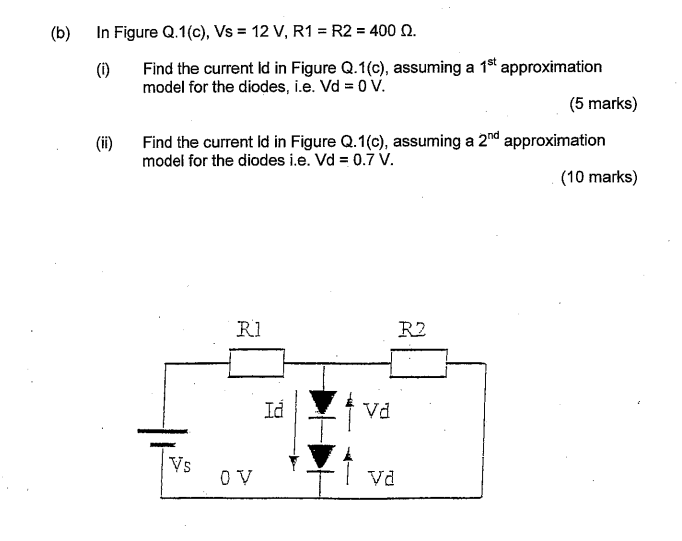
Current Across a 1st Approx. Diode

Thread Starter

Necrocell

Joined Jan 14, 2013
4
Regarding part (b)(i), due to Vd being 0, I am assuming Id is also zero using ohms law, but something about that seems too simple for 5 marks in an exam so I am guessing that I am wrong.

Can anyone care to elaborate?

Much appreciated.


mikeleeson

Joined Aug 22, 2012
26
You have taken Ohm's Law, V= I * R, and assumed that if V=0 then I must be zero. In fact, it is R that is zero (in this first approximation) and so the current can be any value.
Try replacing the two diodes with a short circuit (first approximation) and see what you get when you work out the current.
Then ask yourself, "what can I replace the diodes with to give a voltage drop of 0.7V?". And then see what you get for the current.

 

Thread Starter

Necrocell

Joined Jan 14, 2013
4
Thanks for the help.

Just to quickly clarify if possible, for part (ii) when its using the 2nd aproxx. Is Id 21.5mA?

My solution came from:

Vd = 0.7V
2x Vd = 1.4V

So the voltage drop across R2 will be the same since it is parallel.

Then the voltage drop across R1 must be 12V - 1.7V = 10.3V

Using KCL, I1 = I2 + Id

Then doing some quick Ohms Law I arrived at Id = 21.5mA
 

Thread Starter

Necrocell

Joined Jan 14, 2013
4
Apparently 0.7 + 0.7 ≠ 1.7 :rolleyes:

Thanks for the help again. Ill be using this website alot from now on. Keep up the good work.
 

t06afre

Joined May 11, 2009
5,934
Thanks for the help.

Just to quickly clarify if possible, for part (ii) when its using the 2nd aproxx. Is Id 21.5mA?

My solution came from:

Vd = 0.7V
2x Vd = 1.4V

So the voltage drop across R2 will be the same since it is parallel.

Then the voltage drop across R1 must be 12V - 1.7V = 10.3V

Using KCL, I1 = I2 + Id

Then doing some quick Ohms Law I arrived at Id = 21.5mA
Your approach seams to be correct. But your numbers looks wrong. Hence wrong answer.
 
Top