Can 2 separate circuits share a switch?

Thread Starter

CNR

Joined Jun 30, 2016
7
OK, I like Alberts first drawing, but don't understand how it isolates the 12v switch ON from the 3V remote load? The 'bike chassis' is NOT connected to the remote common... although can it be? They are 2 different battery sources - can their 2 negatives be tied together?
 

GopherT

Joined Nov 23, 2012
8,009
OK, I like Alberts first drawing, but don't understand how it isolates the 12v switch ON from the 3V remote load? The 'bike chassis' is NOT connected to the remote common... although can it be? They are 2 different battery sources - can their 2 negatives be tied together?
Why don't you stick with your first plan? Point us to the link where you originally saw this idea.
 

Thread Starter

CNR

Joined Jun 30, 2016
7
Here's the link : http://www.instructables.com/id/Ins...torcycle/step3/Setting-the-Activation-Switch/

However, its very hard to see in the pics but I do think I 'missread' it. Looks like he's just using the mechanical motion of the switch to press 2 other contacts together ones that he added. Meaning he's not using any of the electronic properties of the switch.

Unfortunately my switch - oddly enough on a much older bike - is completely enclosed with only wires soldered to the back. There is no movement other than the switch slider sticking through the plastic case.
 

EM Fields

Joined Jun 8, 2016
583
I
You could take an idea from pilot-controlled lighting. When you turn your high-beams on and off once it opens door #1. On and off twice, door #2. On and off three times, door #3. It's just a matter of defining the windows for an on-off cycle and how long the high beams have to remain off after the last cycle for the system to decide the command is finished.
And requires the user to be trained to execute the sequence within a specified time frame.
Not a good idea.
 

WBahn

Joined Mar 31, 2012
32,862
I


And requires the user to be trained to execute the sequence within a specified time frame.
Not a good idea.
Why not? It's HIS motorcycle that he is modifying to open HIS garage door.

Just how much training is required to go click-on, click-off, click-on, click-off, click-on, click-off?

How is that any more training than is required to know to use this blinker for that garage door and that blinker for this other garage door and the high beams for yet some other garage door?

If it's such a horrible idea, then why do hundreds of airports around the country use just this system to allow pilots to turn on runway lights and adjust their intensity just by clicking their mike buttons. There's no training beyond: Click 7 times to turn lights on, then click 3, 5, or 7 times to set intensity to low, medium, or high.
 

EM Fields

Joined Jun 8, 2016
583
Hi all,

I'm looking to hook up a garage door remote on my motorcycle and saw some instructions online about using the high beam switch to accomplish this. They soldered 2 wires onto the remotes circuit board to the button contacts so if those wires touch, it acts like a button press. Then they tap into the wires of the high beam switch so when the high beam is on, it closes the remotes 'button' and opens the garage door. Does that sound right to you?

I first thought that a relay would be needed and hooked up to the high beam switch so that on 12V from the high beam power would close its contacts and perform the button press. This makes it more complicated and finding a place to hide the relay/project box is very difficult on a motorcycle.

So can both circuits use the same switch and not interfere with each other? I'm afraid that hooking the remote into a 12V circuit would fry the circuit board or something.

Thanks!
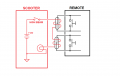
You could do something like this:

Motorcycle switch.png
by winding a reed relay, and it would be very small, but the problem would be that anytime you had the high beam on, the remote would be transmitting continuously.
 

EM Fields

Joined Jun 8, 2016
583
Why not? It's HIS motorcycle that he is modifying to open HIS garage door.

Yeah, but it's irrelevant.

Just how much training is required to go click-on, click-off, click-on, click-off, click-on, click-off?

Depends on what the window looks like.

How is that any more training than is required to know to use this blinker for that garage door and that blinker for this other garage door and the high beams for yet some other garage door?

It's all in the timing, and I posted a blinker solution earlier which uses a retriggerable one-shot to get rid of any sequencing or timing problems.

If it's such a horrible idea, then why do hundreds of airports around the country use just this system to allow pilots to turn on runway lights and adjust their intensity just by clicking their mike buttons. There's no training beyond: Click 7 times to turn lights on, then click 3, 5, or 7 times to set intensity to low, medium, or high.
That's a silly comparison because it's a question of convenience VS necessity, PLUS for the garage door opener the OP was looking for a simple solution, and your way throws in the added complication of decoding the ON-OFF sequence(s) at the receiver and then operating the proper door(s).
 

Tonyr1084

Joined Sep 24, 2015
9,744
So far I like GopherT's idea of using Opto-Isolators. As for multiple door openers - one can run from the high beam the other can run from the brake light.

If you want to complicate things just a little you could use an AND gate so that it takes two switches at the same time to produce a result. Say - HORN and BRAKE to open one door while HORN and HIGH BEAM opens the other. It would be very rare when you'd be pressing the horn button. The only problem with the horn button - you're announcing your lack of care for the peace in the neighborhood.

So we don't use the horn. OK, BRAKE & HIGH BEAM for one door and BRAKE and BLINKER for the other. But now we have the problem of the blinker triggering the open cycle only to cancel it then shut it then cancel it then open it then cancel then open then cancel - on and on. Unless you add an RC on the input of the AND gate. The signal coming from the blinker can energize a capacitor to hold the signal high while the blinker is in the "Blink Off" part of its cycle.

You could use the left blinker to open the left door and the right blinker to open the right door. Just remember that the controls are reversed when you're inside the garage - the left blinker would open the right door (from your perspective). Just remember - left blinker opens the big door and right opens the small door.

Someone posted a drawing showing the high beam, the switch, an LED and resistor along with a 12 volt battery and a 3 volt battery. In that exact circumstance it works. But if the load is NOT diode protected then when the high beam is off 12 volts pushes against the 3 volts resulting in 9 volts reverse current through the remote. You COULD blow it out. And diode protecting it will drop (typically) 0.7 volts. So now your remote is operating on 2.3 volts. With that low power it's unlikely the door will respond.

Keep in mind what you see on YouTube isn't always real. The poster could have his hand on a remote out of camera frame just making it LOOK like it's working.
 

Tonyr1084

Joined Sep 24, 2015
9,744
Be aware that stray light sources will activate the circuit! Do you really want this.
Opto-Isolator's are protected against stray light.

You can even build your own opto-isolator. Just needs an LED and a photo-transistor and some shrink tubing to protect it from stray light sources.
 
Last edited:

EM Fields

Joined Jun 8, 2016
583
Hi all,

I'm looking to hook up a garage door remote on my motorcycle and saw some instructions online about using the high beam switch to accomplish this. They soldered 2 wires onto the remotes circuit board to the button contacts so if those wires touch, it acts like a button press. Then they tap into the wires of the high beam switch so when the high beam is on, it closes the remotes 'button' and opens the garage door. Does that sound right to you?

I first thought that a relay would be needed and hooked up to the high beam switch so that on 12V from the high beam power would close its contacts and perform the button press. This makes it more complicated and finding a place to hide the relay/project box is very difficult on a motorcycle.

So can both circuits use the same switch and not interfere with each other? I'm afraid that hooking the remote into a 12V circuit would fry the circuit board or something.

Thanks!
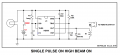
If you leave the remote's battery in the remote and just parallel the button's contacts that you want to activate, this will work:
Motorcycle remote switch.png
It gets around the problem of having the remote always be ON when the high beam is on by using a 555 timer to generate a single pulse when the high beam is turned on. The length of that pulse can be adjusted by changing the values of R1 and C1, where T = 1.1 R1 C1, where R is in ohms and C is in farads.

The output of the 555 is used to directly drive a relay for as long as the pulse is high, and with the relay's contacts connected in parallel with the remote button's switch, will cause the remote to act exactly like it would if the button(s) were pressed manually.

If space is at a premium, there are extremely small relays available, like this, although in a high-vibration environment I'd explore the possibility of using a solid-state relay with a low enough ON-resistance to operate the remote reliably.

I don't know what a motorcycle's electric system looks like, but it wouldn't hurt to put some transient protection across the 555 or even to run it at, say, 9 volts and regulate the voltage into it from the high beam switch.

If you're interested I can edit the schematic to include a regulator.
 

Tonyr1084

Joined Sep 24, 2015
9,744
this will work:
Yes, it will. However, the OP doesn't want to start hanging all kinds of stuff on his bike. Specifically stated - he doesn't want to use a relay.

Also, the 555 is limited in its output capabilities. The relay can be drawing more power than the 555 can source. Perhaps (sorry if that word offends someone) you can replace the relay with an opto-isolator. Much less current and since you're building a board - it can be on the same board.

Then again, a board will need to be incased in something - a box - epoxy - something to protect it from the elements.

And I would suspect that motorcycles are just as noisy as cars (electronically speaking).
 

EM Fields

Joined Jun 8, 2016
583
Yes, it will. However, the OP doesn't want to start hanging all kinds of stuff on his bike. Specifically stated - he doesn't want to use a relay.

Also, the 555 is limited in its output capabilities. The relay can be drawing more power than the 555 can source. Perhaps (sorry if that word offends someone) you can replace the relay with an opto-isolator. Much less current and since you're building a board - it can be on the same board.

Then again, a board will need to be incased in something - a box - epoxy - something to protect it from the elements.

And I would suspect that motorcycles are just as noisy as cars (electronically speaking).
As I recall, the OP was concerned about getting everything into as small a box as possible, and as far as I can tell, my design will fit into less than a cubic inch. Much less.

A 555 can source 100 mA from a 12 volt supply and drop only about 2 volts, and there are relays available with coil currents less than 20 mA, so that's not an issue.

An optoisolator would work if its collector-to-emitter resistance was low enough to substitute for the remote's switch but, depending on the opto's CTR, one might have to bang the LED pretty hard to get there.

I think what's important about the "container" is that it be as small as possible, whatever's in there, so it can be hidden easily.

If motorcycles are just as noisy as cars, then whatever circuitry is used will have to be protected, so the trick here would be to design with as many components as possible that need no protection, wouldn't you agree?
 

WBahn

Joined Mar 31, 2012
32,862
So far I like GopherT's idea of using Opto-Isolators. As for multiple door openers - one can run from the high beam the other can run from the brake light.
You might want to rethink the use of that brake light -- what's the last thing you do when you STOP in front of the garage?
 

WBahn

Joined Mar 31, 2012
32,862
That's a silly comparison because it's a question of convenience VS necessity, PLUS for the garage door opener the OP was looking for a simple solution, and your way throws in the added complication of decoding the ON-OFF sequence(s) at the receiver and then operating the proper door(s).
The OP complicated the problem by wanting to control multiple doors, which your "solution" doesn't do (which makes it not a solution). And what's so hard about decoding multiple on-off sequences using an MCU that has the exact same footprint as the 555 without needing the external timing components?
 

EM Fields

Joined Jun 8, 2016
583
The OP complicated the problem by wanting to control multiple doors, which your "solution" doesn't do (which makes it not a solution). And what's so hard about decoding multiple on-off sequences using an MCU that has the exact same footprint as the 555 without needing the external timing components?
All that's required to simultaneously control any number of doors from a single switch closure on the bike is to wire the door actuators at the receiver end in parallel.

There's nothing particularly difficult about decoding the sequences, but it's a huge PITA if the OP doesn't want to climb the MCU learning curve and would prefer a simple hardware solution, which is what I've offered.

Why do you have a problem with that?
 
Last edited:

WBahn

Joined Mar 31, 2012
32,862
All that's required to simultaneously control any number of doors from a single switch closure on the bike is to wire the door actuators at the receiver end in parallel.

There's nothing particularly difficult about decoding the sequences, but it's a huge PITA if the OP doesn't want to climb the MCU learning curve and would prefer a simple hardware solution, which is what I've offered.

Why do you have a problem with that?
Oh, I see. You are making the assumption that the TS always wants to open ALL the doors instead of just the door that they want to open. Despite the fact that the TS, in the same post that they first mentioned wanting to control multiple doors mentioned using different signals to control the different doors independently. So, once again, you are making unwarranted assumptions in order to simplify the problem and then offer a solution to the simplified problem claiming that it solves the original problem.
 
Top