Audio to Telephone

Thread Starter

Wendy

Joined Mar 24, 2008
23,811
Is there a simple method for taking the Audio In and Audio Out on a computer and converting them to a pseudo phone line? I believe a 9VDC source would be involved, but I'm trying to think how you would do the interfacing. No ringer circuit is necessary.

I think the phone company uses a specialized transformer to accomplish this.

I'm thinking of adding a cordless phone to the computer audio in/out system. This would compliment the free voice over setups already in existence. I do not want specialized software, so please don't suggest this option. Thanks.

Stripping a cheap phone of it's parts is definately an option, if it is practical.
 

Thread Starter

Wendy

Joined Mar 24, 2008
23,811
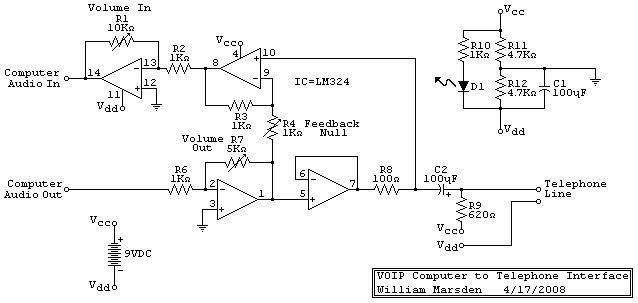
OK, I'll start drawing a schematic and see where it goes. Could a moderator please transfer this thread to electronic projects, since I actually plan on builting this sucker? The schematic will change without notice as I figure stuff out. Thanks.

Audio out is easy, it's audio in I have to figure out. I have to null the audio out signal somehow, which is doable and pretty easy with op amps, for the audio in signal so I don't get unwanted feedback.


Thread Starter

Wendy

Joined Mar 24, 2008
23,811
OK, I misread your post at first, and I think you've misread mine. I don't want to connect to the phone company, I need to create something like a phone line, a pseudo (as in false) phone line, independent from the phone company, that a cordless phone would use to talk to a computer.

It might be as simple as adding a battery to the schematic you've located, but I suspect that audio feedback will be an issue. I don't see what would prevent audio squeal on the design.

Thanks for the forum shift.
 

Audioguru

Joined Dec 20, 2007
11,248
A simple transformer or pair of wires will couple the audio from the phone to the computer but the phone might be smart enough to mute the audio if DC voltage is not present on "the telephone line".

If you want to transmit and receive then the electronic circuit is the equivalent of a "hybrid transformer" that cancels sounds from the computer to the phone from being re-transmitted back to the computer. It also stops feedback if the phone is a speakerphone because it cancels sounds into its microphone from coming out its speaker.
 

Thread Starter

Wendy

Joined Mar 24, 2008
23,811
Yeah, I mentioned something similar in the first post. The schematic I've drawn is the first attempt at something like that, but if you don't ask you miss the easy solutions.

What are the odds a cheap disposable phone would have that transformer you think? Baring that, op amps are easy too.

It might be time to assign some values to those components and try a breadboard to see how bad it is.
 

Thread Starter

Wendy

Joined Mar 24, 2008
23,811
OK, I've come up with some quick and dirty values for the breadboard. I figure I'll set it for unity gain on the amps, and start from there. I have no idea if it will work, so here we go...
 

Thread Starter

Wendy

Joined Mar 24, 2008
23,811
OK, I've updated once again to reflect the parts I have on hand. I'll start slinging the solder now I've kitted the project. I'm using a telephone switch box (data switch box) that I bought for $3 for the case.
 

Thread Starter

Wendy

Joined Mar 24, 2008
23,811
Thinking about it, I've made a minor error. I had forgotten the AC characteristics of the telephone circuit. The phone itself should be around 600 ohm, an assumption, but you have to start somewhere. Two 600 loads in parallel is 300 ohms, and add the 100 ohms in the circuit, and the signal being nulled is 3/4 the amplitude the other input is. I'm going to have to compensate accordingly. The op amp should handle 400 ohms, unless I've misread the data sheet.
 
Top