Another audio Preamp - I just can't get my head around the basics!

Thread Starter

Tobias Feltus

Joined Nov 20, 2016
7
Hi,
I have read through the AAC articles on how Op Amps are used, and have spent hours reading other articles and watching tutorial videos. For some reason my marginally dyslexic brain struggles with what should be very simple logic.

I am building a low-noise battery-powered (portable) audio mixer around a few NE5534s. The power is supplied by a pair of PP3 batteries providing me with +-9v and 0v.

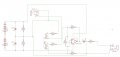
My starting point is this design (below) from here http://www.eeweb.com/blog/extreme_circuits/balanced-microphone-preamplifier
I am using starting from this point because I was advised that it is a good design with low noise and a limited number of components.

Input is balanced. R3 is in place to avoid input oscillation. P1 serves to match the feedback loops. Gain is set at 50dB


I have not found any other circuits which use a feedback loop on both the inverting and noninverting inputs of the opamp at the same time, which makes cross referencing difficult.

My confusion this morning:
1) with most opamp designs, the noninverting pin of the opamp is not connected to the output (via R6) when an inverting feedback loop is being used.
2) I was advised that to use this circuit for an unbalanced input, R1 would be connected to Common Ground rather than Pin2 of K1... My interpretation of this is the following:
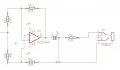
circuit.jpg
This confuses me because both inputs of the opamp are connected to the same signal. Both inverting and noninverting inputs have feedback loops, meaning that both inputs on the opamp are connected both to the signal, the output and the common ground (which in this case is just the chassis ring of the 1/4" output). (NOTE: in the above I have set the gain to 0)

QUESTION assuming that my interpretation is wrong:
a) should R12 be connected to the 0v rather than the input, and the chassis rings be connected to each other?
b) Should R36 be 200k and the connection between R36-C7 be a 20k resistor?

If someone can lend me a hand I would be most grateful.
 
Last edited:

AlbertHall

Joined Jun 4, 2014
12,624
The original circuit is based on the usual op-amp balanced input, single-ended output design. The non-inverting input has one of the input signal lines via R2 and a resistor to ground, R5 + P1 . There is no feedback to this pin.
 

Thread Starter

Tobias Feltus

Joined Nov 20, 2016
7
Hi Albert, So what you are saying is that R6 does not represent a feedback connection, despite the fact that it looks like one to my uneducated eye?
 

AlbertHall

Joined Jun 4, 2014
12,624
The junction of R6 and P1 is connected to ground. There is no signal at that point so nothing is fed back. R6 is just a load resistor for amp output.
 

AlbertHall

Joined Jun 4, 2014
12,624
If they are not then the common mode rejection suffers. Common mode means that if the difference between the two inputs remains constant but both of them vary in voltage together (perhaps the cable picked up some noise/mains hum). If those components are matched then this common mode signal will be cancelled - if they re not it won't be.
This may help: https://www.google.co.uk/url?sa=t&r...licity&usg=AFQjCNGN3VW1sHu9oX9qHBF0zFZh5rkrqw
 

dannyf

Joined Sep 13, 2015
2,197
I was advised that to use this circuit for an unbalanced input, R1 would be connected to Common Ground rather than Pin2 of K1
that advice is incorrect.

The original design is a (unbalanced) differential amplifier. Its output tracks the difference between the two inputs. However, it generally does not present equal loading on the two inputs.

You can still make it work if you want to go down that route - you will need to have a positive and a negative rail, however - a rail spliter will work here.

You can also build a truly balanced input stage - it is fairly easy to do.

You can obviously go unbalanced / SE if you like. Balanced pre-amp is only useful in a heavily polluted setting.

So if I were you, I would try to understand which design priorities are important to you and then go down that path.

BTW, a NE5532 would be much more preferred here, unless output offset is that important to you.
 

Thread Starter

Tobias Feltus

Joined Nov 20, 2016
7
Albert: based on what you wrote and what I understood of the link, modifying the gain level would require the common mode rejection resistors to remain balanced. As a single preamp with variable gain my understanding is that this may work. I also believe that it should have a maximum gain of 60dB, R11 and R13 keeping the opamp from going into saturation when the pot is set to 0r.
circuit2.jpg

Hi Danny,
I do not need a balanced input, but given the option I wanted to understand both balanced and unbalanced designs. The device I am working on will have 3 discreet variable inputs which have their discreet outputs. A further output will be one mixdown of the three inputs (which shall run through a 0% gain inverting opamp). My plan was to have one of the three inputs be balanced.

I already have the NE5534, the form factor of the dual opamp doesn't present any particular benefit to me.

The difficulty is not understanding what my design priorities are, it is understanding the difference between a plethora of designs, whilst also struggling to understand certain aspects of theory. My priority is to have a "high fidelity" reproduction with low noise.
 

AlbertHall

Joined Jun 4, 2014
12,624
OK, for a single-ended input common mode and balanced don't apply any more.
You really don't need R13 and the section of R19 in series with it (a single gang pot will do) - make R13 100k from pin 2 to ground.
Your drawing shows a short circuit across the output of the amp. Remove the link between the negative of C6 and ground.
You have C9 and C10 connected the wrong way round.
You don't need R21 and R22. Just connect the junction of C9 and C10 to the junction of the two batteries. This will better keep the positive and negative supplies correct.
 

Thread Starter

Tobias Feltus

Joined Nov 20, 2016
7
Albert: the short circuit you describe was originally R6 in the reference schematic, and what I was misinterpreting as a noninverting feedback loop.

Thank you very much for all your help. The difference in the way the common mode rejection works does make a lot of sense - I now have a better understanding of why balanced equipment is used for recording vocals.

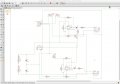
I have probably jumped ahead too far, but I wanted to jot things down while they are still warm in my memory. Below is a single power supply running two distinct variable preamps, one balanced and one unbalanced. On the balanced (upper) I replaced the trimmer to match the CMR.

Doesn't the pot R8 need to match R23 in the unbalanced circuit to be able to reduce the gain to 0?
circuit3.jpg
 

AlbertHall

Joined Jun 4, 2014
12,624
The gain of the unbalanced part is R23/R8 so as long as R23 is not zero the gain can never be zero and, incidentally, if R8 is set to zero you have a theoretical infinite gain which is definitely not what you want. It would be better to make R23 the variable and R8 fixed. Then the pot will vary the gain from some maximum value down to zero. The gain would vary between R23/R8 down to 0/R8.
BTW I just noticed that the capacitors on the output of the amps are shown as 27pF. That won't work for audio frequencies. 27uF would be a better bet (that's what I thought they were).
 

Thread Starter

Tobias Feltus

Joined Nov 20, 2016
7
Albert: I gather I may be getting closer to putting some parts back on a breadboard.

I think the values of C5 and C6 may have been a typo from an earlier iteration, as the source schematic has them at 4.7uF.

With the Balanced circuit, is the position and value of R18 acceptable?

With the Unbalanced circuit should I put R8 and R9 at 1k, R26 at 220k and R23 as a 220k potentiometer?

Thanks again.
 

AlbertHall

Joined Jun 4, 2014
12,624
I find that diagram difficult to read but if R18 is the 200k in series with the 20k pot then no, it isn't OK as the pot plus R18 should be able to match R14, which will only happen right at the end of the pot. Make R18 210k then the pot can adjust between 210k and 230k.

The unbalanced values you describe are fine.
 

Thread Starter

Tobias Feltus

Joined Nov 20, 2016
7
Danny: I have asked for help, and you are suggesting a conflict of possible functionality. Albert seems to think that the circuit will work, and you do not. I find this confusing.

In the past week I have spent in the region of 20h reading and trying to understand the material and context. My dyslexia limits my ability to handle any mathematical question. Said that, my wife is very good with maths, but I would have to be able to explain what the question is for her to be able to help.

Do you have a constructive comment to make?
 
Top