12volt computer fan - want to reverse spin direction

wayneh

Joined Sep 9, 2010
18,149
Most industrial equipment racks use a combination of fans to move air for proper cooling.
No question about that. RB and I were swerving off topic on one specific issue; optimal fan direction for a fan mounted directly on a heat sink, as often found on a computer CPU. It's not likely to be resolved here. ;)


Attachments

Last edited:

nsaspook

Joined Aug 27, 2009
16,473
I like to go with nature. Natural convection makes air rise or move away from top and enter on the bottom. A Tornado sucks and knowing that energy flow in nature usually operates in the most efficient matter works for me.
 

wayneh

Joined Sep 9, 2010
18,149
I like to go with nature.
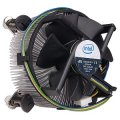
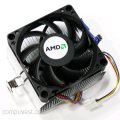
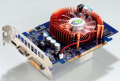
I agree that we ignore nature at our peril. But I also know that smart people were paid good salaries to resolve questions as simple as this one - which way should a heat sink fan blow - and arrived at the answers clearly illustrated above. Dismissing their work would be foolish. RB has personal experience to go on, which I respect. The rest of have to rely on the work of others, to stand on the shoulders of giants in order to see.

Just try to find a picture of a heat sink cooler fan online that doesn't blow away from it's logo face (and into the sink, like the 3 examples pictured above). Defunct companies not accepted.

I'm sure with effort you can find one, but along the way you'll understand my earlier point about blowing into the sink being the industry standard.
 

THE_RB

Joined Feb 11, 2008
5,438
Wayneh, of the three photos you posted above, the 3rd one is properly designed as the radial spill from the fan blades goes outward "through" the heatsink, and as the PCB blocks the other side of the rather flat heatsink it's really a centrifugal blower and sink.
It would work well, and probably work better still with a more centrifugal style rotor.

The heatsink in the first photo is very poorly designed, with no shroud the bulk of the fan energy draws air from the top into the rotor, then radial spill throws most of it out the sides before it even gets near the heatsink. It's unknown whether the heatsink even gets positive or negative pressure at the heatsink vanes (or just turbulence) with that much radial fan spill occuring.

The middle photo is just wrong. With a standard shrouded fan blowing down into a complex restricted cavity the result will be poor. That photo is typical of the heatsinks where you can unscrew the fan and turn it around and get much better cooling.

And as far as an "industry standard" these things are just made in Chinese factories, and screwed together by their workers or some kid in the back of the computer shop. It's logical to "blow on the hot thing". And a lot of the stuff that goes in PCs seems to be designed by someone wanting to make it LOOK really good but has no real understanding of thermodynamics. Only that top end video card you showed in photo 3 looks like someone had an understanding of the important stuff.
 

Ana Dias

Joined Mar 8, 2018
1
Very old post..BUT THE DOUBTS STILL MANTAINS TODAY - liked the discussion so a few remarks for those that today read it as well thinking of a "silly" (sorry) newb situation and ended up reading about cooling :)

ABOUT THE NEW QUESTION - (already answered - the fan uses magnetic sensors to know where the blades/magnetic field is and update the magnetic filed to mantain rotation - it would be quite an ordeal to make it rotate backwards!

ABOUT THE COOLING DISCUSSION:

Air density is important (as everything - when we of the manufaacters tweak for maximum energy removal (i.e. cooling) they consider everything - that's probably why CPU heatsinks get the air blowned to it! - Those companies may produce semi-conductors but I beliee they like to cool their processors the best way - in they're case they blow XD

Sucking or blowing into heatsinks has differences regarding size indeed (and some heatsinks even have their "sctrucutre (shape)" done for air to cirulate sucking and others blowing (for example those seen on forklifts - I've seen them sucking from the heatsink - on computers alywas seen blowing onto the heatsink)


The effect of air acumulation and "desacumulation" and acumulation - periodicly - by the fan blowing (that you are calling cavitation) is not cavitation - it's ressonance and can be a really huge downside - but manufaters think of that when they shape and calculate the air flow and the shape of the heatsinks because if that ressonace would ressonate (see physics about this) with some huge airflow fans it could be bad and have almost no coolong at all!
(PS - Cavitation is another fisical process completely differente - OF COURSE that the use of cavitation was understandeable with no problems)


LOL - 5 year thread - but enjoyed the neverending discution that still prevails today and I am sure prevailed in the 90's..(oh,..and in the 80's)... (ah..and in the 70's...)...................perhaps in the 60 's as well ;) - how to cool your computer - either laptop sized or house sized ;)
 

Techohead

Joined Nov 23, 2020
11
I have 4 12 volt computer fans (that I am not using for a computer) that I want to reverse the spin direction on. I understand there will be limitations due to the capacity of the fans themselves not designed to spin in alternate direction..........but can it be done?

There are three wires, hot-ground-RPM. When I reverse the hot-ground.......the blades don't spin at all..........so I am assuming something internally is keeping me from trying this. Can I removed or bypass this restriction? It seems like this should be achievable..........but I am not experienced at this........and before I butcher a fan (trial and error) I figured I would ask the question here...........to see if someone smarter than me could provide some insight.

Thanks!

Offtwice
Computer fans are electronically commutated and are not easy (if even possible) to reverse. You would have to relocate the Hall Effect sensor that detects the rotor position. Just turn the fan around the other way, or maybe put 2 back to back. The 3rd wire is connected to a transistor that is either switched on while the fan is rotating, and switches off after about a second if it stalls, or switches on & off as the fan rotates, to tell the computer that the fan is working, so it can shut down if the fan fails.
 

nsaspook

Joined Aug 27, 2009
16,473
Computer fans are electronically commutated and are not easy (if even possible) to reverse. You would have to relocate the Hall Effect sensor that detects the rotor position. Just turn the fan around the other way, or maybe put 2 back to back. The 3rd wire is connected to a transistor that is either switched on while the fan is rotating, and switches off after about a second if it stalls, or switches on & off as the fan rotates, to tell the computer that the fan is working, so it can shut down if the fan fails.
necro29844976.jpg
 
Top