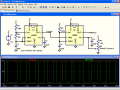
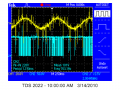
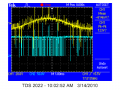
Go to your simulator program and use a square wave for the trigger input and a sine wave for the control input.
Use the 2nd 555 of your circuit only for this experiment.
let the trigger frequency equal the 1/2 the control frequency.
let the trigger frequency equal the control frequency
let the trigger frequency equal twice the control frequency
let the trigger frequency equal ten times the control frequency.
You will know from this inspection the answer to your question.
If you are trying to operate a circuit at high speed and things are not going well, then it is a good idea to slow the circuit down (when possible) and see if things improve. This is not always possible. However, if it can be done, it will help to diagnose a lot of potential problem areas, such as parasitic inductance and capacitance.
The higher in frequency that you go, the greater the effect that parasitics have on a circuit.
thank you for you info and guideline..im really appreciate it.
i've some question...as i know, for PPM and PWM output, they are varied on the position and width of pulse but not the amplitude..however, from the simulation software, development hardware part and refer to LM555 data sheet, the amplitude of pulse are increase...how this can happen?..
besides, what is the factor or component that can affect the output waveform?..is it potentiometer or frequency from the function generator?
thank you for you info and guideline..im really appreciate it.
i've some question...as i know, for PPM and PWM output, they are varied on the position and width of pulse but not the amplitude..however, from the simulation software, development hardware part and refer to LM555 data sheet, the amplitude of pulse are increase...how this can happen?..
besides, what is the factor or component that can affect the output waveform?..is it potentiometer or frequency from the function generator?
The output voltage is shown on the datasheet of an LM555. It is about 13.5V p-p when its supply is 15V and the load current is zero. It drops when loaded.
just for my confirmation, when the value of potentiometer increase the width of pulse will also increase...is it right
The width of the monostable pulse stays the same when the input frequency is raised. But the pulse appears to be wider because the total time period becomes less.

 Facebook
 Google
 GitHub
 Linkedin